California SB 54: Navigating Packaging EPR Reporting Requirements

This blog was originally posted on 14th May, 2026. Further regulatory developments may have occurred after publication. To keep up-to-date with the latest compliance news, sign up to our newsletter.
AUTHORED BY RUAN DOHERTY, REGULATORY COMPLIANCE SPECIALIST, COMPLIANCE & RISKS
Key Insight
California’s Senate Bill 54 (SB 54) establishes the most detailed and operationally demanding Extended Producer Responsibility (EPR) system in the US,, requiring granular, component-level reporting unlike programmes in other states. With the implementing regulations now final, producers face urgent 2026 deadlines for submitting 2023 baseline data, annual supply and source reduction reports, and mandatory individual source reduction plans.
Introduction
With California’s SB 54 implementing regulations finalised on May 1, 2026, producers are now moving into the first major reporting cycle under one of the most detailed and operationally demanding packaging EPR systems in the U.S.
While several US states have adopted packaging EPR laws, California’s framework differs significantly in both reporting scope and compliance complexity. Unlike other state programmes which primarily focus on reporting packaging weight by material category, California requires far more granular data collection, including plastic component-level reporting and detailed material classifications.
California also introduces several compliance obligations not currently seen elsewhere in the US, including producer baseline reporting tied to 2023 supply data, a unique early-fee structure based on 2025 packaging data submissions, and mandatory individual source reduction plans.
For more information on US state-level packaging legislation, download our comparison guide or check out this blog.
Applicability
SB 54 defines the “producer” through a hierarchy:
- Brand owner
- Licensee
- Importer
- Retailer (if no other party applies)
It applies broadly across all packaging formats and materials, including primary, secondary, tertiary, e-commerce packaging, and plastic food-service ware.
Most consumer-facing brands will typically be directly obligated, but in complex supply chains, particularly involving private label or cross-border sales, determining the responsible entity requires careful legal review.
Registration Requirements
Producers must take one of three pathways by June 1, 2026:
- If participating in the approved producer responsibility organization plan, register with Circular Action Alliance (CAA) and submit supply data to CAA;
- If complying individually, register with CalRecycle and apply to be an independent producer; or
- If qualifying for an exemption for small producers, register with CalRecycle and apply for the small producer exemption.
For most companies, PRO participation via CAA will be the default route, but this does not reduce the underlying data and reporting burden.
Reporting Requirements
Reporting Timeline at a Glance
| Report Type | Deadline | Scope |
| 2023 Baseline Report | June 1, 2026 | Covers all covered materials supplied in 2023, including quantities by material type and format. This baseline will be used to measure source reduction progress against 2032 targets. |
| Annual Supply Report | May 31, 2026 | Covers packaging supplied in the previous year using 2025 data, and will inform 2026 early fees and 2027 programme fees. |
| Annual Source Reduction Report | May 31, 2026 | Tracks progress against source reduction targets using 2025 data, to demonstrate measurable reductions in packaging volumes. |
| Individual Source Reduction Plan | No later than August 1, 2026 | A detailed plan outlining how producers will achieve mandated reductions, aligned with the 2032 targets. |
2023 Baseline Report
Although submissions opened in November 2025, producers must now either confirm previously submitted data or submit a new report. Required data elements include:
- Quantity/volume of covered materials by material type and format
- Material composition and classification according to CalRecycle’s Covered Material Category (CMC) list
The baseline serves as the reference point for measuring source reduction progress toward the 2032 target of a 25% reduction in single-use plastic packaging and food service ware compared to 2023 levels.
Annual Supply Report
Producers must disclose the total volume and composition of packaging supplied, using 2025 data, and shall include:
- Material type and format;
- Weight at component level;
- Recyclability status; and
- Post-consumer recycled content.
This data is the basis for calculating EPR fees and assessing overall compliance with SB 54 requirements.
Annual Source Reduction Report
This report focuses on demonstrating producer progress with the mandated source reduction targets, using 2025 data, and shall include:
- Total weight and number of plastic components supplied in California, aligned with annual supply data;
- Source reduction levels achieved compared to the 2023 baseline, measured in both plastic weight and component count;
- Attribution of reductions to specific pathways (e.g. lightweighting, elimination, reuse etc.).
Individual Source Reduction Plan
This plan is unique to California’s packaging EPR framework and serves as a recurring submission to CAA that explains how a producer plans to meet the source reduction targets. CAA will pool all individual plans to support programme planning and implementation, set eco-modulated fees, and show regulators that the statutory targets are achievable.
Rather than reporting what was achieved, producers have to describe what they plan to do, including:
- 2023 baseline plastic supply data, with optional notes on reductions already achieved;
- Projected plastic weight and component numbers for 2027, 2030, and 2032, based on expected sales and redesigns;
- Specific reduction pathways intended to be used (e.g. lightweighting, elimination, reuse etc.); and
- Summary of how reductions were calculated, including key assumptions, planned design changes, and how reductions were allocated.
Compliance Outlook
With 2026 marking the first major compliance milestone in California, producers must navigate complex data reporting and strict deadlines, while preparing for long-term source reduction targets. Success under SB 54 will depend on early preparation, accurate data, and the ability to align reporting with strategic packaging decisions.
As part of this compliance framework, CalRecycle’s Packaging Extended Producer Responsibility System (PEPRS) is the online portal used for producer registration, data submission, and compliance tracking under SB 54. It enables producers and CAA to submit required reporting, source reduction plans, and other compliance documents, with submissions made either through CAA or directly by self-reporting producers.
CalRecycle has also published a range of guidance materials on its producer webpage, including a screening tool to help determine producer obligations, detailed guidance on identifying covered materials, and instructions for submitting Categorically Excluded Materials Notices for specific packaging types such as food and agricultural products.
Frequently Asked Questions
- What makes California’s SB 54 packaging EPR system different from other U.S. states?
California requires more granular data collection, including plastic component-level reporting, as well as additional obligations like source reduction plans and baseline reporting tied to 2023 data. - Who is considered a “producer” under SB 54?
The producer hierarchy includes brand owners, licensees, importers, and retailers (if no other party applies). - What are the main registration options for producers?
Producers can register through CAA under a PRO plan, register individually with CalRecycle, or apply for a small producer exemption. - What is the purpose of the 2023 Baseline Report?
It establishes the reference point for measuring progress toward the 2032 target of reducing single-use plastic packaging and food service ware by 25%. - What is included in the Individual Source Reduction Plan?
It includes projected reductions for 2027, 2030, and 2032, planned approaches, and explanations of how reductions are calculated.
Stay Ahead Of Regulatory Changes in US Packaging Laws
Want to stay ahead of regulatory developments in US Packaging Laws?
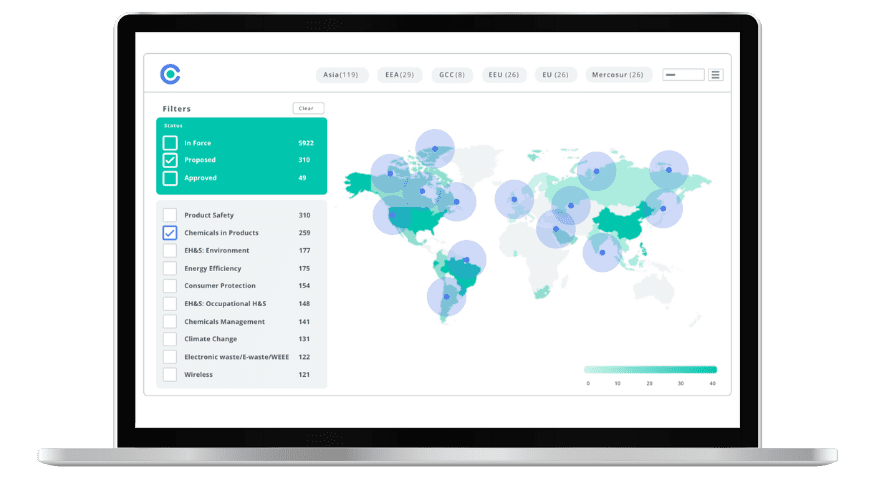
Accelerate your ability to achieve, maintain & expand market access for all products in global markets with C2P, your key to unlocking market access, trusted by more than 300 of the world’s leading brands. C2P is an enterprise SaaS platform providing everything you need in one place to achieve your business objectives by proving compliance in over 195 countries.
C2P is purpose-built to be tailored to your specific needs with comprehensive capabilities that enable enterprise-wide management of regulations, standards, requirements and evidence.
Add-on packages help accelerate market access through use-case-specific solutions, global regulatory content, a global team of subject matter experts and professional services.
- Accelerate time-to-market for products
- Reduce non-compliance risks that impact your ability to meet business goals and cause reputational damage
- Enable business continuity by digitizing your compliance process and building corporate memory
- Improve efficiency and enable your team to focus on business critical initiatives rather than manual tasks
- Save time with access to Compliance & Risks’ extensive Knowledge Partner network
Simplify Corporate Sustainability Compliance
Six months of research, done in 60 seconds. Cut through ESG chaos and act with clarity. Try C&R Sustainability Free.