Compliance Management Software: The Buyer’s Guide for Product & Regulatory Teams
THIS BLOG WAS WRITTEN BY THE COMPLIANCE & RISKS MARKETING TEAM TO INFORM AND ENGAGE. HOWEVER, COMPLEX REGULATORY QUESTIONS REQUIRE SPECIALIST KNOWLEDGE. TO GET ACCURATE, EXPERT ANSWERS, PLEASE CLICK “ASK AN EXPERT.”
Compliance management software is a platform that centralizes regulatory tracking, maps requirements to products or processes, and gives teams a single system of record for proving compliance. For product and regulatory teams specifically, it has to do more than track policies: it has to connect regulations directly to what you build, where you sell, and what evidence you hold.
Most buyer’s guides for compliance software write for legal teams or CCOs. This one is for the people who actually bear the operational weight of product compliance: the regulatory affairs directors, product managers, and compliance engineers who spend their days cross-referencing RoHS limits, updating CE marking documentation, or trying to figure out whether that new PFAS restriction in California affects a component in generation three of a product that ships in six markets.
Quick Answer: Compliance management software helps organizations track regulations, map requirements to products or processes, manage compliance evidence, and maintain audit readiness. For product and regulatory teams, the most important capabilities are regulatory database depth, requirement-to-product traceability, real-time change alerts, and evidence management with expiry tracking. Generic GRC platforms often lack the regulatory content depth that product-focused compliance work demands.
Table of Contents
- What Is Compliance Management Software?
- Who Actually Needs Product-Focused Compliance Software?
- What Features Matter for Product and Regulatory Teams?
- How Should You Evaluate Regulatory Database Coverage?
- What Red Flags Should You Watch for During Demos?
- How Do You Build the Business Case Internally?
- What Questions Should You Ask Every Vendor?
- FAQ
What Is Compliance Management Software?
Compliance management software is a system that tracks regulatory obligations, maps those obligations to internal processes or products, and provides the documentation trail to demonstrate compliance to auditors, regulators, or customers.
The category is broad. Some platforms focus on corporate governance and internal policies. Others target financial services compliance, data privacy, or healthcare. And a third category, which matters most to product and regulatory teams in manufacturing, industrials, and consumer goods, focuses on product compliance: the regulations that determine what materials you can use, how you label products, what testing you need, and which markets you can access.
These are fundamentally different compliance challenges. A financial services compliance platform built around internal policy workflows is the wrong tool for a team managing RoHS, REACH, CE marking, and FDA submissions across 40 product lines in 30 markets.
Understanding that distinction is the first step in buying the right software.
Who Actually Needs Product-Focused Compliance Software?
The buyer for compliance management software often shows up in RFPs as “compliance” or “regulatory affairs.” But the actual users are a wider group than that.
Product compliance software matters when any of these situations are true:
- Your team manually tracks regulatory changes in spreadsheets or email alerts. Someone, or several people, has a personal system for staying current on RoHS amendments or EU REACH candidate list additions. That system works until it doesn’t.
- You sell into multiple jurisdictions. A product sold in the US, EU, UK, and Japan faces different requirements for chemical content, labeling, documentation, and testing. Managing that cross-reference manually at any reasonable product volume does not scale.
- Your engineering team makes component or material decisions that have compliance implications. If product designers and engineers don’t have requirement visibility early in the development cycle, compliance becomes a remediation exercise at the end rather than a design constraint at the start. That is a more expensive, slower, and riskier way to operate.
- You’re facing audit requests or customer due diligence questionnaires. When a major customer asks for your REACH compliance documentation or your CSRD data, you need to produce it fast. The answer cannot be “give us two weeks to pull that together.”
- You’re navigating new regulations like PFAS restrictions, the EU Ecodesign for Sustainable Products Regulation (ESPR), or the Corporate Sustainability Due Diligence Directive (CSDDD). These are not incremental changes. They require systematic tracking and structured response programs, not another spreadsheet tab.
If more than two of these situations apply, you are past the point where a manual process is adequate. The question is which platform fits your actual workflow.
What Features Matter for Product and Regulatory Teams?
Most generic compliance software feature lists look the same: policy management, risk assessment, incident tracking, audit trails, reporting. Those features matter. But for product and regulatory teams, there are additional capabilities that separate a platform that actually works from one that creates a new category of manual work.
Regulatory Content Database
This is the most underrated differentiator. A compliance management platform is only as good as the regulatory intelligence it contains. A platform that requires your team to manually input regulations, update requirements, or monitor government sources defeats the purpose.
Ask specifically: How many regulations does the database cover? How many countries? How frequently is the content updated? Who is doing the updating? Some platforms claim broad coverage but rely on automated web scraping of government sites, which produces incomplete or misformatted content. Others have subject matter experts reviewing and classifying regulatory content before it enters the system.
The depth of regulatory coverage is often what separates a platform built for product compliance from a general GRC tool that adds a compliance module.
Requirement Mapping to Products
Knowing a regulation exists is table stakes. What matters is being able to say: this specific requirement, under this regulation, applies to product category X, and here is the evidence that we meet it.
Requirement traceability connects the regulatory obligation to the product, component, or process it governs. It is what makes compliance auditable. Without it, your compliance position exists as institutional knowledge in someone’s head, not as a defensible record.
Look for platforms that let you map requirements at a granular level, attach evidence directly to those requirements, and surface the mapping in a format that auditors can review.
Real-Time Regulatory Change Alerts
Regulations change. The EU REACH candidate list gets updated twice a year. RoHS exemptions expire. New PFAS restrictions appear in US state legislation, then ripple into EU discussions, then appear in product standard updates.
A compliance management platform should alert your team when changes happen that affect your products, categories, or markets. Not a newsletter. A filtered, targeted alert tied to the specific regulations you track.
The critical distinction here is customization. An alert system that notifies you about every regulatory update in every jurisdiction is noise, not signal. You need alerts scoped to your product categories, materials, markets, and regulatory priorities.
Evidence Management with Expiry Tracking
Compliance evidence is not static. Test reports expire. Certifications lapse. A supplier declaration of conformity from three years ago may no longer be valid if the underlying standard was revised.
Evidence management in a compliance platform should let you attach documents to specific requirements, set expiry dates, and receive advance warnings before evidence lapses. Without this, teams discover expired evidence during audits, not before them.
AI-Assisted Regulatory Intelligence
Newer capabilities in this space include AI models that analyze proposed regulations and predict the probability of enactment. For a product regulatory team planning two or three years ahead, knowing whether a proposed PFAS restriction in a specific jurisdiction is likely to become law in 18 months is operationally useful information. It determines whether to start reformulation now or monitor and wait.
This is different from compliance tracking. It is regulatory foresight, and it is starting to show up in more sophisticated platforms as a distinct capability.
Multi-User Workflow and Role-Based Access
Compliance in a product company is not a one-person function. Regulatory affairs works with procurement, engineering, quality, legal, and sometimes sales. A compliance platform needs to support multi-user workflows where different teams can access the information relevant to their role without compromising data integrity or creating version control issues.
Role-based access also matters for enterprise deployments where different regions, product lines, or business units need visibility into their own compliance data without access to the full corporate picture.
How Should You Evaluate Regulatory Database Coverage?
Database coverage is where most buyers under-interrogate vendors. The questions to ask are specific.
Which jurisdictions does the database cover? Push past “global coverage” to a list of countries. Coverage of the US, EU, and UK is table stakes for most manufacturers. Coverage of China’s GB standards, Brazil’s INMETRO requirements, India’s BIS regulations, and emerging market frameworks is what distinguishes a comprehensive platform from one that handles the easy cases.
Which regulatory frameworks are included? For product compliance, you want to see RoHS, EU REACH, PFAS restrictions, WEEE, CE marking requirements, California Proposition 65, GHS/SDS requirements, Conflict Minerals/CMRT, and sector-specific frameworks like FDA requirements for medical devices, cybersecurity standards for connected products, and the evolving ESPR requirements.
How are regulations classified? A raw database of legislative text is not useful for a compliance team that needs to understand which requirements apply to their product category. Classification by product type, material, industry sector, and jurisdiction is what makes a database actionable rather than just comprehensive.
How current is the content? Ask about the update cycle for specific regulations you track. If the platform cannot tell you when the REACH candidate list was last updated in the system, that is a red flag.
Who maintains the content? The highest-quality regulatory databases are maintained by subject matter experts, not automated scraping. The difference shows in the completeness and accuracy of requirement summaries, the reliability of applicability determinations, and the quality of change alerts.
For product and regulatory teams evaluating compliance management platforms, database depth is often the deciding factor between tools that eliminate work and tools that create a new layer of it.
What Red Flags Should You Watch for During Demos?
Vendor demos for compliance software are designed to show you the best case. Here is what to look for that the demo might not show you.
The platform requires significant professional services to configure. If a vendor cannot show you a working demo using standard industry regulations without custom implementation work, the platform is likely not content-ready out of the box. Some configuration is normal. Extensive services engagements before you can track a single regulation are a warning sign.
The regulatory coverage is customer-maintained. If the regulatory content relies on your team to input regulations, update requirements when standards change, and manually track regulatory developments, you have purchased a structured database template, not a compliance intelligence platform. The ongoing maintenance cost of keeping a customer-maintained database current is substantial.
The platform was built for a different compliance use case. Many general GRC platforms added product compliance modules after the fact. The seams often show in the demo: regulations are not classified by product category, requirement mapping is generic, and there is no evidence management workflow specific to product certifications and test reports. Ask to see a workflow that mirrors your actual day-to-day compliance process, not the platform’s standard demo script.
The user interface requires significant training. Compliance professionals should be able to use a platform without weeks of onboarding. If the demo requires the vendor to walk through every action because the interface is not intuitive, that is a usability problem that will drive low adoption.
There is no integration path with your existing systems. Compliance data does not live in isolation. It connects to PLM systems, ERP, procurement, and quality management. Ask specifically about API availability and existing integrations with systems your team uses.
How Do You Build the Business Case Internally?
Buying compliance software requires internal buy-in beyond the compliance team. Finance wants to see ROI. Legal wants to understand risk mitigation. Operations wants to know if it will create more work before it reduces it.
The business case for compliance management software generally rests on four arguments.
Market access protection. Non-compliance events carry significant costs: product recalls, market withdrawals, customs holds, and regulatory fines. The cost of a single non-compliance event in a major market typically exceeds the annual cost of a compliance platform by a wide margin. The business case is not “how much does the software cost” but “what is one market access disruption worth in lost revenue.”
Audit readiness. The cost of scrambling to prepare for an audit, including staff time, consultant fees, and potential findings, is quantifiable. A team that can produce compliance evidence in hours rather than weeks has a different audit posture entirely.
Engineering efficiency. When product requirements are mapped to regulations before design decisions are finalized, the cost of compliance is lower than when compliance is a remediation exercise after engineering is complete. Estimate the hours your engineering team spends on compliance-related rework or the delay in product launches caused by late compliance discoveries.
Regulatory monitoring efficiency. How much time does your team spend manually tracking regulatory changes? One or two regulatory affairs staff spending 30 to 40 percent of their time on regulatory monitoring is not unusual. That time has a dollar value, and a good part of it can be redirected to higher-value work with the right platform.
For teams building the ROI model, predictive regulatory forecasting capabilities add a further dimension: the cost of proactive reformulation versus reactive recall or market withdrawal is measurable, and it is almost always substantially lower.
What Questions Should You Ask Every Vendor?
When you get to the evaluation stage, these questions separate platforms that work from platforms that look good in a demo.
How many regulations are in your database, and how many of those are fully classified by product category and industry? Total regulation count is less useful than the number that are actionable for your specific product types and markets.
What is the process when a regulation changes? Who updates the content, on what timeline, and how are affected users notified? Understanding the maintenance workflow is as important as understanding the initial coverage.
Can you show us a workflow for a specific regulation we track? Pick a regulation your team works with every day and ask the vendor to demonstrate how a regulatory change in that framework appears in the system, how requirements are mapped to a product, and how evidence is attached and tracked. This is the reality check that a scripted demo does not provide.
What does implementation look like, and how long before we can use the platform without professional services involvement? Get this in writing if possible.
What integrations do you support, and what does an API look like for custom integrations? If you need to connect the platform to your PLM or ERP, ask to speak to a customer who has done that integration.
How do you handle regulations that are still proposed or under consultation? AI-assisted regulatory intelligence, including approval probability scoring for proposed regulations, is a differentiating capability for teams that need to plan product development around regulations that do not yet exist.
What is your customer support model, and do you have subject matter experts available to answer regulatory questions? For technical product compliance questions, access to regulatory SMEs is a meaningful differentiator from a software-only support model.
FAQ
Q: What is the difference between compliance management software and GRC software?
A: GRC, which stands for Governance, Risk, and Compliance, is a broader category that covers corporate governance frameworks, enterprise risk management, and internal compliance programs. GRC platforms are typically built for managing internal policies, risk registers, and audit workflows across a large organization. Compliance management software, particularly for product and regulatory teams, is focused on external regulatory obligations: the laws, standards, and regulations that govern what products can be sold in which markets. The practical difference is regulatory content. A GRC platform usually contains no built-in regulatory database, while a purpose-built compliance management platform includes the regulatory content that makes tracking and mapping possible without manual data entry.
Q: How long does it typically take to implement compliance management software?
A: Implementation timelines vary significantly based on the platform and the complexity of your regulatory scope. A platform with pre-built regulatory content for your industry and markets can have teams tracking regulations within weeks. Platforms that require significant configuration or content building from scratch can take six months or longer before they provide operational value. When evaluating vendors, ask specifically about time-to-value for teams with your profile, including product type, industry sector, and number of markets.
Q: Can compliance management software help with CSRD and ESG reporting?
A: Yes, though the depth of support varies by platform. CSRD and the broader ESG reporting landscape require organizations to track a specific set of metrics, disclose supply chain data, and maintain audit trails for reported information. Compliance platforms that cover sustainability regulations, including CSDDD supply chain due diligence requirements and ESPR product sustainability obligations, provide a structured environment for managing those obligations alongside traditional product compliance requirements. The advantage of managing ESG compliance in the same system as product compliance is a consolidated view of your organization’s regulatory obligations rather than separate siloed processes.
Q: What is the typical cost of compliance management software for an enterprise?
A: Enterprise compliance management platforms are typically priced on a subscription model, with cost driven by the number of users, the scope of regulatory coverage, and the number of products or product lines being managed. Annual costs for enterprise platforms with global regulatory coverage range from the mid-five figures to six figures, depending on the vendor and configuration. The relevant comparison is not just the cost of the software but the total cost of the current approach, including staff time on manual regulatory monitoring, consultant fees for regulatory expertise, and the financial exposure of a non-compliance event.
Q: How do compliance management platforms handle regulatory changes?
A: The best platforms monitor regulatory sources continuously and update their databases when changes occur, then notify users through filtered alerts based on their tracked regulations, markets, and product categories. When a regulation in your filter set changes, you receive an alert that describes the change, identifies affected requirements, and prompts you to update your compliance documentation if necessary. Lower-quality platforms rely on customer-initiated updates or periodic batch refreshes that may lag behind actual regulatory changes. When evaluating platforms, ask for a specific example of how a recent regulatory change, such as a REACH candidate list update or a new RoHS exemption decision, appeared in the system and was communicated to users.
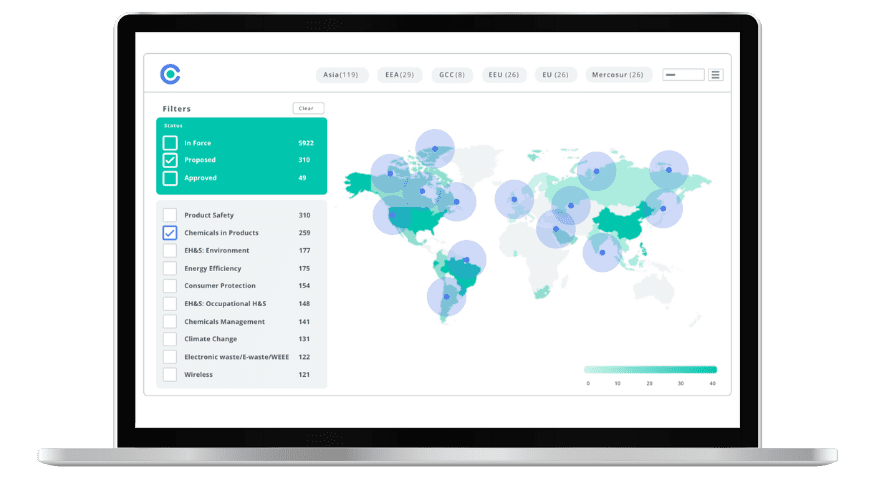
Simplify Corporate Sustainability Compliance
Six months of research, done in 60 seconds. Cut through ESG chaos and act with clarity. Try C&R Sustainability Free.