Compliance Risk Assessment: A Step-by-Step Framework for Regulatory Teams
THIS BLOG WAS WRITTEN BY THE COMPLIANCE & RISKS MARKETING TEAM TO INFORM AND ENGAGE. HOWEVER, COMPLEX REGULATORY QUESTIONS REQUIRE SPECIALIST KNOWLEDGE. TO GET ACCURATE, EXPERT ANSWERS, PLEASE CLICK “ASK AN EXPERT.”
Regulatory teams that run structured compliance risk assessments catch exposure before it turns into a violation. Those that don’t tend to find out about gaps the hard way, through audits, market withdrawals, or enforcement actions.
A compliance risk assessment is the structured process of identifying where your organization is exposed to regulatory risk, scoring that exposure by likelihood and impact, and prioritizing what to address first. Done well, it transforms compliance from a documentation exercise into an early-warning system.
Quick Answer: A compliance risk assessment is a systematic process that maps regulatory obligations to business operations, identifies where gaps or violations could occur, scores those risks by probability and impact, and drives a prioritized remediation plan. Most enterprise frameworks complete assessments in five to seven phases, from scoping and obligation mapping through testing, reporting, and ongoing monitoring.
Table of Contents
- What Is a Compliance Risk Assessment?
- Why Regulatory Teams Run Assessments on a Schedule
- Step 1: Define Scope and Regulatory Universe
- Step 2: Map Obligations to Business Operations
- Step 3: Identify and Document Risk Exposure
- Step 4: Score and Prioritize Risks
- Step 5: Develop and Execute Remediation Plans
- Step 6: Test Controls and Validate Effectiveness
- Step 7: Report and Monitor Continuously
- Common Gaps That Undermine Assessment Quality
- How Technology Changes the Assessment Equation
- FAQ
What Is a Compliance Risk Assessment?
A compliance risk assessment is the process of systematically examining your organization’s regulatory obligations, identifying where those obligations may not be fully met, and evaluating the potential consequences of each gap.
For product companies and global manufacturers, this typically means examining product regulations, safety standards, import and export requirements, environmental rules, and sector-specific mandates across every market you operate in. The assessment produces a risk register: a structured inventory of exposures ranked by severity, with ownership assigned and remediation plans attached.
The distinction between a compliance risk assessment and a general audit matters. An audit tells you what your current state is. A risk assessment tells you what could go wrong before it does, and which of those potential outcomes would hurt most.
Why Regulatory Teams Run Assessments on a Schedule
The regulatory environment does not hold still. In a given year, a global manufacturer tracking product compliance across 50 markets may see hundreds of regulatory changes: new directives, amended standards, updated enforcement guidance, and shifting thresholds.
Without a structured cadence for reassessment, organizations accumulate regulatory drift. Controls that were effective six months ago may no longer address current requirements. Products that were compliant at launch may fall out of scope as regulations update.
Running assessments on a defined schedule, quarterly for high-risk product categories and annually at minimum for the broader regulatory universe, keeps your risk register accurate and gives leadership the current picture they need to make informed decisions.
Teams that track regulatory changes through a platform like C2P from Compliance & Risks can link new obligations directly into assessment workflows, reducing the gap between regulatory change and risk response.
Step 1: Define Scope and Regulatory Universe
Every effective assessment starts with a clear definition of what it covers. This means identifying:
- Product scope: Which product lines, SKUs, or categories are in scope for this assessment cycle?
- Geographic scope: Which markets are you selling into, manufacturing in, or sourcing from? Each adds a distinct set of regulatory obligations.
- Regulatory universe: What categories of regulation apply? For a global electronics manufacturer, this might include product safety directives, RoHS and REACH substance restrictions, electromagnetic compatibility requirements, energy efficiency mandates, and customs classifications.
Incomplete scoping is the most common reason risk assessments miss significant exposure. Teams that focus only on their largest markets or most visible product lines often discover that mid-tier or emerging markets carry disproportionate risk.
If your organization has not recently mapped your full regulatory universe against your current product portfolio and geographic footprint, that mapping exercise is the foundation everything else builds on.
Step 2: Map Obligations to Business Operations
Once you have defined scope, the next step is connecting each regulatory obligation to the specific business processes, products, and systems where compliance is achieved or lost.
This mapping work surfaces the contact points between regulation and operations: where your engineering team makes design decisions that affect regulatory status, where your supply chain introduces new substances or materials, where your documentation process generates the evidence regulators may request.
For each contact point, the relevant question is: what could go wrong here, and what controls currently exist to prevent it?
A compliance risk assessment matrix is a useful tool at this stage. It organizes obligations, contact points, and control descriptions in a format that can be reviewed across business units and used to assign ownership. The Use Cases section of C2P illustrates how this mapping approach scales for enterprise product portfolios.
Step 3: Identify and Document Risk Exposure
With obligations mapped to operations, the assessment team can systematically identify where gaps exist. Risk exposure appears in several forms:
- Control gaps: Where a required control is absent or inadequate. For example, no formal process for reviewing component changes against substance restriction lists.
- Documentation gaps: Where the obligation is likely being met operationally but the evidence trail is insufficient to demonstrate compliance to a regulator or auditor.
- Knowledge gaps: Where the team is unaware of an applicable obligation because their regulatory monitoring does not cover that jurisdiction or regulatory category.
- Change-lag gaps: Where a regulation has been updated but the internal processes or product specifications have not yet caught up.
Each identified risk should be documented with enough specificity to drive action. Vague descriptions like “EU chemical compliance risk” are not useful. A well-documented risk entry identifies the specific regulation, the product or process affected, the nature of the gap, and the potential consequence if unaddressed.
Step 4: Score and Prioritize Risks
Not all compliance gaps carry equal urgency. A scoring methodology allows teams to prioritize remediation resources against the exposures that pose the greatest threat.
The two standard dimensions are likelihood (how probable is a violation or enforcement action?) and impact (what is the potential consequence?). Impact should account for financial exposure, market access implications, reputational risk, and product safety concerns.
Scoring does not need to be complex to be effective. A straightforward 1-5 scale on each dimension, producing a composite score that places risks in high, medium, or low priority bands, is sufficient for most enterprise programs. The goal is a ranked list, not a mathematically precise risk index.
High-priority risks demand immediate remediation plans with owners, deadlines, and escalation paths. Medium-priority risks need remediation plans on a defined timeline. Low-priority risks should be documented and monitored, with reassessment scheduled.
Step 5: Develop and Execute Remediation Plans
Each high- and medium-priority risk needs a remediation plan that specifies what will be done, who owns it, and by when it will be complete.
Effective remediation plans are specific about the intervention. “Improve chemical compliance process” is not a plan. “Implement substance restriction review checkpoint in component approval workflow, assign ownership to Materials Compliance lead, complete by Q2 end” is.
For organizations managing compliance across multiple product lines and markets, tracking remediation across dozens of open items requires a system. Spreadsheets work for small programs. At enterprise scale, they become a liability: items fall through, ownership is unclear, and there is no reliable view of aggregate progress.
Evidence Management capabilities in compliance platforms allow teams to attach remediation documentation directly to the risk record, creating an auditable trail of what was done and when.
Step 6: Test Controls and Validate Effectiveness
Remediation closes the gap on paper. Testing confirms it closed the gap in practice.
Control testing involves sampling real transactions, documents, or decisions to verify that the control is operating as intended. A process change that looks correct in a procedure document may not have been adopted consistently by the team executing it. Testing surfaces that disconnect before an auditor or regulator does.
For product compliance, testing often means reviewing a sample of product launches, engineering change orders, or supplier qualification records against the applicable requirements. The question in each case is: does the evidence show that the obligation was being met at the point of decision?
Testing results feed back into the risk register. Controls confirmed as effective can be downgraded in priority. Controls that fail testing require renewed remediation attention.
Step 7: Report and Monitor Continuously
The compliance risk assessment is not a one-time project. Its value comes from continuous operation: regular updates as regulatory requirements change, as products evolve, and as remediation progresses.
Reporting to leadership should translate risk assessment outputs into business terms. Compliance teams that report in regulatory language often struggle to secure the resources they need. Reporting that frames risk in terms of market access, revenue exposure, and audit readiness tends to be more effective.
Monitoring between formal assessment cycles means maintaining awareness of regulatory changes that could shift your risk profile. Organizations that track regulatory developments through automated intelligence, rather than relying on manual monitoring or periodic consultant updates, maintain a more accurate picture of their current exposure. The Compliance & Risks blog covers regulatory change patterns that affect product manufacturers globally.
Common Gaps That Undermine Assessment Quality
Even well-intentioned assessment programs frequently fall short in predictable ways:
- Scope that is too narrow: Focusing on known, high-visibility markets while underinvesting in emerging markets or newer regulatory categories.
- Static obligation libraries: Using a regulatory inventory that was accurate at one point but has not been updated as regulations changed.
- Assessment as a box-check: Running an assessment primarily to satisfy an auditor or a customer requirement, rather than to drive genuine risk reduction.
- Weak remediation follow-through: Identifying risks in the assessment but failing to maintain accountability for remediation until the next assessment cycle reveals the same gaps.
- No linkage to product development: Running compliance risk assessment as a standalone function rather than integrating it into product design and engineering change processes.
How Technology Changes the Assessment Equation
Manual compliance risk assessment, built on spreadsheets and periodic reviews, has a structural ceiling. It can tell you where you stood at a point in time, but it cannot keep pace with a regulatory environment that changes continuously.
AI-powered compliance intelligence platforms change the equation by connecting regulatory monitoring directly to the assessment process. When a regulation changes, teams can see immediately which products and markets are affected, rather than waiting for the next scheduled review cycle to surface the gap.
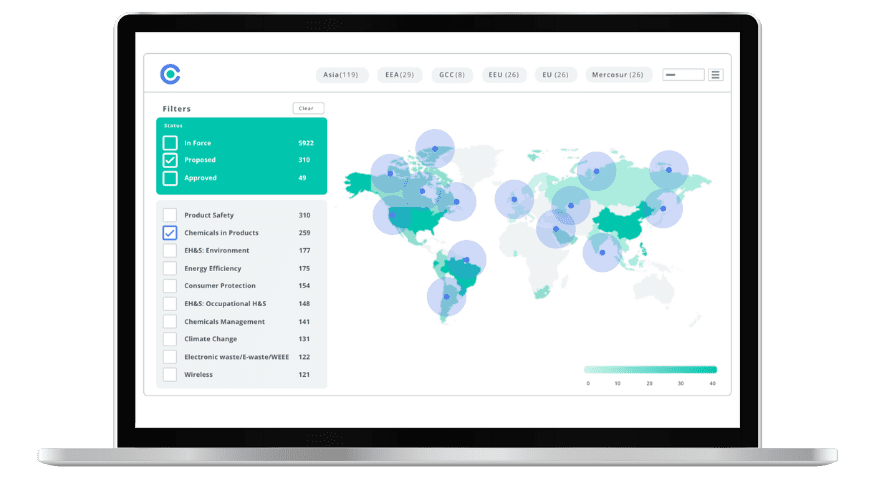
C2P from Compliance & Risks tracks over 110,000 regulatory source documents across 195 countries. When a relevant change is identified, it surfaces as an actionable intelligence item that can be linked to the affected obligations in your risk register, triggering a review rather than waiting for it to be discovered.
That connection between regulatory intelligence and risk assessment is what separates a program that responds quickly from one that is perpetually catching up.
Frequently Asked Questions (FAQ)
- What is the difference between a compliance risk assessment and a compliance audit?
A compliance audit examines whether your current state meets regulatory requirements, typically at a specific point in time. A compliance risk assessment is forward-looking: it identifies where gaps could occur and evaluates potential consequences before a violation happens. Both are valuable, but they serve different purposes in a compliance program. - How often should a compliance risk assessment be conducted?
Most enterprise programs run formal assessments annually at minimum, with more frequent reviews (quarterly or triggered by regulatory change) for high-risk product categories or markets. The right cadence depends on the pace of regulatory change in your sector and the complexity of your product portfolio. - What does a compliance risk score measure?
A compliance risk score typically measures two dimensions: the likelihood that a violation or enforcement action could occur, and the potential impact if it does. Impact factors include financial penalties, market access loss, reputational damage, and product safety consequences. The combined score prioritizes which risks warrant immediate attention. - Who should own the compliance risk assessment process?
Formal ownership typically sits with the Chief Compliance Officer or VP of Regulatory Affairs, but effective assessments require input from product engineering, legal, supply chain, and business unit leadership. Cross-functional participation ensures the assessment reflects operational realities rather than only the compliance team’s perspective. - How does regulatory change management connect to risk assessment?
Every regulatory change is a potential input to your compliance risk assessment. A new directive, an amended standard, or updated enforcement guidance may create new obligations, close existing control gaps, or shift the likelihood and impact scores for risks already in your register. Organizations that link regulatory monitoring to their assessment process respond faster and more accurately than those running the two functions separately.
Simplify Corporate Sustainability Compliance
Six months of research, done in 60 seconds. Cut through ESG chaos and act with clarity. Try C&R Sustainability Free.