
February 11th, 2026
WATCH ON-DEMAND

This blog was originally posted on 21st January, 2026. Further regulatory developments may have occurred after publication. To keep up-to-date with the latest compliance news, sign up to our newsletter.
AUTHORED BY EMILIA ASSENZA, SENIOR REGULATORY COMPLIANCE SPECIALIST AND TEAM LEADER, COMPLIANCE & RISKS
One of the key objectives of Directive (EU) 2024/825, known as the Empowering Consumers for the Green Transition – ECGT Directive, is to better inform consumers on the durability of products by giving more harmonised information on consumer’s legal guarantees rights.
To that end, the ECGT Directive supplements the Consumer Rights Directive 2011/83/EU (CRD) with a new Article 22a which establishes two instruments, the Harmonised Notice and the Harmonised Label, to provide information concerning guarantees for goods.
The new tools are to be used across all EU Member States starting from 27 September 2026. They must be easily recognisable and understandable for consumers and easy to use and reproduce for traders.
To support their implementation, the EU Commission has specified the design and content of both tools through Regulation (EU) 2025/1960 which, in line with the ECGT Directive, will become applicable on the same date (27 September 2026).
Both the harmonised notice and the harmonised label only apply to B2C products.
In fact, the harmonised notice and the harmonised label implement the provisions of Directive (EU) 2024/825 which amends the Consumer Rights Directive (CRD).
The CRD applies to “contracts concluded between consumers and traders”, including both sales contracts and service contracts.
Sales contract means any contract under which the trader transfers or undertakes to transfer ownership of goods to the consumer, including any contract having as its object both goods and services.
The definition of goods is taken from point (5) of Article 2 of Directive (EU) 2019/771 – meaning any tangible movable item.
There are very limited exceptions as listed in Article 3(3) of the CRD, such as foodstuffs, contracts concluded by means of automatic vending machines or automated commercial premises, contracts for healthcare etc.
The harmonised notice serves as a reminder to the consumers about the legal guarantee of conformity applicable to all goods in accordance with Directive (EU) 2019/771. It should remind consumers about its existence and its main elements, such as its minimum duration of two years.
It is mandatory and must be displayed in a prominent manner. It must be in the language of the Member State where the product is offered.
As confirmed by the recent FAQ document published in November 2025, the harmonised notice must be displayed, for example, on a poster in an eye-catching way on a wall in the shop, next to the checkout counter or, in cases of online sale, placed as a general reminder on the website of the trader selling goods.
Regulation (EU) 2025/1960, in its Annex I, provides for its design and content as follows:
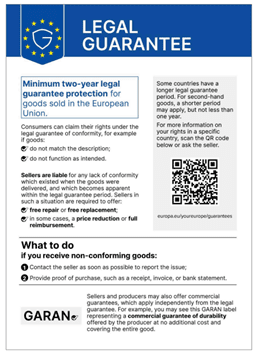
The notes establish the colours to be used (either colour or black and white, apart from online where it must be in colour) and the minimum size (A4). The QR code must lead to the dedicated language section on the legal guarantee of conformity on the Your Europe portal, in order to provide consumers with more detailed information on their rights provided by the legal guarantee of conformity as established by Directive (EU) 2019/771.
It is important to note that none of the elements of the harmonised notice can be edited.
The harmonised label aims to inform consumers about the fact that a commercial guarantee of durability is offered in accordance with Article 17 of Directive (EU) 2019/771. It is a new label for producers willing to promote the durability of their products and for consumers interested to choose for products with a longer lifespan.
It applies to commercial guarantees of durability that are offered by the producer:
It represents the voluntary commercial guarantee of durability and must be displayed in a prominent manner.
As clarified by Recital 28 of the ECGT Directive, the harmonised label should be used in a way that allows consumers to easily identify which particular good benefits from such commercial guarantees of durability, for example by placing the label directly on the packaging of a particular good, by displaying the label in a prominent manner on the shelf where the goods covered by such a guarantee are placed or by placing it directly next to the picture of the good in the case of online sale.
It is important to note that the harmonised label must be used whenever the producer offers a commercial guarantee of durability. In other words, the harmonised label is not mandatory unless the producer offers a commercial guarantee of durability.
Additionally, as confirmed by Recital 32 of the ECGT Directive, the producer and the seller remain free to offer other types of commercial guarantees and after-sales services. However, the information provided to the consumer about other commercial guarantees or services should not confuse the consumer with regard to the existence and duration of the commercial guarantee of durability offered, and for which a harmonised label is used.
A final clarification relates to which operator is required to comply. As clarified in Recital 26, displaying such a label is required by traders, where the producer offers such commercial guarantees of durability and makes the information available to the trader. Importantly, traders are not required to actively search for relevant information from the producer, for example, by searching on product specific websites or elsewhere.
According to the template shown in Annex II of Regulation (EU) 2025/1960, the harmonised label must have the following format:
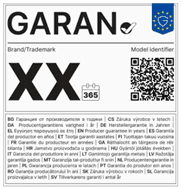
Certain elements of the harmonised label can be edited to specify the duration of the commercial guarantee of durability and the information on the brand/trademark and the model identifier. The elements that cannot be edited are instead:
For distance contracts concluded through an online interface, the harmonised label can be displayed using a nested display, as shown below:

The transposition of the ECGT Directive by Member States is still ongoing and must be completed by 27 March 2026. The new harmonised tools will then apply in each Member State by 27 September 2026.
Compliance & Risks has been informed by the EU authorities that the EU Commission is currently working on an online tool which would enable producers and retailers to issue the harmonised notice and the harmonised label. This tool is likely to be available in the second quarter of 2026.
Want to stay ahead of regulatory developments in Consumer Protection?
Accelerate your ability to achieve, maintain & expand market access for all products in global markets with C2P, your key to unlocking market access, trusted by more than 300 of the world’s leading brands. C2P is an enterprise SaaS platform providing everything you need in one place to achieve your business objectives by proving compliance in over 195 countries.
C2P is purpose-built to be tailored to your specific needs with comprehensive capabilities that enable enterprise-wide management of regulations, standards, requirements and evidence.
Add-on packages help accelerate market access through use-case-specific solutions, global regulatory content, a global team of subject matter experts and professional services.
Six months of research, done in 60 seconds. Cut through ESG chaos and act with clarity. Try C&R Sustainability Free.