From Cost Center to Competitive Edge: How Regulatory Foresight Redefines Winning
THIS BLOG WAS WRITTEN BY THE COMPLIANCE & RISKS MARKETING TEAM TO INFORM AND ENGAGE. HOWEVER, COMPLEX REGULATORY QUESTIONS REQUIRE SPECIALIST KNOWLEDGE. TO GET ACCURATE, EXPERT ANSWERS, PLEASE CLICK “ASK AN EXPERT.”
You know that feeling in your gut right before a major product launch? It’s a mix of excitement and a low-grade, humming anxiety. And deep down, you know where the anxiety comes from. It’s the question that surfaces in late-night emails and tense pre-launch meetings: “Are we sure we’re covered in Germany for the new packaging rules?” Or, “Did anyone check the latest materials restrictions in California?”
For too long, regulatory compliance has been a defensive game. A checklist-driven, reactive scramble to avoid fines and answer auditor questions. It feels like a cost center because, frankly, that’s how most companies treat it. It’s a shield. A necessary, heavy, and expensive shield.
But what if that’s the wrong way to look at it entirely?
What if the constant flood of global regulations wasn’t a threat to be managed, but an opportunity to be seized? What if, instead of playing defense, you could use regulatory intelligence to go on offense – to design better products, enter markets faster, and build a brand that customers genuinely trust?
This isn’t a theoretical fantasy. It’s a strategic shift that leading companies are making right now. They are transforming compliance from a siloed legal function into a powerful engine for competitive advantage. This guide is your blueprint for doing the same. We’re going to break down how to move beyond reactive firefighting and start using regulatory foresight to win.
Table of Contents
- The Hidden Drag of Reactive Compliance: Why Most Programs Fail to Add Value
- The Regulatory Foresight Maturity Model: From Firefighting to Market Shaping
- Unlocking the Value Drivers: 3 Strategic Plays Powered by Foresight
- AI-Powered Intelligence: Your Global Team of Virtual Experts
- Key Takeaways: Building Your Advantage
- Frequently Asked Questions
The Hidden Drag of Reactive Compliance: Why Most Programs Fail to Add Value
Here’s a hard truth. In the world of enterprise software, studies show that a staggering 18% to 70% of major implementation projects fail. Think about that. The top reasons aren’t usually a lack of features, but rather human factors: poor usability, lack of training, and – most critically – cross-functional misalignment.
Now, let’s apply that lens to regulatory compliance. The “failure rate” here isn’t a single software project going belly-up. It’s a slow, continuous drain on resources, innovation, and morale. It’s the death-by-a-thousand-cuts that comes from a fundamentally broken, reactive approach.
A reactive compliance program “fails” when:
- Cross-functional misalignment is the norm. This is the classic scenario: The R&D team spends 18 months designing a groundbreaking product, only for the compliance team to flag a banned substance or a new labeling requirement weeks before launch. The result? Costly redesigns, missed market windows, and internal friction. Research shows over 70% of project failures stem from this kind of misalignment.
- The intelligence isn’t usable. Your legal team might subscribe to alerts, but if they arrive as 50-page PDFs of dense legalese, they’re effectively useless to an engineer or a product manager. When data has poor usability, people stop using it. It’s no surprise that 20% of enterprise tool users switch solutions simply because the one they have is too hard to use. The same principle applies here. If the insights aren’t accessible and actionable, they will be ignored.
- You lack the necessary expertise. Let’s be honest, you don’t have a dedicated expert on Vietnamese chemical regulations or Brazilian e-waste directives. No one does. A reported 32% of project failures cite a lack of technical expertise. In a global market, expecting one team to master the regulatory landscape of 195 countries is a recipe for failure.
This reactive state isn’t just inefficient; it’s incredibly expensive. The real costs aren’t on the compliance department’s balance sheet. They show up as delayed revenue, wasted R&D budgets, and the immeasurable cost of lost opportunities. You’re perpetually playing catch-up in a game where the winners are already looking three moves ahead.
The Regulatory Foresight Maturity Model: From Firefighting to Market Shaping
The first step to fixing the problem is diagnosing where you stand. Most organizations fall into one of three stages of regulatory maturity. The goal is to move from left to right – from being a rule-taker to a market-shaper.
Stage 1: Reactive (The Cost Center)
This is the default for many companies. Compliance is a siloed function, often in the legal or quality department. Their job is to react to new laws, conduct audits, and answer questions when asked. Information lives in spreadsheets and email chains. The primary focus is avoiding fines. It’s pure defense, and it’s a constant source of last-minute emergencies.
- Hallmarks: Firefighting, checklist-based audits, siloed knowledge, high risk of non-compliance.
- Business Impact: Market delays, unexpected costs, innovation bottleneck.
Stage 2: Proactive (The Risk Mitigator)
This is a significant step up. The organization has systems in place to monitor regulatory changes and provide alerts to relevant teams. Compliance is considered earlier in the product development lifecycle. There’s a shared understanding that getting ahead of regulations is better than being surprised by them. Teams might use a centralized platform to track requirements, but the focus is still primarily on risk mitigation rather than value creation.
- Hallmarks: Automated monitoring, early-stage impact assessments, cross-functional awareness.
- Business Impact: Reduced risk, smoother product launches, more predictable timelines.
Stage 3: Predictive (The Value Driver)
This is where the magic happens. Here, the company treats regulatory intelligence as a strategic asset, on par with market research or competitive analysis. It’s not just about what the law is today, but where it’s going tomorrow. The intelligence informs core business strategy, from product design and M&A activity to ESG reporting and brand positioning.
- Hallmarks: Trend analysis, compliance-led innovation, C-suite dashboards, ESG leadership.
- Business Impact: First-mover advantage, enhanced brand reputation, access to new markets, true competitive differentiation.
Moving from Stage 1 to Stage 3 doesn’t happen overnight. It requires a shift in mindset and the right enabling technology. But the payoff is transforming a department that costs you money into a capability that makes you money.
Unlocking the Value Drivers: 3 Strategic Plays Powered by Foresight
When you reach the predictive stage, regulatory intelligence stops being about what you can’t do and starts being about what you can do. Here are three concrete ways this creates a powerful competitive advantage.
1. The C-Suite Dashboard: Translating Risk into Revenue
Your board doesn’t want a 300-page report on REACH compliance. They want to know: How are we positioned against our competitors on sustainability? Is there a regulatory risk to our Q4 revenue forecast in Europe? What emerging “green” standards can we meet to unlock a new premium customer segment?
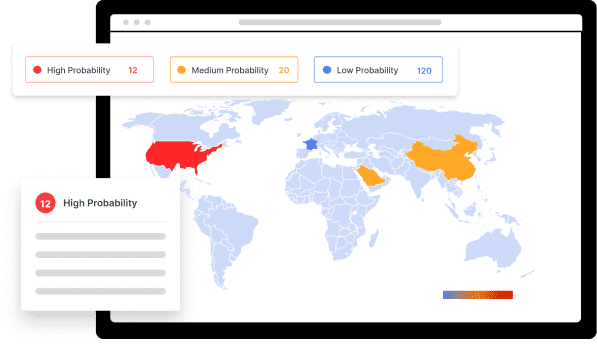
Predictive foresight allows you to build a C-suite dashboard that answers these questions. It visualizes regulatory intelligence in the language of business – risk, opportunity, and market share.
Instead of tracking violations, you track readiness. You can map your product portfolio against upcoming regulations to see your revenue-at-risk. You can benchmark your ESG disclosures against peers to identify gaps and opportunities for leadership. This transforms the conversation from “Are we compliant?” to “How can compliance help us win?”
2. Compliance-Led Innovation: Designing Products for Tomorrow’s Regulations
Imagine this: Five years ago, your team analyzed regulatory proposals and industry chatter and saw the “right to repair” movement gaining serious momentum. While your competitors were still gluing batteries into their devices, you began designing your next-generation product with a modular, easily replaceable battery.
When the regulations finally hit, your competitors are scrambling to re-engineer their entire product lines. But you? You’re launching a marketing campaign celebrating your durable, sustainable, and now fully compliant product. You didn’t just meet the standard; you set it. You look like a visionary, and you capture the market.
This is compliance-led innovation. It’s about using foresight to skate to where the puck is going. By analyzing draft legislation, NGO position papers, and policy trends, you can anticipate future requirements for things like:
- Recycled content percentages
- Energy efficiency standards
- Data privacy and cybersecurity
- Restrictions on PFAS or other “forever chemicals”
Building these future requirements into your product roadmap today is the ultimate competitive moat. It’s infinitely cheaper to design it right the first time than to fix it under pressure later. And it allows you to build products that are not only safe and sustainable but also years ahead of the competition.
3. M&A Readiness and Supply Chain Resilience
In the world of mergers and acquisitions, regulatory due diligence is often a painful, slow, and uncertain process. Does the target company’s flagship product comply with regulations in all 50 countries they sell to? Answering that question can take months of manual work.
With a mature regulatory intelligence program, you have this data at your fingertips. You can assess a target’s compliance posture in days, not months, giving you a massive advantage in negotiations and integration planning. You can spot hidden liabilities that others might miss.
The same applies to your supply chain. Is your key supplier in Southeast Asia about to be impacted by new forced labor legislation? Are the materials you source from Brazil subject to new environmental export rules? Foresight gives you the ability to proactively vet suppliers and build a more resilient, ethical, and defensible supply chain. It moves you from reacting to supply chain disruptions to anticipating and routing around them before they happen.
AI-Powered Intelligence: Your Global Team of Virtual Experts
So, how do you possibly achieve this? How can a team in Cork or California possibly stay on top of regulatory proposals in Korea and South Africa?
This is where technology, specifically AI, becomes the great equalizer. Remember the finding that 32% of projects fail due to a lack of expertise? AI-powered regulatory intelligence platforms are the solution. Think of it as having a virtual, always-on team of global subject matter experts working for you 24/7.
A powerful platform like C2P doesn’t just send you alerts. It uses AI to:
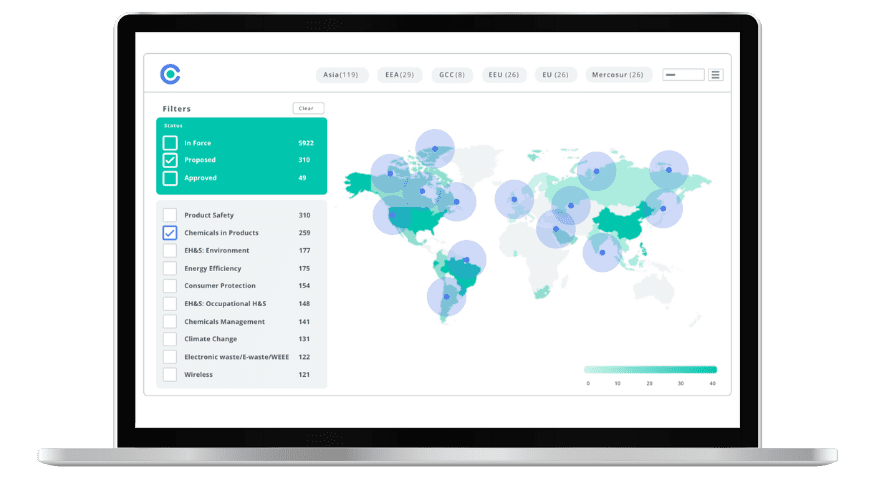
- Filter the Signal from the Noise: It monitors tens of thousands of global sources – from government gazettes to standards bodies – and automatically identifies the handful of updates that specifically impact your products and markets.
- Translate Complexity into Clarity: It synthesizes dense legal text into clear, concise business impact summaries. You don’t need to be a lawyer to understand what you need to do.
- Provide Actionable Insights: It goes beyond just information, delivering clear action plans and evidence management tools so your teams can collaborate effectively and maintain an audit-ready trail.
- Predict Future Trends: By analyzing the entire landscape of proposed and draft regulations, it can help you spot the trends – like “right to repair” – long before they become law.
This isn’t about replacing human experts. It’s about augmenting them. It automates the soul-crushing, manual work of monitoring and initial analysis, freeing up your talented team to focus on high-value strategic thinking. It’s the force multiplier that makes the move to a predictive model possible for any organization.
Key Takeaways: Building Your Advantage
Let’s boil it down. Shifting from a reactive cost center to a proactive value driver hinges on a few key ideas:
- Recognize the Failure of Reactive Compliance: The constant firefighting, last-minute redesigns, and cross-functional friction are symptoms of a broken model. The real cost is in lost revenue and missed opportunities.
- Adopt a Maturity Mindset: Identify where your organization sits on the Reactive-Proactive-Predictive scale and build a roadmap to move forward.
- Focus on Strategic Value Drivers: Use regulatory foresight to inform C-suite strategy, drive product innovation, and de-risk M&A and supply chain operations.
- Leverage AI as a Force Multiplier: You cannot manually monitor the globe. Use intelligent platforms to automate the grunt work and empower your team with actionable, predictive insights.
The world is not getting less regulated. For companies that remain in a reactive posture, this complexity will become an ever-heavier anchor. But for those who embrace regulatory foresight, it becomes a tailwind, pushing them ahead of the competition into a future they helped to shape.
Frequently Asked Questions
- Q: Isn’t this kind of strategic compliance program only for huge multinational corporations?
Not at all. While large enterprises certainly need it, the principles are even more critical for growing businesses. A single, unexpected regulatory barrier in a new market can be catastrophic for a smaller company. Scalable intelligence platforms allow lean teams to punch far above their weight, avoiding costly early mistakes and expanding globally with confidence. - Q: Our legal team handles compliance. Why does engineering or product need to be involved?
This is the core of the reactive mindset. When compliance is only handled at the end of the process by legal, you get expensive, late-stage problems. Involving product and engineering teams from the very beginning – giving them direct access to usable regulatory intelligence – is how you design compliance in, rather than bolting it on. This is what saves time and money. - Q: How can we possibly prove the ROI of moving from reactive to proactive?
You measure what matters. Track metrics like: Reduction in redesign cycles: How many projects required late-stage changes due to compliance issues this year vs. last year?; Time-to-market: Are your product launches getting faster and more predictable?; Cost of non-compliance: Quantify not just fines, but the cost of delayed shipments, reworked products, and administrative overhead; New Market Access: Track revenue from markets you were able to enter more quickly and confidently due to better foresight. - Q: We just don’t have the bandwidth to track all of this. It seems overwhelming.
You’re right. It is overwhelming – if you try to do it manually. This is precisely the problem that intelligent compliance platforms are built to solve. They don’t add to your team’s workload; they reduce it. By automating the monitoring, filtering, and analysis, they act as a force multiplier, giving your team the bandwidth to focus on strategy instead of search.
Ready to turn your compliance program into a competitive weapon? Explore the C2P platform and see how regulatory foresight can help you build safer, more sustainable products for a rapidly changing world.
Experience the Future of ESG Compliance
The Compliance & Risks Sustainability Platform is available now with a 30-day free trial. Experience firsthand how AI-driven, human-verified intelligence transforms regulatory complexity into strategic clarity.
👉 Start your free trial today and see how your team can lead the future of ESG compliance.
The future of compliance is predictive, verifiable, and strategic. The only question is: Will you be leading it, or catching up to it?
Simplify Corporate Sustainability Compliance
Six months of research, done in 60 seconds. Cut through ESG chaos and act with clarity. Try C&R Sustainability Free.