
Navigating the 2026 Regulatory Wave in the Middle East
This blog was originally posted on 3rd March, 2026. Further regulatory developments may have occurred after publication. To keep up-to-date with the latest compliance news, sign up to our newsletter.
AUTHORED BY JUMANA IGHBARIA HAMAM, REGULATORY COMPLIANCE SPECIALIST, MOHAMMED ALREFAEI, REGULATORY COMPLIANCE ANALYST, & SAMI ROMDHANI, REGULATORY COMPLIANCE ANALYST, COMPLIANCE & RISKS
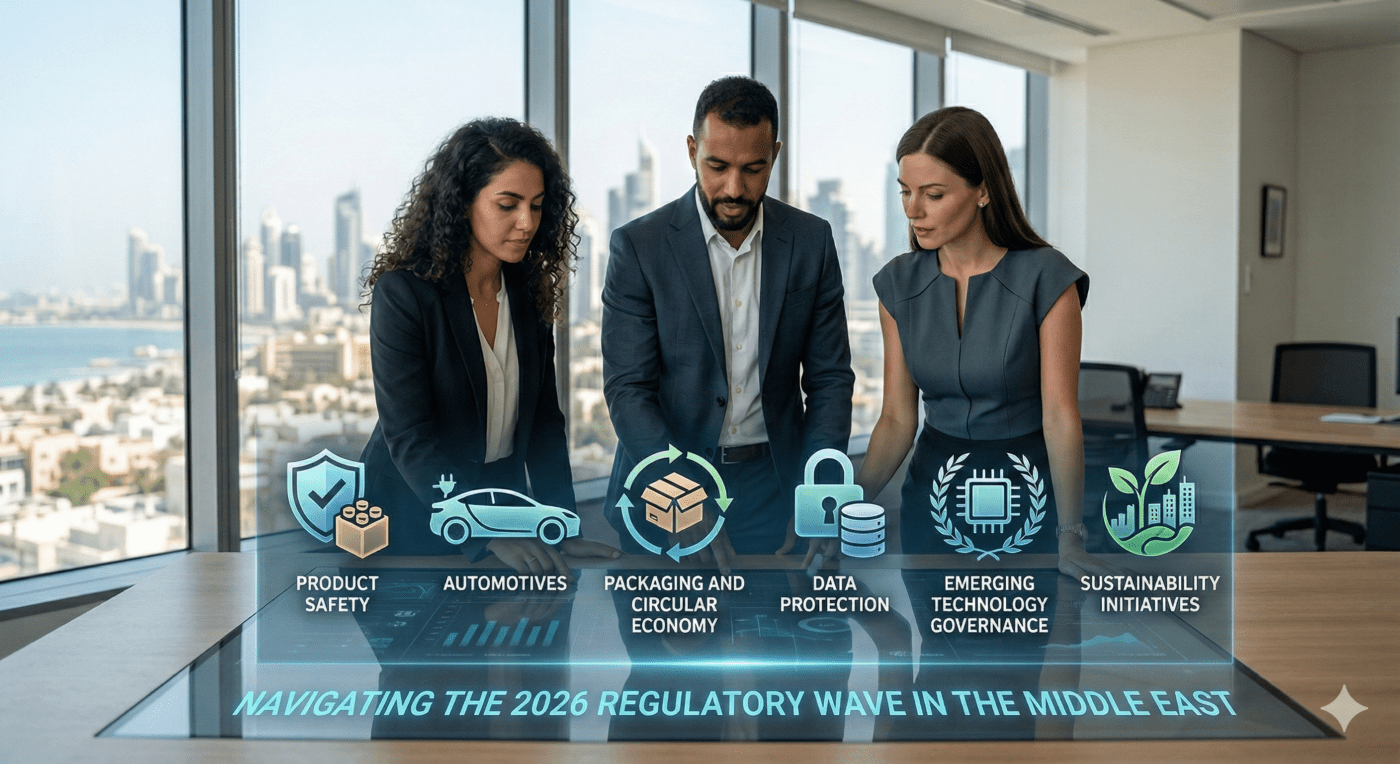
The regulatory landscape across the Middle East and the Mediterranean is currently undergoing a transformative shift as nations move to harmonize local requirements with global standards. As we move through the first quarter of 2026, staying ahead of these changes is no longer just a legal necessity but a critical competitive advantage for businesses aiming to maintain seamless market access. From Israel’s alignment with European chemical restrictions to the UAE’s pioneering digital safety laws and Saudi Arabia’s ambitious circular economy frameworks, the region is rapidly modernizing its technical, environmental, and safety protocols.
In this update, we highlight the primary regulatory developments organized by key fields and themes, ranging from product safety and medical devices to sustainability and digital governance. Navigating this “regulatory wave” requires a proactive approach to compliance. Governments are increasingly prioritizing consumer protection, high-tech governance, and sustainable industrial growth, often introducing strict enforcement mechanisms alongside transitional grace periods. This detailed update explores the essential shifts providing the insights necessary to steer your operations through the complexities of the 2026 regulatory environment.
Product Safety & Technical Standards
Significant updates have been introduced to enhance consumer protection, particularly for vulnerable populations:
- In February 2026, Israel proposed a temporary order to establish maximum limits for formaldehyde release in children’s furniture. This is intended to bridge a regulatory gap until EU REACH restrictions take effect in August 2026. Israel also updated its toy safety standards (SI 562 Part 3) and medical electrical equipment standards (SI 60601 Part 1) , while allowing a one-year transition period for the older versions.
- Similarly, Egypt‘s Ministry of Industry mandated compliance with updated toy safety specifications regarding phthalate esters and microbiological safety as of 15 December 2025.
- Turkey has also tightened its borders with a suite of 2026 Product Safety and Inspection Communiqués, requiring strict TAREKS registration for imports across sectors like toys and machinery.
- In Saudi Arabia, the SFDA issued new guidance in January 2026 to help companies classify “borderline” products between drugs, health products, and cosmetics.
- Iraq has been equally active, with the Specification Standards Authority adopting and updating various national standards for chemical and consumer products, construction, and food safety as of November 2025. By January 2026, Iraq further adopted the amendments for household electronic appliances, recycling plastic food contact materials, batteries and more.
- In Kuwait, Ministerial Decision No. 51/2025 given by the Ministry of Commerce and Industry, adopted over 1,100 Gulf Standard Specifications as optional national standards across fields like chemistry, mechanics, and electronics.
Automotive and Transportation
The automotive sector is seeing a diversification of regulations covering everything from high-tech autonomous systems to the preservation of vintage vehicles:
- Kuwait adopted several Gulf Standard Specifications for electrically propelled mopeds and motorcycles as mandatory regulations in late 2025.
- In Dubai, Administrative Decision No. 939 of 2025 established a rigorous licensing framework for self-driving vehicles, requiring operators to report system failures immediately and maintain constant software updates.
- Saudi Arabia is refining its market for traditional vehicles; a November 2025 proposal would allow the import of sport and antique vehicles that do not meet standard age or energy limits, provided they use specific “Antique Vehicle Plates”. Saudi Arabia also clarified the responsibilities for auto spare parts, prohibiting the import of most used or refurbished items except for major components like engines.
- Cyprus modernized its safety requirements for the road transport of dangerous goods through Law 193(I)/2025.
Energy Efficiency & Electrical Infrastructure
Energy conservation remains a top priority, with several nations tightening the requirements for household and industrial equipment:
- The United Arab Emirates (UAE) introduced binding standards for large and low-capacity air conditioners, effective November 2026, which mandate minimum performance scores and the use of RFID tags for tracking. Furthermore, the UAE set a full compliance deadline of May 2027 for national technical requirements regarding EV charging equipment.
- In Saudi Arabia, the long-term transition to a 230/400 volt grid hit a milestone in November 2025 with the prohibition of importing spare parts for older 127-volt equipment.
- Israel also updated its mandatory safety standards for washing machines (IS 60335 Part 2.7) and low-voltage switchgear assemblies, providing a 12-month transition period (until December 2026) for both to allow industry adjustment.
Packaging, Chemicals & Circular Economy
Sustainability efforts are increasingly focused on the lifecycle of materials and the elimination of hazardous substances:
- The UAE and Dubai have significantly expanded bans on single-use products as of January 2026, now including non-plastic bags, cutlery, and styrofoam containers.
- Saudi Arabia is pushing its circular economy agenda with new draft standards for Aluminium and Container Glass recycling, requiring recyclers to maintain origin records for five years.
- Jordan ended its transition period for GHS-compliant labeling in December 2025, meaning all chemical products must now feature bilingual hazard information.
- Israel has also focused on the environment by setting HFC import quotas for 2026 and introducing a new integrated environmental licensing regime based on European standards.
Want to learn more about chemicals regulations worldwide? Watch our Chemicals Quarterly – Q4 2025 Regulatory Update.
Medical Devices
Regulatory bodies are streamlining medical product registration while intensifying safety oversight:
- In Egypt, the Drug Authority (EDA) issued updated procedures in February 2026 to facilitate the registration and renewal of medical devices. New guidelines also define evaluation criteria for devices in pharmaceutical dosage forms.
- Kuwait established a structured framework for the withdrawal or suspension of medicines and medical devices that exhibit defects or health risks. Additionally, Kuwaiti Ministerial Decree No. 387 of 2025 now regulates the registration and circulation of diagnostic (IVD) devices.
- In Saudi Arabia, new draft guidance (MDS-G-028) allows for the bundling of multiple medical devices into a single marketing authorization, provided they share the same manufacturer and risk class.
The global medical device industry is undergoing a profound digital transformation, driven by the ubiquitous integration of Artificial Intelligence (AI), software, and connectivity into all aspects of healthcare. Check out our guide for more information!
Data Protection, Digital Safety & Labor
New protections for digital rights and worker safety have emerged as key legislative themes:
- The UAE‘s Federal Decree-Law No. 26 of 2025 took effect in January 2026, strictly regulating the use of children’s data for targeted advertising and mandating parental controls.
- Egypt has moved forward with its Personal Data Protection Law, issuing executive regulations that require data controllers to obtain specific permits for processing personal information.
- In the realm of labor and social welfare, Israel passed an amendment in January 2026 extending maternity and parental leave for parents of toddlers with complex disabilities.
- Saudi Arabia also introduced a unified framework for the medical oversight and licensing of workers in high-risk professions, which will enter into force in July 2026.
- Qatar now requires large financial firms to align their sustainability reporting with international ISSB standards as of January 2026.
Digital Governance & Emerging Tech
As digital transformation accelerates, new regulations are governing the infrastructure and safety of the tech sector:
- Lebanon‘s Telecommunications Regulatory Authority (TRA) issued Decision No. 3/2026 in January 2026, amending type approval regulations for telecommunications equipment.
- Kuwait‘s CITRA issued Decision No. 397/2025 to regulate the voluntary sharing of non-active telecommunications infrastructure for wireless sites.
- Israel published updated standards for cybersecurity and data protection in February 2026.
Conclusion
The transition from late 2025 into early 2026 marks a decisive shift toward higher safety standards and more robust digital governance across the Middle East and Mediterranean. Whether it is Saudi Arabia’s focus on circular economy standards , the UAE’s stringent new digital safety laws for children , or Israel’s alignment with European chemical restrictions, the recurring theme is one of modernization and international harmonization. As grace periods for these new mandates begin to expire, businesses must prioritize agile compliance strategies to maintain seamless market access.
Staying ahead of these technical updates is no longer just a regulatory hurdle; it is a fundamental component of operational excellence in an increasingly interconnected global market.
Stay Ahead Of Regulatory Changes
Want to stay ahead of these regulatory developments?
Accelerate your ability to achieve, maintain & expand market access for all products in global markets with C2P – your key to unlocking market access, trusted by more than 300 of the world’s leading brands.
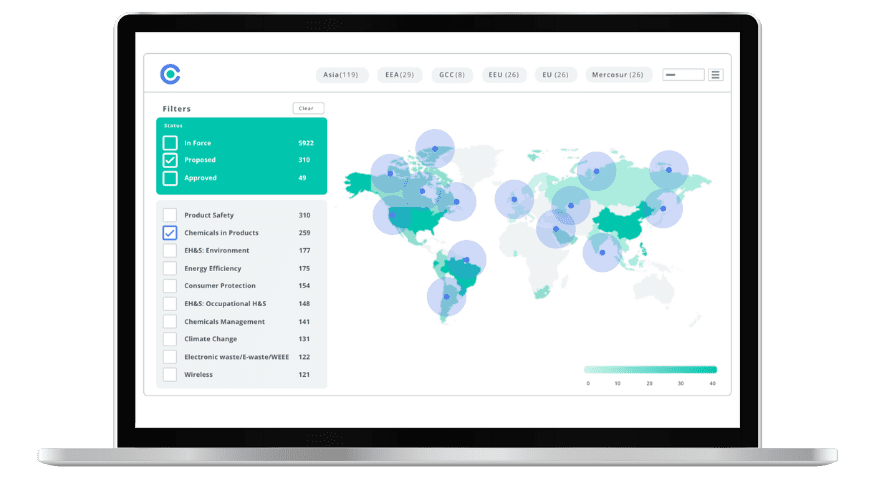
C2P is an enterprise SaaS platform providing everything you need in one place to achieve your business objectives by proving compliance in over 195 countries.
C2P is purpose-built to be tailored to your specific needs with comprehensive capabilities that enable enterprise-wide management of regulations, standards, requirements and evidence.
Add-on packages help accelerate market access through use-case-specific solutions, global regulatory content, a global team of subject matter experts and professional services.
- Accelerate time-to-market for products
- Reduce non-compliance risks that impact your ability to meet business goals and cause reputational damage
- Enable business continuity by digitizing your compliance process and building corporate memory
- Improve efficiency and enable your team to focus on business critical initiatives rather than manual tasks
- Save time with access to Compliance & Risks’ extensive Knowledge Partner network
Cutting Through the Chaos: A 2025-2026 Survival Guide to ESG, Sustainability & Product Compliance
Unpack the latest regulatory developments in 2025, gain practical insights, and learn what’s coming next in 2026!
Whether you’re grappling with deadlines or planning for future compliance, this webinar-on-demand is your roadmap to navigate the challenges and opportunities ahead.