Regulatory Change Management: How to Stop Finding Out Too Late
THIS BLOG WAS WRITTEN BY THE COMPLIANCE & RISKS MARKETING TEAM TO INFORM AND ENGAGE. HOWEVER, COMPLEX REGULATORY QUESTIONS REQUIRE SPECIALIST KNOWLEDGE. TO GET ACCURATE, EXPERT ANSWERS, PLEASE CLICK “ASK AN EXPERT.”
Your product ships into a new market. Six months later, you learn there was a regulatory update that changed the certification requirements. The deadline passed three months ago. Now you have a non-compliant product in market, an angry legal team, and a very uncomfortable call with your VP of Compliance.
This is not a rare scenario. It happens to global manufacturers every day, across every regulated sector: consumer electronics, medical devices, automotive, chemicals, industrial machinery, aerospace. The regulations change constantly. The failure point is almost always the same: finding out too late.
Regulatory change management is the discipline that prevents this. Done well, it turns a reactive scramble into a controlled, auditable workflow. Done poorly, or not at all, it leaves your organization perpetually one missed update away from a market access problem.
Quick Answer
Regulatory change management is the process by which organizations monitor, assess, and implement changes to applicable laws, regulations, and standards before enforcement deadlines. An effective process includes continuous regulatory monitoring across relevant jurisdictions, structured impact assessment, task assignment to the right teams, and documented evidence of implementation. The most common failure point is not the implementation phase but the monitoring phase: companies miss regulatory changes because their tracking systems are too slow, too narrow, or too manual.
Table of Contents
- What Is Regulatory Change Management?
- Why Do Companies Find Out About Regulatory Changes Too Late?
- The Real Cost of Regulatory Lag
- How to Build a Regulatory Change Management Process
- What a Modern Regulatory Change Management System Looks Like
- Frequently Asked Questions
What Is Regulatory Change Management?
Regulatory change management is a structured set of policies, workflows, and controls that an organization uses to track changes in applicable regulation and translate those changes into operational updates before the relevant deadlines.
The word “management” carries real weight here. Monitoring alone is not enough. A process that alerts you to a new regulation but stops there has done half the job. The full workflow runs from identification through to evidenced implementation.
For product companies operating globally, regulatory change management covers a wide surface. A single product category can be subject to regulations in 50 or more countries, each with its own regulatory body, publication schedule, and enforcement calendar. The EU’s CE marking regime, the FDA’s 510(k) clearance requirements, REACH chemical regulations, automotive type approval under UNECE rules, medical device directives under EU MDR and IVDR: each of these has its own amendment cadence, and each has deadlines that do not move because your compliance team was busy.
The core activities in any regulatory change management process are:
- Regulatory monitoring across all relevant jurisdictions and regulatory bodies
- Change identification and preliminary triage
- Impact assessment against current products, processes, and documentation
- Task assignment and implementation planning
- Evidence capture to document that required changes were made
- Ongoing review and audit readiness
The challenge, as we will get to, is that most organizations handle several of these steps well and one of them catastrophically.
Why Do Companies Find Out About Regulatory Changes Too Late?
The most common answer in post-incident reviews is “we didn’t know it had been published.” That answer almost always traces back to one of three structural problems.
- The monitoring scope is too narrow. Many compliance teams rely on regulatory alerts from a handful of government agency websites, trade associations, or newsletter subscriptions. That approach works in a single jurisdiction with a small regulatory footprint. It does not work when your product ships into 30 countries. Regulations that matter to your product get published in languages your team does not read, by bodies your team does not track, on timelines your team has not mapped.
- The monitoring process is too slow. Manual regulatory tracking, where someone reviews sources periodically and routes relevant updates to the right owner, introduces lag. At some organizations, that lag runs to weeks or months. A regulation published in January with a June implementation deadline sounds like plenty of time. It stops sounding like plenty of time when you find out in May.
- The routing breaks down. Even when a change is identified on time, regulatory change management processes frequently fail during handoff. A compliance analyst identifies a relevant update, sends an email to a product engineer, and the thread gets buried. No one follows up. The implementation deadline passes without action. This is not a people problem; it is a process problem.
The consequence of any of these failures is the same: a compliance gap that becomes visible only when something goes wrong. A failed audit. A customs hold. A product recall notice. A regulator inquiry.
The Real Cost of Regulatory Lag
There is a version of this conversation that stays abstract, discussing “reputational risk” and “regulatory exposure.” Here is the more specific version.
Market access disruption means you cannot sell. A product found to be non-compliant with a destination market’s regulations gets stopped at customs, pulled from shelves, or refused certification renewal. The revenue impact is immediate and the recovery timeline is measured in months, not weeks.
Remediation costs are rarely small. Redesigning a product or reformulating a chemical substance to meet a missed regulatory requirement is expensive. If the non-compliance surfaces after market launch, add recall costs, customer notifications, and potential third-party liability on top of the engineering work.
Regulatory penalties range from administrative fines to criminal liability depending on jurisdiction and severity. In the EU, enforcement under regulations like EU MDR or REACH can result in significant fines and market withdrawal. Regulatory bodies in the US, Japan, and Australia have similar enforcement authorities.
There is also an indirect cost that rarely appears in post-incident analyses: the organizational cost of operating in a permanent reactive state. Teams that are constantly playing catch-up spend less time on the higher-value work of building a product compliance strategy and more time firefighting. The cost compounds quietly.
How to Build a Regulatory Change Management Process
Getting this right requires deliberate design across five areas. This is not a technology problem with a technology solution. It is a workflow problem, and the technology you choose should serve the workflow.
- Step 1: Map your regulatory footprint
Start with a complete inventory of the jurisdictions and regulatory bodies relevant to your products. This includes destination markets, manufacturing locations, and any jurisdictions where your supply chain creates regulatory obligations. For a global electronics manufacturer, this list can span 50 or more countries and hundreds of regulatory bodies.
Most organizations underestimate their footprint at this stage, particularly for emerging markets. The footprint mapping exercise is not glamorous, but it is foundational. You cannot monitor what you have not defined.
- Step 2: Establish continuous monitoring
Manual monitoring cannot keep pace with global regulatory output. Continuous regulatory monitoring means automated tracking of regulatory publications, standards updates, and proposed rule changes across all sources in your defined footprint. Monitoring should cover both enacted regulations and proposed changes, because a proposed change gives you more lead time than waiting for enactment.
The monitoring system needs to surface changes that are relevant to your products, not just changes in a broad regulatory category. A general alert that “EU chemical regulations have been updated” is less useful than an alert that says “REACH Annex XIV has been amended, and substances used in your product category are affected.”
- Step 3: Assess impact systematically
Not every regulatory change requires action. Some changes affect product categories you are not in. Some updates clarify requirements you already meet. The impact assessment step filters the relevant from the irrelevant and assigns a priority to everything that requires attention.
A structured impact assessment asks: which products are affected? Which teams need to act? What is the implementation deadline? What evidence will be required to demonstrate compliance? Skipping this step, or doing it informally, is where many organizations lose control of the process.
- Step 4: Assign and track implementation
Once a change is assessed as relevant, the implementation work needs to be assigned to a specific owner with a specific deadline, and that assignment needs to be tracked. Email threads are not a tracking system. A compliance task that lives in someone’s inbox has no visibility, no escalation path, and no audit trail.
Implementation tasks might go to product engineers for design changes, to regulatory affairs for documentation updates, to procurement for supplier qualification work, or to legal for policy revisions. Each task needs an owner and a due date that accounts for the regulatory deadline with enough lead time to verify and document the work.
- Step 5: Capture and store evidence
Regulators do not take your word for it. When an audit or an enforcement inquiry arrives, you need evidence that you identified the change, assessed its impact, implemented the required modifications, and verified the outcome. That evidence needs to be organized, retrievable, and credible.
Evidence management is the step most often treated as an afterthought in regulatory change management design. Organizations that have strong monitoring and implementation workflows but weak evidence capture find themselves unable to demonstrate compliance, even when the underlying work was done. You can explore what structured evidence management looks like in practice as part of this workflow.
What a Modern Regulatory Change Management System Looks Like
The process above works. The question is whether you can execute it at scale, across 195 countries, across hundreds of regulatory bodies, across multiple product lines, with a compliance team that is already stretched.
Manual execution of this process at global scale is not realistic. Not because people are not capable, but because the volume of regulatory output is too large and too geographically distributed for any team to monitor by hand at scale. The organizations that get this right have built or adopted systems that automate the monitoring and routing steps, allowing their compliance teams to focus on assessment, implementation, and expert judgment rather than source tracking.
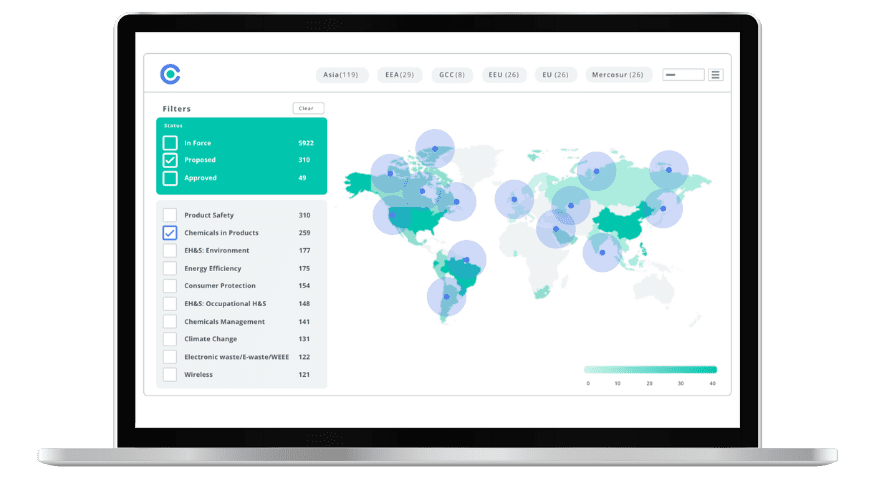
A modern regulatory change management system provides access to a global corpus of regulatory information: proposed and enacted regulations, standards, and technical requirements across all relevant jurisdictions. It monitors that corpus continuously and surfaces relevant changes based on your product categories and regulatory footprint. When a change is identified, it routes to the right owner with context, triggers an impact assessment workflow, and tracks implementation through to evidence capture.
Compliance & Risks built C2P specifically for this use case. C2P covers 110,000+ regulatory source documents across 195 countries, continuously updated. It supports the full workflow from regulatory monitoring through to evidence management, with 40+ in-house subject matter experts available when a change requires deeper interpretation than the document alone can provide. Companies including Tesla, Samsung, Bose, Stryker, and Thermo Fisher use C2P to manage their global regulatory footprint.
The honest limitation worth naming: even the best system does not eliminate compliance risk entirely. A regulation published by a minor regulatory body in an emerging market may have a short notice period. Regulatory interpretation questions, particularly in medical devices or chemicals, sometimes require expert analysis that no software can fully replace. The system handles the scale and the structure; expert judgment still matters for the edge cases. That is precisely why the use cases for regulatory change management software are strongest when the technology and human expertise work together, not when one substitutes for the other.
The companies that find out about regulatory changes too late are not, for the most part, staffed with careless people. They are staffed with capable professionals running a process that was not designed to handle the volume and geographic breadth of modern regulatory output. The process fix is structural, not motivational.
Frequently Asked Questions (FAQ)
- What is the difference between regulatory change management and compliance management?
Compliance management is the broader discipline of ensuring an organization meets all applicable regulatory requirements. Regulatory change management is a specific subset of that discipline focused on tracking and implementing changes to those requirements. Compliance management maintains the current state. Regulatory change management manages the transitions when the required state changes. - How often do regulations change?
More often than most compliance teams expect. Across 195 countries and all regulated product categories, thousands of regulatory updates, proposed rules, and standards revisions are published each year. Major regulatory regimes, such as EU product safety legislation, REACH, FDA device regulations, and automotive type approval frameworks, issue amendments, guidance documents, and enforcement updates on an ongoing basis. The pace of regulatory change has accelerated in recent years, driven by technology-related regulation, supply chain transparency requirements, and environmental compliance mandates. - What is the biggest risk in regulatory change management?
The biggest risk is not failing to implement a change correctly. It is failing to identify the change in the first place. Organizations that discover their monitoring scope is incomplete, or that their monitoring process has too much lag, often discover this fact at the worst possible time: when a compliance gap is already in market. Monitoring design is the highest-impact point in the process. - Can regulatory change management be automated?
The monitoring and routing steps can be substantially automated. Impact assessment benefits from automation but still requires human judgment on many questions, particularly for complex regulations or novel product types. Implementation is inherently a human workflow, though task assignment and tracking can be automated. Evidence capture can be systematized with the right platform. Full end-to-end automation is not realistic or advisable; the goal is to use automation to handle the volume so that expert attention is available where it adds the most value. - How do you demonstrate regulatory change management effectiveness to auditors?
Through evidence. Auditors want to see that your organization identified a regulatory change, assessed its relevance and impact, assigned implementation tasks to accountable owners, completed the required changes before the effective date, and captured documented proof of each step. A well-structured regulatory change management process generates this audit trail as a byproduct of doing the work, rather than requiring a separate documentation effort when an audit arrives.
Simplify Corporate Sustainability Compliance
Six months of research, done in 60 seconds. Cut through ESG chaos and act with clarity. Try C&R Sustainability Free.