
December 10th, 2025
WATCH ON-DEMAND

This blog was originally posted on 14th April, 2026. Further regulatory developments may have occurred after publication. To keep up-to-date with the latest compliance news, sign up to our newsletter.
AUTHORED BY KELLY BUGIERA, SENIOR REGULATORY COMPLIANCE SPECIALIST AND TEAM LEADER, COMPLIANCE & RISKS
The world of consumer electronics is in constant flux, not only are the products becoming more complex, but the related requirements are becoming far more complex, too. Global consumers, industry, regulators and legislators have demanded safer and more sustainable consumer products, including electronics and the batteries used to power them. Regardless of your position in the global consumer electronics supply chain, you will be impacted by the new trend towards more global regulation and legislation.
This blog provides a global overview of some of the key regulatory/legislative actions related to the consumer electronics sector that are taking place as we start Q2 of 2026.
Resource Productivity & Recovery Authority (RPRA) is delaying some audit and verification requirements in 2026 for the following categories: batteries; information technology; telecommunications and audio-visual (ITT/AV); and lighting.
Please note that the deadline for submitting annual supply and performance reports by April 30, 2026 remains the same. Registrants will be notified when the registry is open for reporting.
RPRA is delaying the requirement for producers and Producer Responsibility Organizations (PROs) of batteries, ITT/AV, or lighting to submit a performance audit report in 2026. This decision was made because RPRA had been still in the process of finalizing registry procedures for performance audit reporting.
Battery, ITT/AV, and lighting producers and PROs will be required to submit their first performance audit report at a later date that is to be confirmed in consultation with PROs, and in accordance with the finalized procedures. RPRA will communicate directly with producers and PROs about their performance audit requirements later in 2026.
RPRA is currently consulting on proposed updates to the cut-off thresholds that determine whether a producer is considered to be large or small for supply data verification per the batteries and ITT/AV programs. After the consultation period, RPRA will revise its batteries and ITT/AV supply data verification procedures, which will include the finalized thresholds.
Batteries and ITT/AV producers who meet the “large producer” threshold in these finalized procedures will be required to submit a supply data verification report by June 30, 2026. Small producers will not be required to submit a verification report, but will still be subject to inspections.
The Fourth Session of the 14th National People’s Congress passed China’s first Ecological and Environmental Code. This is a landmark piece of legislation that consolidates decades of fragmented environmental law into a single, unified legal framework.
For those working in electronics manufacturing, its supply chain, or in product compliance, one aspect of this Code warrants particular attention: China RoHS now has express legislative backing.
The Code explicitly stipulates that electrical and electronic products must be designed with their full lifecycle impact in mind. This means a prioritization of non-toxic, harmless, easily degradable, or easily recyclable solutions, and the reduction and substitution of hazardous substances at source.
The Code will work alongside the forthcoming mandatory national standard – GB 26572-2025 Requirements for the Restriction of Hazardous Substances in Electrical and Electronic Products, thus forming a two-tiered system of law and standard. This combination provides both the legal foundation and the technical requirements for enforcement, while creating a more coherent framework for cross-departmental supervision and corporate compliance.
For companies selling into or manufacturing in China, two key deadlines are approaching:
Any electrical and electronic product that is within the scope of GB 26572-2025 and is manufactured after 1 August 2027 will be subject to the Code’s penalty provisions.
The Indian Ministry of Electronics and Information Technology (MeitY) has postponed the compliance deadline for the standard IS 18112:2022 from 26 January 2026 to 26 July 2026. This extension will provide television manufacturers with an additional six months in order to implement the required technical standards.
Driven by their immense global economic significance, sand and silicates have become the world’s two most extracted solid materials.
Sand and silicates are essential for construction and infrastructure, in addition to the manufacture of semiconductors and energy. Trade dependencies for silicate-based raw material inputs for solar and semiconductor supply chains fluctuate between OECD (Organisation for Economic Co-operation and Development) countries and the People’s Republic of China, switching direction multiple times along the supply chain.
China has achieved global dominance over the solar supply chain, in addition to key segments of the semiconductor value chain. However, China is dependent on the United States for high-purity quartz (HPQ), a raw material that is critical for crucibles that are used to process silicon metal into polysilicon for both semiconductors and solar panels.
OECD countries, such as Germany, Japan, Korea and the United States, all play leading roles in other parts of the semiconductor supply chain. OECD standards on responsible business conduct (RBC) implore enterprises to undertake risk-based due diligence to identify, prevent, mitigate and account for how they address the actual and potential adverse impacts in their own operations and supply chains. Implementation of RBC standards, including sustainability initiatives, generally focus on widely traded higher-value minerals, but are also an important basis for wider uptake of due diligence in sand and silicate supply chains.
There are a number of key actions that companies producing and sourcing these materials can take in order to apply OECD standards.
Key actions include, but are not limited to, the following:
There was some critical compliance news regarding the Uzbekistan Technical Regulation on the Restriction of Hazardous Substances (RoHS)
Resolution No. 517, 2025 was originally set with an enforcement date of 16 February 2026. However, the Uzbek Agency for Technical Regulation confirmed an official amendment in order to postpone this deadline.
The 12-month extension is a significant win for manufacturers and global trade partners, allowing more time to ensure that all technical documentation and substance restrictions are fully aligned with the new standards.
On 15 January 2026, Representative Huizenga introduced H.R. 7085, a Bill to repeal the conflict mineral reporting requirements under the Securities Exchange Act of 1934 and the Dodd-Frank Act.
If enacted, this bill would have significant, yet somewhat contradictory, implications for the future of mandatory sustainability disclosures in the USA. Publicly traded companies would no longer be required to disclose to the Securities and Exchange Commission (SEC) whether their products contain “conflict minerals” (tin, tantalum, tungsten, or gold) sourced from the Democratic Republic of Congo or adjoining regions. They would also be exempt from reporting the due diligence measures taken to avoid financing armed groups.
In contrast, even without this SEC disclosure rule, businesses would still face pressure from:
This Bill is still pending in Congress, we will provide updates on any future developments.
CalRecycle has updated the lists of manufacturers of covered battery-embedded products (CBEP).
In order to better assist regulated stakeholders, such as retailers, approved collectors, and approved recyclers, CalRecycle has compiled two lists of CBEPs. The first list is in the form of an Excel spreadsheet that provides the manufacturer’s name, the UPC codes, and a description of the product. The second list is an easy-to-read table, containing categories of products, manufacturers and brand names, and examples of products within each category. Both lists have been posted on CalRecycle’s Manufacturer Notice Guidance Page.
This information is from notices that were sent to CalRecycle by manufacturers per Public Resources Code (PRC) section 42466.2.
Please note: These lists may not constitute a complete list of all CBEPs as they are based on the notices that manufacturers have provided to CalRecycle. The absence of a CBEP from these lists does not relieve a manufacturer from their responsibilities pursuant to PRC section 42466.2 or a retailer’s obligation to collect the covered battery-embedded waste recycling fee on a CBEP from a consumer. These lists may also erroneously include devices that are not CBEPs such as:
If a retailer is unsure, they are encouraged to contact the manufacturer.
Please note that these lists are subject to change as CalRecycle receives new or updated information from manufacturers. Therefore, these lists will be updated periodically. Additionally, a new version of the related Q&A guidance document has been posted on CalRecycle’s Manufacturer Notice Guidance Page.
The approval of Oregon’s House Bill 4144 (2026) represents a significant step forward in the evolution of battery regulation in the United States, establishing a comprehensive Extended Producer Responsibility (EPR) framework for batteries and certain battery-containing products.
The legislation introduces a clear market access condition, whereby producers are prohibited from selling covered batteries or products into the state unless they participate in a Battery Producer Responsibility Organization (PRO). This requirement centralizes compliance, while ensuring that all obligated producers contribute to a statewide system for collection, recycling, and responsible end-of-life management. Even where obligations are delegated to a PRO, legal responsibility remains with the producer, reinforcing accountability across the supply chain.
The scope of the law is broad, covering portable batteries and medium-format batteries, as well as certain battery-containing products. Please note that there are exclusions for categories such as electric vehicle batteries, large lead-acid batteries, non-removable embedded batteries, medical device batteries, and stationary energy storage systems.
PROs will be required to submit detailed program plans to the Oregon Department of Environmental Quality for approval, outlining how they will manage collection, transportation, processing, public awareness, and financing. These plans must include measurable performance targets, such as collection rates, recycling efficiency, and public awareness metrics.
This law also introduces one of the most detailed collection infrastructure requirements in U.S. battery EPR legislation, mandating that 95% of residents be within 15 miles of a collection site and setting minimum thresholds for the number of sites based on population density.
The legislation also reinforces the principle of cost internalization by prohibiting producers from charging consumers a visible fee at the point of sale. All program costs must be absorbed through producer membership fees within the PRO. The law also explicitly allows for eco-modulated fee structures which enable differentiation based on product design characteristics such as recyclability, material composition, and use of recycled content.
Reporting and traceability requirements also strengthen the framework as PROs will be required to submit annual reports which detail collection volumes by chemistry, processing pathways, end markets, financial expenditures, and performance against targets. The emphasis on ensuring that materials are directed to “responsible end markets” reflects an increasing concern about downstream environmental and social impacts.
Please continue to follow Compliance & Risks to keep up to date on topics related to Consumer Electronics such as:
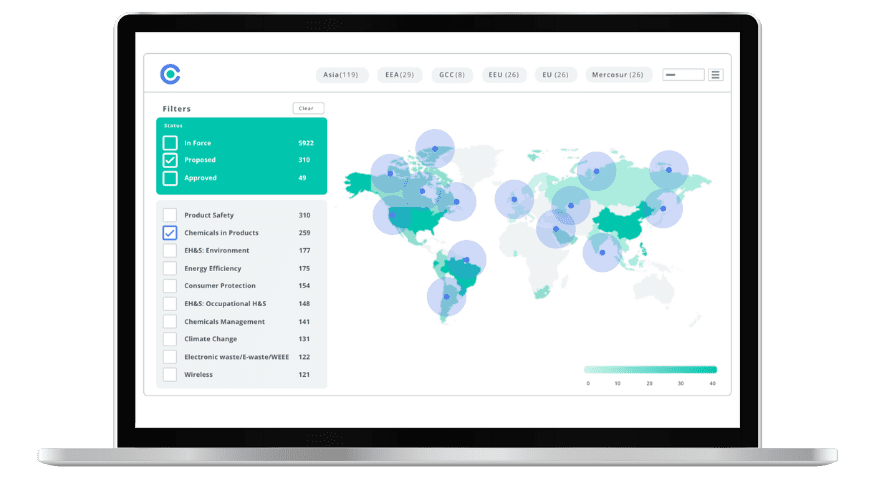
Want to stay ahead of regulatory developments in consumer electronics? Accelerate your ability to achieve, maintain & expand market access for all products in global markets with C2P – your key to unlocking market access, trusted by more than 300 of the world’s leading brands.
C2P is an enterprise SaaS platform providing everything you need in one place to achieve your business objectives by proving compliance in over 195 countries.
C2P is purpose-built to be tailored to your specific needs with comprehensive capabilities that enable enterprise-wide management of regulations, standards, requirements and evidence.
Add-on packages help accelerate market access through use-case-specific solutions, global regulatory content, a global team of subject matter experts and professional services.
Gain a strategic look at the regulatory and liability trends businesses should be monitoring in 2026, along with practical approaches to maintaining compliance and managing legal exposure in a rapidly evolving global environment.