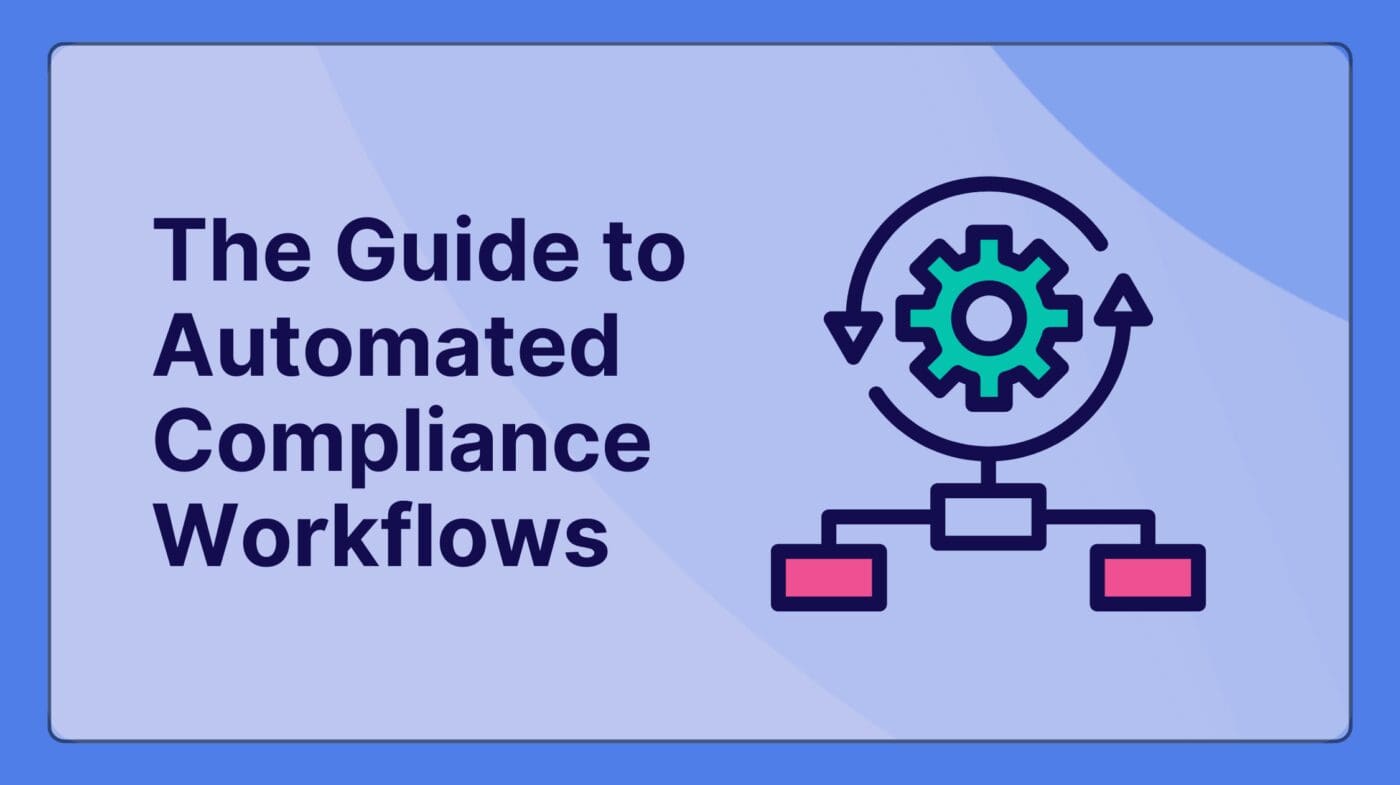
The Architect’s Guide to Automated Compliance Workflows: Moving Beyond Task-Based Fixes
THIS BLOG WAS WRITTEN BY THE COMPLIANCE & RISKS MARKETING TEAM TO INFORM AND ENGAGE. HOWEVER, COMPLEX REGULATORY QUESTIONS REQUIRE SPECIALIST KNOWLEDGE. TO GET ACCURATE, EXPERT ANSWERS, PLEASE CLICK “ASK AN EXPERT.”
You know that feeling in the pit of your stomach when the audit notification lands in your inbox? It’s a specific kind of dread. A frantic scramble through spreadsheets, email chains, and shared drives, trying to piece together a coherent story of who approved what, when, and why. It’s the manual, human-error-prone process that keeps compliance managers up at night.
And honestly, it should.
Because the cost of getting it wrong is staggering. Research shows that the financial fallout from non-compliance is roughly 2.7 to 3 times higher than the cost of proactively getting it right. For some sectors, like healthcare, a single data breach can spiral into a $7.42 million catastrophe. This isn’t just about avoiding fines; it’s about avoiding a massive, unnecessary liability that’s hiding in plain sight within your manual processes.
For years, we’ve tried to patch this with isolated tools, a bit of Robotic Process Automation (RPA) here, a Business Process Management (BPM) tool there. But these are point solutions for a systemic problem. They don’t talk to each other, they break when legacy systems change, and they fail to create the single, defensible source of truth that auditors demand.
This guide is different. We’re not going to give you another list of “12 best tools.” Instead, we’re going to give you the architectural blueprint – a unified strategy for designing and orchestrating automated compliance workflows that are not just efficient, but audit-proof. We’ll explore how to combine the strengths of RPA, BPM, and workflow orchestration to build a system that finally lets you breathe easy when that audit email arrives.
Key Takeaways
- The Financial Imperative: The cost of non-compliance is 2.7x to 3x higher than proactive investment. Manual processes are a significant financial liability.
- The Technology Trio: True automation requires three components working in concert:
- RPA (Robotic Process Automation): The “Doer” for repetitive, rule-based tasks.
- BPM (Business Process Management): The “Designer” for modeling end-to-end human and system processes.
- Orchestration: The “Conductor” that coordinates the entire workflow, manages handoffs, and connects disparate systems.
- The Architectural Blueprint: A successful strategy relies on a central orchestration layer that acts as the “brain,” directing RPA bots, integrating with legacy systems via APIs, and managing the flow of information.
- Audit-Readiness is Key: The ultimate goal is to create an immutable, time-stamped log of every action, decision, and approval – a “chain of responsibility” that satisfies auditors without manual effort.
Table of Contents
- The Automated Compliance Maturity Model: Where Do You Stand?
- RPA vs. BPM vs. Orchestration: Defining the Roles in Your Compliance Playbook
- The Unified Compliance Architecture Blueprint
- Solving the Compliance Handoff Nightmare: Approvals, Handoffs, and Audits
- The Hard Part: Integrating with Legacy Systems and Data Silos
- The Future is Now: Continuous Compliance and AI in GRC
- Frequently Asked Questions (FAQ)
- Your Next Step: From Blueprint to Build
The Automated Compliance Maturity Model: Where Do You Stand?
Before you can build the future, you need to be honest about the present. Most organizations fall into one of three stages of compliance automation maturity. Identifying where you are is the first step toward building a real strategy.
Level 1: Manual & Reactive (The Spreadsheet Empire)
This is the default for many companies. Compliance is managed through spreadsheets, email, and sheer human effort. Documentation is fragmented, processes are inconsistent, and audit prep is a fire drill. You’re entirely dependent on institutional knowledge, and if a key person leaves, the whole system crumbles. The risk here is enormous, but it’s often invisible until it’s too late.
Level 2: Task Automation (The Rise of the Bots)
Organizations here have started using RPA to automate specific, painful tasks. Think about a bot that scrapes data from an invoice and enters it into an ERP system or one that checks a supplier against a sanctions list. This is a huge step up. It reduces errors and saves time on repetitive work. But it’s still a piecemeal solution. The bots handle tasks, not entire processes. The handoffs between bots and humans are still manual, creating bottlenecks and breaking the audit trail. You’ve made a part of the process faster, but you haven’t fixed the whole system.
Level 3: Orchestrated & Continuous (The Conductor)
This is the goal state. Here, you have a central orchestration engine that manages the entire end-to-end compliance process. It assigns tasks to RPA bots, routes approvals to the right people, pulls data from various systems via APIs, and logs every single action in a centralized, immutable audit trail. It’s a system that doesn’t just react to compliance events but continuously monitors for them. This is what we call an orchestrated, continuous compliance model – and it’s where top-performing organizations are heading.
RPA vs. BPM vs. Orchestration: Defining the Roles in Your Compliance Playbook
The market is flooded with confusing acronyms. To build the right architecture, you have to understand the specific job of each component. It’s not about “RPA vs. BPM”; it’s about how they work together under a single conductor.
Think of it like a symphony orchestra.
| Component | The Metaphor | Primary Role | Best For… | Weakness When Used Alone |
|---|---|---|---|---|
| RPA (Robotic Process Automation) | The Musician (The “Doer”) | Executes specific, repetitive, rule-based tasks. It reads the sheet music perfectly every time. | Filling out forms, scraping data from websites, moving files, validating data against a checklist. | Can’t handle complex decisions, exceptions, or end-to-end processes. It just does its one job. |
| BPM (Business Process Management) | The Composer (The “Designer”) | Designs and models the entire musical piece. It maps out who plays what and when. | Visualizing complex, multi-step human workflows, defining business rules, and identifying process bottlenecks. | Great at design, but often lacks the muscle to connect to and control all the different systems (especially legacy ones). |
| Orchestration Engine | The Conductor | Leads the entire orchestra. It tells the musicians when to play, keeps tempo, and ensures all sections are in sync to create a cohesive performance. | Coordinating tasks across people, bots, and systems (like your ERP, CRM, and custom apps). It manages exceptions, handles API calls, and provides a single pane of glass for the whole process. | It’s the brain, not the hands. It needs RPA “doers” and a BPM “design” to be truly effective. |
The failure of most automation projects comes from asking one component to do another’s job. You can’t ask an RPA bot (a musician) to conduct the whole orchestra. And you can’t expect a BPM tool (the sheet music) to magically make all the instruments play in harmony. You need the conductor.
The Unified Compliance Architecture Blueprint
So what does this “orchestra” actually look like in a technical diagram? This is the blueprint that moves you from theory to practice. It’s a layered approach that creates a resilient, scalable, and audit-ready system.
Let’s break down the layers:
- The Foundation (Data & Systems Layer): This is your existing IT landscape. It’s a mix of modern applications with clean APIs (like Salesforce or your ERP) and, let’s be honest, cumbersome legacy systems that don’t talk to anything. This is reality.
- The Action Layer (RPA & Human Tasks): This is where the work gets done. RPA bots are deployed to handle the repetitive tasks, especially interacting with those legacy systems through screen scraping. This is also where human experts are brought in for judgment-based decisions and approvals.
- The Brain (The Orchestration Layer): This is the heart of the architecture. It’s a modern workflow engine that acts as the central coordinator.
- It initiates workflows based on triggers (e.g., a new vendor is added to the ERP).
- It assigns tasks to the appropriate resource – telling an RPA bot to run a background check or sending an approval request to a compliance manager.
- It connects systems using APIs, acting as a universal translator between your old and new technology.
- Most importantly, it logs everything. Every step, every decision, every data point is recorded in an immutable audit log.
This architecture is the key. It allows you to automate intelligently without having to rip and replace the legacy systems your business still depends on.
Solving the Compliance Handoff Nightmare: Approvals, Handoffs, and Audits
The single biggest failure point in any manual process is the handoff. It’s the email that gets missed, the approval that sits in someone’s inbox for weeks, the verbal sign-off that was never documented. This is where compliance breaks down and where auditors dig in.
An orchestrated workflow solves this by design.
Think about a standard “Know Your Customer” (KYC) process:
- Trigger: A new customer signs up in your CRM. The orchestration engine automatically initiates the KYC workflow.
- Data Collection (RPA): The orchestrator assigns an RPA bot to collect basic information, check public records, and screen against international sanctions lists. The bot deposits its findings into a central case file.
- Risk Scoring (AI/Rules Engine): The orchestrator feeds this data into a rules engine or an AI model to assign a risk score.
- Conditional Approval (Human-in-the-Loop):
- Low-Risk: The orchestrator automatically approves the customer and updates the CRM. No human touch needed.
- Medium-Risk: The case is automatically routed to a junior compliance analyst for review. They have all the data pre-packaged for them. They approve or deny within the system.
- High-Risk: The case is automatically escalated to a senior compliance manager, along with the analyst’s notes.
- Audit Trail: Every single step – from the bot’s data scrape to the manager’s final click – is time-stamped, user-stamped, and logged. When an auditor asks, “Show me the approval process for this high-risk client,” you don’t have to hunt for emails. You simply pull up the log. This is your defensible proof.
This automated chain of responsibility is what auditors dream of seeing. It’s clear, consistent, and undeniable. And it’s a direct result of moving from simple task automation to full-process orchestration. In fact, automation can make remediating audit findings 60% less expensive than in manual environments, simply because the evidence is already organized and available.
The Hard Part: Integrating with Legacy Systems and Data Silos
Let’s address the elephant in the room: your ancient, creaking, but absolutely critical legacy systems. This is the “architectural anxiety” that stalls so many projects. The business can’t function without them, but they don’t have APIs. How do you automate that?
This is where the layered architecture shows its true power. You don’t try to force the old system to be new. You wrap it with intelligent automation.
- RPA for the “Last Mile”: For systems with no APIs, RPA bots can act as a “virtual user.” They can log in, navigate screens, copy-paste data, and extract information just like a person would. This is often called “screen scraping.” It can be brittle, but it’s a pragmatic way to connect the unconnected.
- The Orchestration Layer as the API Bridge: The orchestration engine becomes the modern interface for your old systems. Other applications don’t need to know how to talk to your mainframe; they just need to talk to the orchestrator via a simple, modern API. The orchestrator then translates that request and tells the RPA bot what to do on the legacy system.
This approach de-couples your systems. If you eventually replace that old mainframe, you don’t have to rebuild all your workflows. You just update the connection in the orchestration layer, and the rest of the process remains the same. You’ve contained the technical debt instead of letting it spread.
The Future is Now: Continuous Compliance and AI in GRC
The world of GRC (Governance, Risk, and Compliance) is shifting from a periodic, “check-the-box” activity to a model of continuous compliance. Regulators and boards no longer accept a once-a-year audit as sufficient. They want to know that you are compliant right now.
This is only possible through orchestration. A well-architected system can continuously monitor for compliance-related events. For example:
- IT Compliance: A workflow can constantly scan your cloud infrastructure to ensure it complies with PCI DSS or SOC 2 controls, automatically remediating misconfigurations.
- ESG & Sustainability: As part of your corporate sustainability program, a workflow can monitor supplier data for new environmental regulations, automatically triggering a reassessment process.
- Regulatory Change: By connecting to regulatory compliance solutions like our C2P platform, the orchestrator can ingest new regulatory alerts and automatically trigger impact assessments and task assignments to the relevant product teams.
And AI is accelerating this. PwC found that 65% of organizations see automation as the most effective way to manage the growing complexity of compliance. We’re moving toward “Agentic Orchestration,” where AI agents don’t just score risk but can dynamically adjust workflows based on real-time events, making intelligent decisions that were once the exclusive domain of human experts.
Frequently Asked Questions (FAQ)
- Q: Isn’t this overly complex? We’re not a huge enterprise.
You don’t need to orchestrate the entire company on day one. Pick one high-risk, high-pain process – like vendor onboarding or evidence collection for SOX controls. Build the blueprint for that single process. The principles of orchestration scale down. The key is to think architecturally from the start, even if you begin with just one workflow. - Q: We’ve tried RPA and it failed. Why would this be different?
Many early RPA projects failed because they were treated as IT projects, not business process transformations. They automated a broken task, which just made the wrong thing happen faster. And they were brittle, breaking with any system update. The orchestrated approach is different because it starts with designing the right end-to-end process (the BPM part) and builds a resilient system around it where the orchestration engine manages the bots, handles errors, and provides a buffer against system changes. - Q: What’s the real ROI here? How do I sell this to my CFO?
The ROI conversation has three parts: (1) Cost Avoidance: This is the easiest to calculate. Use the 2.7x non-compliance cost multiplier as your benchmark. Frame it as insurance against multi-million dollar fines and remediation costs. (2) Operational Efficiency: Calculate the hours your team spends manually chasing approvals, compiling reports for audits, and fixing errors. Automating this frees them up for high-value strategic work. (3) Business Agility: In a world of ever-changing regulations, the speed at which you can adapt your processes to remain compliant is a competitive advantage. An orchestrated system allows you to modify a workflow in days, not months. - Q: Which tools should I use?
The tool comes last. The architecture comes first. Once you have your blueprint, you can evaluate platforms based on how well they fit that vision. You’ll need to consider categories like Enterprise BPM (Pega, Camunda), Data Orchestration (Airflow), and GRC-specific platforms that often come with pre-built regulatory content and workflows, like our own knowledge management platform, C2P. The key is to choose a platform that can truly act as a central “conductor,” not just another siloed tool.
Your Next Step: From Blueprint to Build
You no longer have to accept the frantic, last-minute chaos of compliance. The technology and the architectural patterns now exist to build a calm, controlled, and continuously compliant organization.
It starts not with a tool, but with a decision: to stop patching the problem and start designing the solution. Take the blueprint we’ve outlined here. Map one of your most painful compliance processes against it. Identify the tasks a bot can do, the decisions a human must make, and the handoffs that an orchestrator can manage.
This is the path to transforming compliance from a cost center into a strategic asset – a source of confidence that lets you move faster, manage risk more intelligently, and finally get a good night’s sleep.
Experience the Future of ESG Compliance
The Compliance & Risks Sustainability Platform is available now with a 30-day free trial. Experience firsthand how AI-driven, human-verified intelligence transforms regulatory complexity into strategic clarity.
👉 Start your free trial today and see how your team can lead the future of ESG compliance.
The future of compliance is predictive, verifiable, and strategic. The only question is: Will you be leading it, or catching up to it?
Six Months of Research, Done in 60 Seconds
Cut through ESG chaos and act with clarity. Try C&R Sustainability Free.