What Is Regulatory Intelligence? (And Why Compliance Teams Can’t Work Without It)
THIS BLOG WAS WRITTEN BY THE COMPLIANCE & RISKS MARKETING TEAM TO INFORM AND ENGAGE. HOWEVER, COMPLEX REGULATORY QUESTIONS REQUIRE SPECIALIST KNOWLEDGE. TO GET ACCURATE, EXPERT ANSWERS, PLEASE CLICK “ASK AN EXPERT.”
Regulatory intelligence is the systematic process of collecting, analyzing, and acting on regulatory information to ensure that an organization understands its compliance obligations, anticipates upcoming changes, and can respond before risk materializes. It is not a report. It is not a newsletter. It is an operational function, and for global product companies operating across dozens of markets and regulatory jurisdictions, it is the difference between staying ahead of compliance obligations and scrambling to catch up.
Quick Answer
Regulatory intelligence (RI) refers to the structured capability of monitoring laws, standards, and regulatory developments that affect an organization, analyzing their potential impact, and translating that analysis into action. Unlike general compliance monitoring, regulatory intelligence is forward-looking: it is designed to surface what is changing, what is coming, and what it means for your business before a deadline forces your hand.
Table of Contents
- What Does Regulatory Intelligence Actually Include?
- How Does Regulatory Intelligence Differ From Compliance Management?
- Why Regulatory Intelligence Is Harder Than It Looks
- What a Mature Regulatory Intelligence Capability Looks Like
- The Cost of Getting It Wrong
- How Regulatory Intelligence Connects to Broader Compliance Strategy
- What to Look for in a Regulatory Intelligence Platform
- Frequently Asked Questions
What Does Regulatory Intelligence Actually Include?
The term gets used loosely, so it is worth being specific. True regulatory intelligence encompasses four interconnected activities:
- Regulatory monitoring is the continuous scanning of regulatory sources, including government bodies, standards organizations, trade associations, and legislative databases, to detect new and amended requirements as they emerge. For a global manufacturer, this means tracking proposed and enacted regulations across every market where products are sold or components are sourced. At scale, that can mean thousands of regulatory events per year across dozens of jurisdictions.
- Impact analysis is where monitoring becomes intelligence. Once a regulatory change is identified, the next question is: does this affect our products, our markets, our materials, or our operations? This step requires matching regulatory scope to product portfolios, identifying which business units are affected, and estimating the time and resources required to respond. Without this step, monitoring is just noise.
- Requirements translation converts regulatory obligations into specific, actionable requirements that engineers, product teams, and quality managers can actually use. A regulation may run to hundreds of pages. The compliance intelligence function extracts the obligations that matter, defines what evidence of compliance looks like, and communicates that clearly to the people responsible for implementation.
- Audit readiness closes the loop. Regulatory intelligence is not complete until the organization can demonstrate compliance, not just claim it. That means maintaining organized evidence, tracking compliance status by product and market, and being able to produce documentation quickly when regulators, customers, or auditors ask for it.
Most compliance teams handle one or two of these activities reasonably well. The ones that handle all four, systematically, across global markets, with visibility at the leadership level, are the ones that avoid the costly surprises.
How Does Regulatory Intelligence Differ From Compliance Management?
This distinction matters, and it gets blurred more often than it should.
- Compliance management is the operational execution of known requirements. It is the process of documenting obligations, assigning ownership, tracking progress, managing evidence, and demonstrating that your organization is meeting its current regulatory commitments. It is essential work. But it is inherently backward-looking: it manages what is already known.
- Regulatory intelligence is the function that feeds compliance management. It identifies what obligations exist or are emerging, assesses their relevance and urgency, and translates them into the inputs that compliance management systems then act on. Without regulatory intelligence, compliance management operates on an incomplete picture. Teams work hard to comply with last year’s requirements while new obligations are taking shape in regulatory dockets they are not watching.
The practical consequence of confusing the two: organizations that invest exclusively in compliance management tooling find themselves perpetually reactive. They learn about regulatory changes from customers, from industry alerts, or, worst of all, from enforcement actions. Regulatory intelligence shifts the operational posture from response to anticipation.
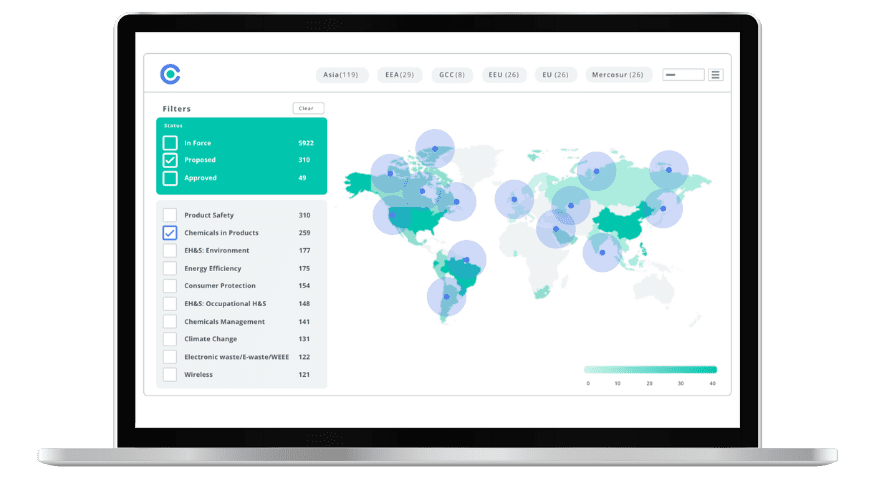
For global product companies, this is not a theoretical distinction. The C2P platform from Compliance & Risks was built specifically to bridge these two functions, connecting regulatory monitoring and impact analysis directly to requirements management and evidence workflows.
Why Regulatory Intelligence Is Harder Than It Looks
Here is the honest version: most compliance teams underestimate how difficult it is to do regulatory intelligence well at scale.
- The volume problem is real. Regulatory activity across 195 countries, the full scope for a global consumer electronics or medical device manufacturer, runs into tens of thousands of documents per year. No manual process can cover that scope reliably. Teams that try end up relying on subscriptions to a handful of sources, personal networks, and periodic manual reviews. Coverage gaps are inevitable.
- The relevance problem compounds the volume problem. Even when a team catches a regulatory change, determining whether it applies to specific products in specific markets requires deep domain knowledge. A new chemical restriction under EU REACH affects some product categories and not others. A revised IEC safety standard may apply to one product line but not a similar one sold under a different classification. Getting this wrong in either direction is costly: missing a real obligation creates compliance risk; over-engineering a response to something that does not apply wastes engineering resources.
- The translation problem is underappreciated. Even when a compliance team correctly identifies a relevant regulatory change and assesses its impact, communicating that to product engineers in a way they can act on is a distinct skill set. Regulatory language is not product engineering language. The gap between a regulatory obligation and a product specification requirement is where a lot of well-intentioned compliance programs fall apart.
This is why access to 40+ in-house subject matter experts, available through the C2P platform, represents real operational value. Not as a nice-to-have, but as the mechanism for bridging the translation gap at speed.
What a Mature Regulatory Intelligence Capability Looks Like
Compliance teams that have built a mature regulatory intelligence function share a few characteristics.
- They have defined coverage. They know exactly which regulatory bodies, standards organizations, and market authorities they are monitoring, and they have documented the scope of that coverage. They know what is in scope and, importantly, what is not.
- They have structured workflows from detection to action. When a new regulation enters the monitoring system, there is a defined process: who assesses impact, how they do it, what the output looks like, who receives it, and what the follow-on actions are.
- They connect regulatory requirements directly to product portfolios. The most mature teams can answer, at any given time, which products are subject to which regulations, in which markets, and what the compliance status is for each.
- They maintain audit-ready evidence. Demonstrating compliance is not a once-a-year exercise before a certification audit. It is an ongoing function. Evidence is captured, organized, and accessible.
The Cost of Getting It Wrong
Regulatory compliance failures are expensive in direct and indirect ways.
The direct costs are well documented: product recalls, market withdrawals, regulatory fines, and the engineering costs of emergency remediation. The indirect costs are harder to quantify but often larger: delayed market entry while competitors move faster, engineering rework that consumes product development capacity, and reputational damage with customers and partners who depend on your compliance status for their own programs.
For medical device manufacturers, a failure to track regulatory change in a key market can mean loss of market authorization. For consumer electronics companies, a missed chemical restriction under RoHS or REACH can trigger a product recall and a supply chain redesign. For automotive manufacturers, failure to track evolving vehicle safety standards across multiple markets creates both safety risk and significant financial exposure.
The common thread in most of these failures is not malicious intent or poor execution on known obligations. It is a gap in regulatory intelligence: a change that was not tracked, an impact that was not assessed, or a requirement that was not communicated to the team that needed to act on it.
How Regulatory Intelligence Connects to Broader Compliance Strategy
Regulatory intelligence does not exist in isolation. It is the upstream input to regulatory change management, product compliance programs, and enterprise risk management.
A robust regulatory change management process depends on a reliable intelligence feed. If the monitoring function misses a change or surfaces it too late, the downstream change management process cannot compensate. The quality of the intelligence determines the quality of everything that follows.
Product compliance, specifically, is where regulatory intelligence delivers its most direct business value for manufacturers. The ability to design products that meet regulatory requirements across all target markets, to identify market access barriers early in the product development cycle, and to respond quickly to regulatory changes without expensive late-stage redesigns, is entirely dependent on having current, accurate, and well-analyzed regulatory intelligence.
What to Look for in a Regulatory Intelligence Platform
Not all regulatory intelligence solutions are built for the same use case. Financial services firms need regulatory intelligence focused on banking regulations, securities law, and reporting requirements. Global product manufacturers need something different: coverage of product safety standards, chemical restrictions, market authorization requirements, and sector-specific technical regulations across every market where products are sold.
When evaluating a regulatory intelligence platform for a product compliance use case, the key questions are:
- Coverage depth: How many regulatory sources does the platform actually track, and across how many jurisdictions? Coverage of 110,000+ regulatory source documents across 195 countries reflects a different commitment level than a platform aggregating a few hundred headline sources.
- Relevance filtering: Can the platform filter regulatory content to what is actually relevant to your specific products, materials, and markets?
- Expert access: Is there a mechanism to get fast human expert analysis on complex or unfamiliar regulations?
- Integration with execution: Does the platform connect regulatory intelligence to the workflows where action happens, including requirements management, engineering change management, and evidence capture?
Frequently Asked Questions (FAQ)
- What is regulatory intelligence in simple terms?
Regulatory intelligence is the organizational capability to track laws, standards, and regulatory requirements that affect your business, understand their impact, and act on them in time. For product companies, it means knowing what regulations apply to your products in each market, when requirements are changing, and what you need to do to maintain compliance. - Who is responsible for regulatory intelligence in an organization?
Responsibility typically sits with compliance, regulatory affairs, or legal teams. In product companies, regulatory intelligence functions are often embedded within product compliance or regulatory affairs departments. For it to be effective, the outputs need to reach product engineers, supply chain managers, and business unit leaders who are responsible for acting on compliance requirements. - How is regulatory intelligence different from regulatory compliance?
Regulatory compliance is the state of meeting known obligations. Regulatory intelligence is the capability that tells you what those obligations are, which ones are changing, and what they will require of your organization. Compliance is the destination; regulatory intelligence is the navigation system. - Can regulatory intelligence be automated?
Significant parts of the monitoring and initial triage functions can be supported by technology, including AI-powered analysis that flags relevant regulatory changes and assesses their potential scope. The impact analysis and requirements translation steps still benefit substantially from human expert judgment, particularly for complex or technically specialized regulations. - What industries need regulatory intelligence the most?
Any industry subject to evolving regulatory requirements across multiple markets benefits from structured regulatory intelligence. In practice, the highest-complexity use cases involve global manufacturers in sectors like medical devices, consumer electronics, automotive, chemicals and materials, industrial machinery, and aerospace and defense, where products must meet technical safety standards, chemical restrictions, market authorization requirements, and sector-specific regulations across dozens of jurisdictions simultaneously.
Simplify Corporate Sustainability Compliance
Six months of research, done in 60 seconds. Cut through ESG chaos and act with clarity. Try C&R Sustainability Free.