The U.S. Battery Stewardship Surge: What’s Driving It, Why Now, and What States Keep Copying

This blog was originally posted on 9th March 2026. Further regulatory developments may have occurred after publication. To keep up-to-date with the latest compliance news, sign up to our newsletter.
AUTHORED BY ANDREW O’NEILL, REGULATORY COMPLIANCE SPECIALIST, COMPLIANCE & RISKS
Introduction: A Shift in Perspective
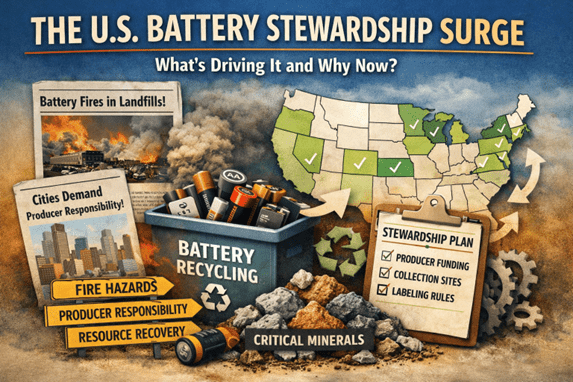
Over the last few months, U.S. policymakers have been converging on a blunt reality: batteries are no longer a niche waste stream. They’re everywhere (phones, toys, tools, vapes, e-bikes), they’re increasingly lithium-based, and when they’re mishandled they create a uniquely expensive problem – fires in trucks, MRFs, transfer stations, and landfills paired with a growing opportunity: recovering critical minerals and metals back into the supply chain. Colorado’s legislative findings spell this out in plain language: fire risk, toxic releases, and the value of materials recovery are central justifications for shifting end-of-life costs away from local governments and onto producers.
That’s the backdrop to a noticeable policy acceleration: more states proposing or passing “battery stewardship” frameworks that look and feel like extended producer responsibility (EPR), but tailored to the operational and safety realities of battery collection.
What Made This Happen: Why Are States Moving Together?
Fire Incidents Became the Political Accelerant
- Lithium-ion batteries are now a routine ignition source in the waste system. Once states and municipalities start paying for truck fires, facility shutdowns, insurance spikes, and worker safety incidents, the argument that “batteries don’t belong in curbside” turns into legislation. Colorado explicitly anchors its program rationale in the “inherent risk of fires” from improper disposal.
Local Governments Pushed Back on Unfunded Collection Costs
- A recurring theme is that House Hold Waste programs, special collection events, and ad hoc acceptance by retailers are “limited, inconvenient, and costly” and that municipalities are stuck holding the bill. Colorado again is direct here: battery collection events and facilities are costly for local governments to operate.
States are Borrowing a Ready-made Policy Template
- Washington and D.C. have already implemented detailed stewardship structures (definitions, plan approvals, fees, labeling, collection site rules). Washington’s battery stewardship rule is effectively a “how-to manual” for running the program mechanics (fees, marking, collection standards).
- D.C.’s final rulemaking similarly operationalizes producer membership in a battery stewardship organization (BSO) and stewardship plan requirements.
“Circular Economy” and Critical Materials Narratives Help Sell the Program
- Legislative findings increasingly pair the safety problem with resource recovery: batteries are both hazardous in the waste stream and valuable as a recoverable materials stream. Pennsylvania’s draft emphasizes recovering and reusing materials and reducing extraction impacts, and it frames consumer confusion as a key failure of the status quo.
The Scope Problem (Battery-Containing Products) Forced Expansion
- A major trend is explicitly pulling battery-containing products into scope because that’s where many embedded/easily-removable batteries sit in real life. D.C.’s rule and multiple state drafts define and regulate battery-containing products alongside standalone batteries.
- Vermont’s Act 152 is explicitly about expanding and modernizing scope to include rechargeable batteries and battery-containing products.
Why it’s Happening Now: Why the Last Few Months Feel Different
The pace shift is partly legislative timing (session calendars), but the bigger reason is policy maturation: once a few jurisdictions prove the model works, more states reuse the structure rather than inventing it. Colorado’s SB 25-163 became law in 2025, and it’s being treated as a “new flagship” alongside earlier movers like Washington and Vermont. Vermont’s expansion (Act 152 of 2024) is also feeding momentum by showing that states are willing to broaden beyond older, narrower “primary battery” concepts.
Battery stewardship is not only increasing in the U.S., but across the globe. Check out our whitepaper ‘A New Era for Batteries Within the EU: Batteries and Waste Batteries Regulation 2023/1542‘.
The Similarities Across States: The Emerging U.S. “Battery Stewardship Blueprint”
Even when states disagree on details, the core architecture is converging fast:
A Producer-Responsibility Trigger (Membership + Plan)
Most models require producers of covered batteries (and often battery-containing products) to participate in a stewardship organization and operate under an approved stewardship plan.
- D.C.: Producers must be members of a battery stewardship organization (BSO) and implement a battery collection program under a stewardship plan.
- Colorado: Establishes battery stewardship organizations and requires an “approved plan” structure for program operation.
- Washington: Codifies plan administration/oversight and BSO processes.
- Pennsylvania draft: Creates “Battery Stewardship Plans” as the compliance backbone.
Why this matters: it standardizes compliance around a singular concept rather than thousands of separate brand-by-brand take-back schemes.
A Shared Scope Logic: Portable + Medium Battery
States are coalescing around two main covered categories:
- Small consumer batteries
- Medium-format batteries (e-bike, scooter, some tool packs
A definition for portable vs medium-format with the now-familiar weight and Wh thresholds (≤11 lbs/≤300 Wh for portable rechargeable; medium-format up to 25 lbs and ≤2,000 Wh). Washington uses the same conceptual thresholds and also delays medium-format inclusion until 2029. Pennsylvania’s draft mirrors this approach (portable now, medium-format later).
Exclusions
The exclusion list is remarkably consistent across jurisdictions:
- Medical devices (non-consumer-focused)
- Batteries with free liquid electrolyte
- Certain lead-acid batteries
- Batteries not designed to be easily removable from products
- Motor-vehicle batteries
You can see these exclusions repeated in Colorado, Washington, Pennsylvania and Kentucky drafts.
Convenience + “Free to the Consumer” Collection as the Political Bargain
The common promise is: collection must be regular, convenient, and accessible, typically at no direct cost to consumers (and often with retailer/site participation). D.C.’s rulemaking uses exactly that accessibility framing for the collection.
Performance Management: Collection Rates, Reporting, and Plan Oversight
These programs are built to be measured:
- Collection rate definitions (usually weight-based; often using a multi-year sales baseline)
- Annual reporting requirements
- Plan approvals and amendments
- Administrative fee
Colorado’s statute defines collection rate and sets up the program as a state-approved oversight.
Washington’s rule goes deep on department oversight fees, marking, and program administration.
Pennsylvania’s draft includes stewardship plan requirements and penalties (a typical enforcement hook).
Oklahoma’s draft similarly builds a plan-review, fee, annual reporting, and enforcement structure.
Labeling/Marking Provisions are Becoming Prescriptive
Washington explicitly includes marking requirements: producer identification, battery capacity and an indication not to discard in household garbage.
Why this matters: it’s one of the requirements in what is otherwise a program/finance regime and it’s an easy harmonization target across states.
Stewardship Organizations as the Compliance “Choke Point”
States increasingly treat the BSO as the entity that is:
- Liable for the product disposal
- Runs the program,
- Maintains a public-facing website/listing, documents and keeps files
Vermont’s annual registration form is a simple but telling artifact: it operationalizes the idea that the stewardship organization is the accountable program actor (and must list participating producers and demonstrate qualification criteria).
The Strategic Takeaway for Manufacturers and Importers
For regulated companies, the real story isn’t “50 different battery laws.” It’s that states are steadily converging on a modular EPR playbook:
- Determine whether you are the “producer” (brand owner/manufacturer/importer-of-record logic repeats everywhere).
- Join a BSO (or establish one, though this is rare in practice). Fund the program through the BSO, comply with stewardship plan obligations, reporting requirements, and marking provisions, and carefully manage product scope and exclusions particularly in relation to battery-containing products and “easily removable” design criteria.
Conclusion: A Unilateral Approach is Forming
The recent surge in U.S. battery stewardship legislation is not fragmented experimentation. It is coordinated evolution.
States are responding to a shared problem: lithium battery fires in the waste stream and the rising cost of unmanaged collection systems. They are deploying a shared solution: producer-funded stewardship organizations operating under state-approved plans.
While the United States lacks a unified federal framework, the structural convergence among states suggests that battery stewardship is becoming a durable feature of the U.S. regulatory landscape.
For producers, the question is no longer whether stewardship will expand but how quickly additional states will adopt the model, and how efficiently companies can build scalable compliance systems to meet it.
Stay Ahead Of Regulatory Changes in Batteries
Want to stay ahead of regulatory developments in batteries in the United States?
Accelerate your ability to achieve, maintain & expand market access for all products in global markets with C2P – your key to unlocking market access, trusted by more than 300 of the world’s leading brands.
C2P is an enterprise SaaS platform providing everything you need in one place to achieve your business objectives by proving compliance in over 195 countries.
C2P is purpose-built to be tailored to your specific needs with comprehensive capabilities that enable enterprise-wide management of regulations, standards, requirements and evidence.
Add-on packages help accelerate market access through use-case-specific solutions, global regulatory content, a global team of subject matter experts and professional services.
- Accelerate time-to-market for products
- Reduce non-compliance risks that impact your ability to meet business goals and cause reputational damage
- Enable business continuity by digitizing your compliance process and building corporate memory
- Improve efficiency and enable your team to focus on business critical initiatives rather than manual tasks
- Save time with access to Compliance & Risks’ extensive Knowledge Partner network

Simplify Corporate Sustainability Compliance
Six months of research, done in 60 seconds. Cut through ESG chaos and act with clarity. Try C&R Sustainability Free.