Textile Labelling in EAEU: Transition to the “Smart Label” Model
This blog was originally posted on 2nd April, 2026. Further regulatory developments may have occurred after publication. To keep up-to-date with the latest compliance news, sign up to our newsletter.
AUTHORED BY ANNA SHIPUNOVA, REGULATORY COMPLIANCE SPECIALIST, COMPLIANCE & RISKS
Key Insight
As of January 2026, the textile industry in the EAEU has transitioned to a mandatory “Total Traceability” model requiring synchronized physical and digital labelling. All garments must feature a unique DataMatrix code that ensures technical compatibility and mutual recognition across all five member states.
Table of Contents
- Transition to the “Smart Label” Model
- Regulatory Architecture of EAEU Labelling (2026)
- Primary Regulation: TR CU 017/2011
- EEC Decision No. 127: Unified Labelling Standards
- Mandatory Digital Labelling and Traceability
- National Operators and Regional Systems
- Mechanism for Mutual Recognition of Codes
- Integrating DataMatrix into Label Design
- Data Structure: What the Law Requires on Every Tag
- Specifics for Imports from Outside the EAEU
- Frequently Asked Questions
Transition to the “Smart Label” Model
The textile landscape across the Eurasian Economic Union (EAEU), comprising Russia, Belarus, Kazakhstan, Armenia, and Kyrgyzstan, is currently navigating its most significant regulatory transformation in decades. As of January 2026, the industry has moved beyond simple product identification into a sophisticated era of Total Traceability.
Driven by the mandatory expansion of the DataMatrix system and the rigorous enforcement of TR CU 017/2011, compliance is now the primary barrier to entry for the world’s most resilient consumer markets.
Regulatory Architecture of EAEU Labelling (2026)
While supranational legislation (EEC Decisions) establishes the general framework, the specific timelines and technical platforms for implementing labelling may vary slightly from one country to another. Here are the specific laws and acts that shape the “January 2026 regulatory environment” for the entire Union.
Primary Regulation: Technical Regulation on Safety of Textiles and Other Light Industry Products (TR CU 017/2011)
Technical Regulation on Safety of Textiles and Other Light Industry Products introduced by the Decision No. 876, 2011 (TR CU 017/2011) serves as the mandatory safety and labeling framework for all light industry products sold within the Eurasian Economic Union (EAEU).
- Key change: Total synchronization between the “physical” label (tag) and the “digital” label (DataMatrix code).
- Digital Labeling: The possibility of moving part of the information to a QR code or DataMatrix has been legalized, provided that the basic information (fiber content, EAC mark) remains on the physical carrier.
Decision of the Council of the Eurasian Economic Commission (EEC) No. 127, 2019 on Labelling of Light Industry Goods with Means of Identification
This is the “fundamental” law for the entire Union regarding the introduction of labeling for light industry goods.
- This specific Decision, as amended by the decisions No. 28 and No. 85, established a unified list of goods (ranging from shirts to coats) and a unified DataMatrix code standard for all five member states.
- The Result: A code issued in one member state must be seamlessly readable in others. 2026 marks the deadline by which most member states complete the transition to mandatory labelling for all major textile categories.
Digital Labelling
As of 2026, the most critical is Mandatory Digital Marking. This is no longer a pilot program; it is a hard requirement for nearly all textile categories entering the EAEU market.
How it Works
- Traceability: This code tracks the item from the factory to the retail cash register.
- Anti-Counterfeit: Consumers can scan the code with a smartphone app to see the fiber content, manufacturer details, and legal status.
- 2026 Update: Penalties for missing or “dead” codes have significantly increased. Starting in 2026, remote audits allow tax authorities to fine businesses instantly if the digital trail is broken.
National Operators of EAEU Countries
Each country within the Union has its own official labelling system administrator. Each member state operates its own systems:
| Country | Labeling System Name |
| Russian Federation | “Chestny ZNAK” |
| Kazakhstan | “Naqty Sauda” |
| Belarus | “Elektronny Znak” |
| Kyrgyzstan | “Teksher” |
| Armenia | “Electronic Signature and Data Exchange” |
All these systems operate using a unified DataMatrix code standard established by EEC Council Decision No. 127.
Mechanism for Mutual Recognition of Codes
According to EEC Board Decision No. 19, full technical compatibility has been achieved by 2026.
- How it works: If, for example, a manufacturer in Kyrgyzstan applies a local labeling code to a batch of t-shirts, this code is recognized in Russia.
- Single Window: Data between national systems is transmitted via secure communication channels. When crossing a border within the EAEU, information regarding the change of goods ownership is updated automatically in both systems.
Integrating DataMatrix into Label Design
As of 2026, the DataMatrix code is an inseparable part of labeling in the EAEU.
- Placement: The code must be applied to the product tag or label so it can be scanned without opening the packaging.
- Accuracy: If the information in the digital system (backend) contradicts the information on the physical label, the batch is considered “unlabeled” and subject to seizure.
- Sanctions: Missing, damaged, or unreadable DataMatrix codes on the label lead to administrative fines and the immediate removal of the goods from circulation.
Data Structure: What the Law Requires on Every Tag
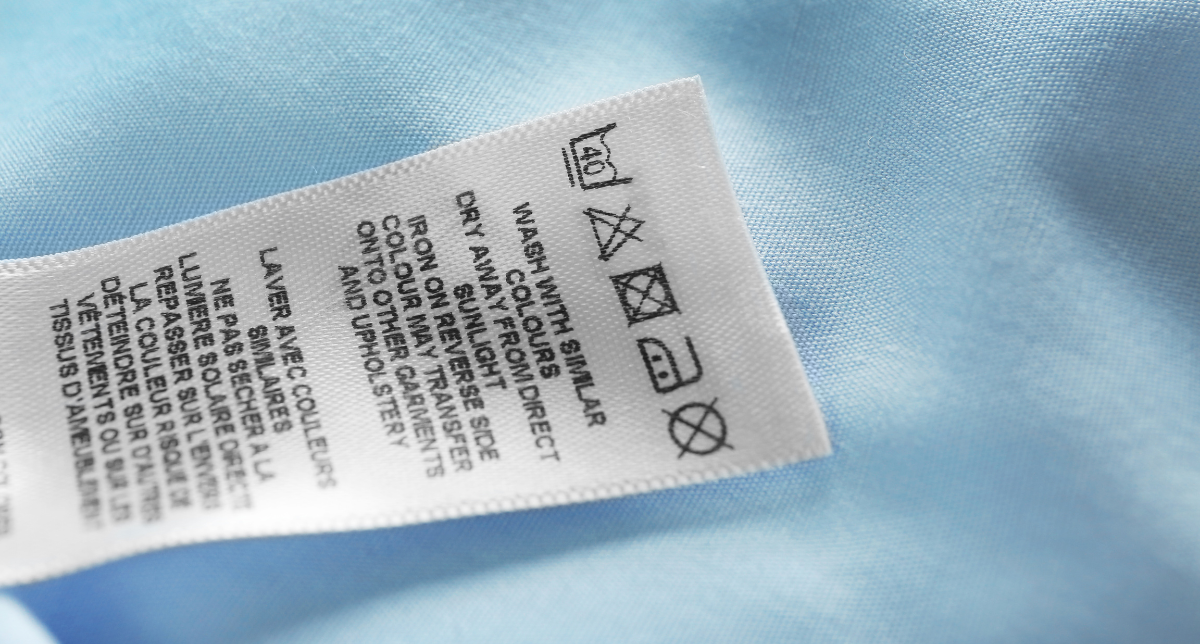
According to Article 9 of TR CU 017/2011, any textile unit sold within the EAEU must be labeled and display the following “core” data on its label:
- Product & Origin: Product name, country of manufacture, and the full legal address of the manufacturer (or importer/authorized representative).
- Identification: Size of the garment/item and the manufacturing date.
- Legal Compliance: The EAC mark (Unified Mark of Circulation) and any necessary warranty obligations or batch numbers.
- Branding: Raw material composition and the trademark (if applicable).
Category-Specific Requirements
Depending on the type of product, the law mandates additional information:
| Product Category | Additional Requirements |
| Clothing & Textiles | Model, care symbols, and specific fiber breakdown for both shell and lining. |
| Footwear | Model/Article number, material types for the upper, lining, and sole, and care instructions. |
| Knitwear/Carpets | Colorfastness (for fabrics), weight at standard moisture, finish type, and care symbols. |
| Fur Products | Type of fur, treatment method (dyed vs. undyed), and care instructions. |
| Leather Goods | Upper material name, model, and exploitation instructions. |
| Leather & Pelts | Grade (sort), thickness, and total area or mass. |
Specifics for Imports from Outside the EAEU
If goods are imported from countries outside the EAEU (e.g., China, Turkey, or Uzbekistan), labeling must be applied before crossing the Union border or at a customs warehouse.
In this case, the importer orders codes in the system of the country where the goods will first be released into free circulation (for example, in Russia’s “Chestny ZNAK” or Kazakhstan’s “Naqty Sauda”).
Frequently Asked Questions
- Do I need to re-label goods from Belarus for sale in Russia?
No. If the goods are labelled with Belarusian codes in the “Elektronny Znak” system, they are automatically recognized in Russia through the “Chestny ZNAK” system. - Can Russian “Chestny ZNAK” codes be used in Kazakhstan?
Yes, provided that the transfer of rights to the goods has been registered between the parties in their respective national systems. The codes can be read by scanners in both countries. - Is there a single “Union-wide” labelling code?
Technically, the DataMatrix standard is unified for all five countries. Although the code issuers are different (national operators), the data structure allows the code to be “understood” by the regulatory authorities of any EAEU country. - Who oversees the operation of these systems across the entire Union?
General coordination and the legal framework are provided by the Eurasian Economic Commission (EEC), which issues decisions that are mandatory for all member states (e.g., No. 127 and No. 19). - What happens if the digital code information contradicts the physical label?
If the backend information contradicts the physical label, the batch is considered “unlabeled.” This makes the goods subject to seizure and may lead to administrative fines.
Stay Ahead Of Regulatory Changes in Textile Labelling in EAEU
Want to stay ahead of regulatory developments in Textile Labelling in EAEU?
Accelerate your ability to achieve, maintain & expand market access for all products in global markets with C2P, your key to unlocking market access, trusted by more than 300 of the world’s leading brands. C2P is an enterprise SaaS platform providing everything you need in one place to achieve your business objectives by proving compliance in over 195 countries.
C2P is purpose-built to be tailored to your specific needs with comprehensive capabilities that enable enterprise-wide management of regulations, standards, requirements and evidence.
Add-on packages help accelerate market access through use-case-specific solutions, global regulatory content, a global team of subject matter experts and professional services.
- Accelerate time-to-market for products
- Reduce non-compliance risks that impact your ability to meet business goals and cause reputational damage
- Enable business continuity by digitizing your compliance process and building corporate memory
- Improve efficiency and enable your team to focus on business critical initiatives rather than manual tasks
- Save time with access to Compliance & Risks’ extensive Knowledge Partner network
Simplify Corporate Sustainability Compliance
Six months of research, done in 60 seconds. Cut through ESG chaos and act with clarity. Try C&R Sustainability Free.