ESG Reporting Tools: What Teams Are Using to Manage Sustainability Compliance
THIS BLOG WAS WRITTEN BY THE COMPLIANCE & RISKS MARKETING TEAM TO INFORM AND ENGAGE. HOWEVER, COMPLEX REGULATORY QUESTIONS REQUIRE SPECIALIST KNOWLEDGE. TO GET ACCURATE, EXPERT ANSWERS, PLEASE CLICK “ASK AN EXPERT.”
ESG reporting tools fall into two distinct categories: platforms built for voluntary disclosure and platforms built for regulatory compliance. Most teams discover this distinction the hard way, after deploying a disclosure tool and realizing it cannot track mandatory obligations, map requirements to products, or generate audit-ready evidence. The right ESG reporting tool depends entirely on whether your obligations are voluntary or legally mandated.
Quick Answer
ESG reporting tools range from sustainability disclosure platforms (focused on stakeholder communication) to regulatory compliance platforms (focused on legal obligations, mandatory frameworks, and audit readiness). Teams subject to CSRD, EU Taxonomy, supply chain due diligence laws, EU CSDDD, or product sustainability requirements need compliance-grade tools, not disclosure tools. The difference in capability is significant and has direct legal risk implications.
Table of Contents
- What Are ESG Reporting Tools?
- The Two Categories: Disclosure vs. Compliance
- What Do Mandatory ESG Obligations Actually Require?
- What to Look For in ESG Reporting Tools
- Common Mistakes Teams Make When Selecting ESG Tools
- How C2P Supports ESG Compliance Management
- FAQ: ESG Reporting Tools
What Are ESG Reporting Tools?
ESG reporting tools are software platforms that help organizations collect, organize, and communicate environmental, social, and governance data. That definition sounds simple, but it covers a wide range of capabilities, from basic data collection spreadsheets and disclosure templates to enterprise-grade regulatory tracking systems that monitor legal obligations across jurisdictions in real time.
The term “ESG reporting” has created significant market confusion. In common usage, it often refers to annual sustainability reports published for investors and stakeholders. In a legal sense, particularly under frameworks like the EU Corporate Sustainability Reporting Directive, it comes with mandatory regulatory disclosure with legal consequences for non-compliance.
For product manufacturers, consumer goods companies, and global enterprises, the ESG landscape now includes binding regulations: CSRD with double materiality assessments, EU Taxonomy alignment requirements, supply chain due diligence laws, EU CSDDD, packaging and circular economy mandates, and chemical restriction frameworks tied to product sustainability claims. These obligations require tracking regulatory text, mapping requirements to specific products and operations, and maintaining evidence of compliance.
The Two Categories: Disclosure vs. Compliance
Understanding the difference between these tool categories is the most important decision a compliance team can make before selecting ESG software.
Disclosure tools are designed to aggregate sustainability metrics, calculate carbon footprints, and format data according to voluntary reporting frameworks like GRI, SASB, or TCFD. They are optimized for annual reports and investor communications. Most were built before mandatory ESG regulations existed and were not designed with legal compliance workflows in mind.
Compliance tools are designed to track mandatory regulatory obligations, monitor changes to legal requirements, map those requirements to products or operations, and generate audit-ready evidence. They are built around the workflow of a compliance team managing legal risk, not a sustainability communications team managing stakeholder perception.
The distinction matters because mandatory ESG regulations require a fundamentally different workflow. Under CSRD, companies must conduct double materiality assessments, disclose against European Sustainability Reporting Standards (ESRS), and have their reporting assured by auditors. Under EU Taxonomy, companies must prove economic activities meet technical screening criteria. Under supply chain due diligence regulations like CSDDD, companies must document due diligence processes with traceable evidence.
These are legal requirements, not voluntary commitments. They require the same rigor as product safety compliance, chemical regulation compliance, or financial reporting. Teams using disclosure-only tools for mandatory obligations face audit gaps that are often discovered only when regulators ask questions.
The C2P platform from Compliance & Risks is purpose-built for the compliance side of this divide. It tracks regulatory changes across jurisdictions, maps requirements to specific products and business activities, and provides evidence management capabilities designed for audit-readiness.
What Do Mandatory ESG Obligations Actually Require?
The current mandatory ESG landscape varies by jurisdiction, company size, and sector. For global product manufacturers, the most significant obligations cluster around several frameworks.
CSRD (Corporate Sustainability Reporting Directive) applies to large EU companies and certain non-EU companies with significant EU operations. It requires double materiality assessment, disclosure against ESRS standards, and third-party assurance. The phased implementation began in 2024 and expands through 2026 and 2028. Companies in scope need tools that track ESRS requirements, document materiality processes, and manage the evidence trail for assurance engagements. While the Omnibus I Simplification Package has reduced certain obligations for disclosure and narrowed the scope of companies to which the requirements apply, the core commitment of CSRD remains strong: fostering responsible corporate behavior through mandatory disclosure.
EU Taxonomy requires companies subject to CSRD to report the proportion of their revenue, capital expenditure, and operating expenditure aligned to sustainable economic activities. This requires mapping business activities to taxonomy technical screening criteria, tracking environmental objectives, and maintaining documentation of alignment assessments.
Chemical and product sustainability regulations impose ESG-adjacent obligations on manufacturers. Restrictions on hazardous substances, extended producer responsibility rules, packaging requirements, and circular economy mandates all require compliance tracking and evidence management. These obligations sit at the intersection of product compliance and ESG compliance.
Supply chain due diligence laws, including CSDDD and national-level implementations like Germany’s Supply Chain Due Diligence Act (LkSG), require documented due diligence processes covering human rights and environmental impacts across supply chains. Documentation and traceability are core requirements.
Conflict minerals reporting under regulations like Dodd-Frank Section 1502 and the EU Conflict Minerals Regulation requires manufacturers to trace tin, tantalum, tungsten, and gold through their supply chains and report on sourcing due diligence. This applies to a wide range of electronics, automotive, and industrial products.
Teams managing these obligations need compliance monitoring capabilities, not just disclosure capabilities. The regulatory landscape changes continuously, and manual tracking is not sustainable at enterprise scale.
What to Look For in ESG Reporting Tools
The criteria for evaluating ESG reporting tools depend on whether your primary need is voluntary disclosure, mandatory compliance, or both. For teams with mandatory obligations, these capabilities matter most.
Regulatory content coverage. Does the platform include the actual text of mandatory ESG regulations, or only framework guidance? For CSRD compliance, you need the ESRS requirements mapped at a granular level. For EU Taxonomy, you need the technical screening criteria. For product-related ESG obligations, you need the specific regulatory requirements by jurisdiction.
Change monitoring. ESG regulations are evolving rapidly. Frameworks like CSRD have undergone revisions, ESRS standards are being updated, and national implementations of supply chain due diligence laws differ from their EU-level counterparts. A platform that does not monitor regulatory changes in real time creates gaps that only become visible during audits.
Requirements mapping. Can you map specific regulatory requirements to your products, operations, or business activities? This is the core workflow for compliance management. Generic ESG tools track metrics at the company level. Compliance tools track obligations at the product or activity level, which is what regulations typically require.
Evidence management. Mandatory ESG obligations require documented evidence of compliance. That means version-controlled documentation, audit trails, and the ability to share evidence with auditors or regulators.
Expert access. ESG regulations are technically complex, and interpretation questions arise frequently. Platforms that include access to in-house regulatory experts provide a significant advantage over platforms that rely entirely on self-service.
Integration with existing compliance programs. ESG compliance does not exist in isolation. Chemical compliance, product safety, and supply chain compliance programs all have ESG dimensions. Tools that integrate across these domains reduce duplication and improve consistency.
Common Mistakes Teams Make When Selecting ESG Tools
The ESG software market has grown quickly, and many tools were built for the voluntary disclosure use case rather than the mandatory compliance use case. These are the most common evaluation mistakes.
Evaluating tools designed for a different problem. Carbon accounting tools, ESG rating platforms, and annual report builders are all marketed as ESG tools. They are useful for their intended purposes but are not designed to manage legal compliance obligations. Selecting them for a compliance function creates structural gaps from day one.
Prioritizing UI over coverage. Many ESG platforms have polished interfaces but limited regulatory content. The quality of the underlying regulatory database matters far more than the quality of the dashboard. Teams should ask specifically about coverage depth: which frameworks are included, how frequently the content is updated, and how requirements are mapped.
Underestimating the evidence burden. Mandatory ESG regulations require audit-ready evidence. Teams that collect data informally or in general-purpose document management systems find themselves unable to produce organized evidence when auditors or regulators request it. This is a systemic workflow problem, not a one-time documentation problem.
Ignoring cross-functional integration. ESG compliance touches product teams, procurement, legal, and operations. Tools that only support sustainability teams create handoff friction. The platforms that perform best in enterprise environments support workflows across functions with appropriate role-based access and cross-team visibility.
Treating ESG compliance as a one-time project. Regulatory requirements change. CSRD implementation timelines and scope have already shifted after the adoption of the Omnibus I Package. New regulations are in development across jurisdictions. An ESG compliance program needs a continuous monitoring function, not a one-time documentation exercise.
How C2P Supports ESG Compliance Management
The C2P platform from Compliance & Risks was built for teams managing regulatory compliance at enterprise scale. Its ESG capabilities are specifically designed for mandatory obligations, not voluntary disclosure.
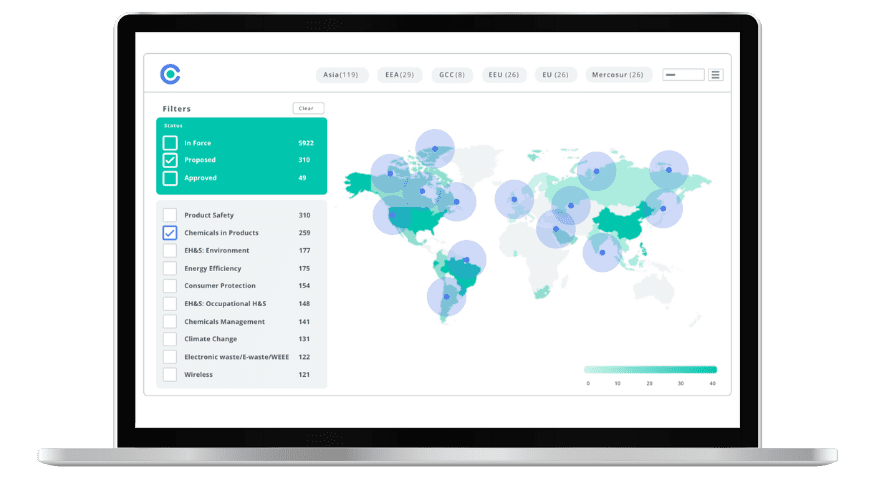
The platform covers 110,000 proposed and enacted regulations across 195 countries, including the ESG-related regulations that matter most to product manufacturers: CSRD, EU Taxonomy, chemical restriction frameworks, product sustainability requirements, supply chain due diligence laws, and extended producer responsibility regulations.
Requirements management in C2P allows teams to map specific regulatory obligations to products, operations, or business activities, creating a traceable link between the regulatory requirement and the compliance status. This is the foundation of an auditable compliance program.
Standards management provides cross-referencing between regulations and standards, supporting teams that need to align with both mandatory legal requirements and voluntary frameworks like ESRS or GRI.
The platform’s predictive analytics capabilities, powered by AI, support regulatory change forecasting, giving compliance teams advance visibility into changes before they take effect. For ESG regulations in particular, where implementation timelines have been complex and phased, this capability has significant operational value.
Access to C2P’s 40-plus in-house subject matter experts provides teams with interpretation support for complex regulatory questions. This is particularly valuable for ESG regulations that are new, evolving, or technically ambiguous.
FAQ: ESG Reporting Tools
- What is the difference between ESG reporting tools and ESG compliance tools?
ESG reporting tools typically refer to platforms designed for voluntary sustainability disclosure, such as annual reports prepared for investors under GRI or TCFD frameworks. ESG compliance tools are designed to track mandatory legal obligations, monitor regulatory changes, map requirements to products or operations, and manage audit-ready evidence. Many organizations need both, but they serve different functions and have different capability requirements. Selecting a disclosure tool for a compliance function creates structural gaps that surface during audits. - Do ESG reporting tools include regulatory tracking?
Most general ESG reporting platforms do not include regulatory tracking as a core feature. They are built around metrics collection and framework alignment, not legal obligation monitoring. Compliance-focused platforms like C2P include curated regulatory databases, change monitoring, and requirement mapping capabilities that disclosure platforms lack. If your ESG obligations are mandatory rather than voluntary, regulatory tracking is a non-negotiable requirement in your tool selection. - What ESG regulations require compliance management software?
CSRD requires companies to track ESRS disclosure requirements, conduct double materiality assessments, and maintain documentation for third-party assurance. EU Taxonomy requires mapping business activities to technical screening criteria with documented evidence. Supply chain due diligence laws including CSDDD require traceable due diligence processes. Chemical restriction and product sustainability regulations impose ESG-adjacent requirements on product manufacturers. All of these obligations benefit from purpose-built compliance management software rather than general-purpose ESG reporting tools. - How do ESG tools handle CSRD compliance specifically?
CSRD compliance requires coverage of the European Sustainability Reporting Standards, which define specific disclosure requirements across environmental, social, and governance topics. Platforms designed for CSRD compliance track ESRS requirements at a granular level, support double materiality assessment workflows, manage the evidence required for assurance engagement, and monitor changes to ESRS standards as they are updated by the European Financial Reporting Advisory Group (EFRAG). General ESG reporting tools may provide framework guidance but typically lack the requirement-level granularity and change monitoring needed for legal compliance. - What should compliance teams ask vendors when evaluating ESG tools?
Key questions include: What mandatory regulations are included in your regulatory database, and how is content updated? How do you map regulatory requirements to specific products or business activities? What evidence management capabilities do you provide for audit support? Do you include subject matter experts for interpretation questions? How does your platform monitor and alert on regulatory changes? What is your coverage across the jurisdictions where we have legal obligations? The answers reveal whether the tool was built for disclosure or for compliance, and that distinction drives the rest of the evaluation.
Simplify Corporate Sustainability Compliance
Six months of research, done in 60 seconds. Cut through ESG chaos and act with clarity. Try C&R Sustainability Free.