ESG Compliance Software: How to Choose the Right Platform for Your Team
THIS BLOG WAS WRITTEN BY THE COMPLIANCE & RISKS MARKETING TEAM TO INFORM AND ENGAGE. HOWEVER, COMPLEX REGULATORY QUESTIONS REQUIRE SPECIALIST KNOWLEDGE. TO GET ACCURATE, EXPERT ANSWERS, PLEASE CLICK “ASK AN EXPERT.”
The ESG software market has expanded rapidly, and so has the confusion about what these tools actually do. A platform that helps a financial institution prepare voluntary ESG disclosures is a fundamentally different product from one that helps a global manufacturer track regulatory obligations across 50 markets and demonstrate compliance to an external auditor.
If you are evaluating ESG compliance software, the first question is not which platform has the best reviews. It is whether the platform is built for your regulatory compliance use case or for voluntary reporting.
Quick Answer: ESG compliance software helps organizations track ESG-related regulatory obligations, collect and validate compliance data, manage evidence documentation, and generate audit-ready reports. The right platform depends on your regulatory scope, the complexity of your product portfolio, the markets you operate in, and whether your primary driver is mandatory regulatory compliance or voluntary stakeholder reporting. Features to prioritize include regulatory library coverage, evidence management, audit trail functionality, workflow automation, and integration with existing systems.
Table of Contents
- ESG Compliance Software vs. ESG Reporting Software: The Distinction That Matters
- Who Needs ESG Compliance Software?
- What ESG Regulations Are Companies Tracking in 2026?
- Key Features to Evaluate
- Questions to Ask Every ESG Software Vendor
- Common Mistakes in Platform Selection
- How C2P Approaches ESG Compliance for Product Teams
- How to Build a Business Case for ESG Compliance Investment
- FAQ
ESG Compliance Software vs. ESG Reporting Software: The Distinction That Matters
Not all ESG software is the same. The category contains two fundamentally different types of tools, and selecting the wrong one for your use case is an expensive mistake.
ESG reporting software is designed primarily to collect sustainability data across an organization, calculate metrics like carbon emissions or water usage, and produce reports for stakeholder communication. These tools are optimized for voluntary frameworks like GRI, SASB, or CDP, and for regulatory reporting requirements focused on disclosure, such as the EU’s CSRD. They excel at data aggregation and report generation. They are not typically designed to manage regulatory compliance obligations, track whether specific requirements are being met, or maintain the evidence documentation required for regulatory audits.
ESG compliance software is designed to manage regulatory obligations directly. It tracks the regulatory requirements that apply to your products and operations across each market, assesses whether those requirements are currently being met, manages the evidence documentation that demonstrates compliance, and alerts teams when regulations change or when compliance status needs review. For product manufacturers subject to specific ESG regulations, substance restrictions, chemical reporting requirements, or environmental standards, this is the category of tool that addresses the core compliance challenge.
Some platforms attempt to serve both use cases. Understanding where a vendor’s roots and primary investment are helps predict which use case they will serve better when trade-offs arise.
Who Needs ESG Compliance Software?
Organizations with mandatory ESG regulatory obligations, not just voluntary reporting goals, are the primary candidates for ESG compliance software.
The profile that most often benefits from purpose-built ESG compliance tools includes:
- Global manufacturers tracking product-specific ESG regulations across multiple markets: substance restrictions like REACH and RoHS, environmental product requirements, chemical reporting mandates, and sector-specific sustainability rules.
- Companies subject to CSRD that need to manage the data collection, obligation tracking, and evidence management required for a mandatory disclosure regime with third-party assurance.
- Organizations with complex supply chains that must collect ESG compliance data from suppliers, validate it, and integrate it into their own compliance documentation.
- Enterprises with multiple product lines across many jurisdictions where the surface area of regulatory obligation is too large for spreadsheet-based tracking.
If your ESG compliance challenge is primarily about voluntary stakeholder communication, a general ESG reporting platform may be sufficient. If it is about managing regulatory obligations with legal consequence, the tool selection criteria are significantly more demanding.
What ESG Regulations Are Companies Tracking in 2026?
The ESG regulatory landscape for product companies and manufacturers has become substantially more complex over the past several years. Organizations active in global markets are typically tracking some combination of:
- EU CSRD: The Corporate Sustainability Reporting Directive, which requires detailed ESG disclosures under European Sustainability Reporting Standards, with mandatory third-party assurance. Applies to large EU companies now and to non-EU companies with significant EU revenue starting in 2028.
- CSDDD: The Corporate Sustainability Due Diligence Directive, which requires companies to identify, prevent, and mitigate adverse human rights and environmental impacts across their global value chains. Applies from 2029 to large EU and non-EU companies meeting specific turnover thresholds.
- EU REACH: The regulation on chemicals that requires manufacturers and importers to register chemicals, assess safety, and provide information to downstream users. Substance of Very High Concern (SVHC) obligations are particularly active.
- EU RoHS: The Restriction of Hazardous Substances Directive, restricting specific hazardous substances in electrical and electronic equipment.
- EU CBAM: The Carbon Border Adjustment Mechanism, which requires importers of certain products into the EU to account for carbon costs, effectively creating a carbon compliance obligation for non-EU manufacturers selling into the EU.
- EUDR: The EU Deforestation Regulation, requiring due diligence to ensure certain commodities and products sold in the EU have not contributed to deforestation.
- California SB 253: California’s Climate Corporate Data Accountability Act, which requires annual disclosure of Scope 1, 2, and 3 greenhouse gas emissions in accordance with the GHG Protocol, with mandatory third-party assurance. Applies to U.S. companies with over $1 billion in annual revenue doing business in California, with the first Scope 1 and 2 reports due by August 10, 2026.
- California SB 261: California’s Climate-Related Financial Risk Act, which mandates biennial reporting on climate-related financial risks and mitigation strategies aligned with the TCFD framework. Applies to U.S. companies (excluding insurers) with over $500 million in annual revenue doing business in California; while the initial January 2026 deadline is currently impacted by ongoing litigation, reporting remains a core requirement for in-scope entities.
- US UFLPA: The Uyghur Forced Labor Prevention Act, which enforces a legal presumption that all goods sourced from the Xinjiang region are made with forced labor and are prohibited from US entry, requiring companies to provide “clear and convincing” evidence of compliant, transparent supply chains.
- EU ESPR: The Ecodesign for Sustainable Products Regulation establishes a framework for setting mandatory circularity and performance requirements , and introduces the use of a Digital Product Passport (DPP) for lifecycle transparency. Applies to nearly all physical goods placed on the EU market, with a phased-in rollout beginning in 2026.
- EU PPWR: The Packaging and Packaging Waste Regulation, which introduces binding reuse targets and minimum recycled content for plastics, while harmonizing labeling across the member states. Applies to any business placing packaging and packaged products on the EU market, with the first major compliance deadlines, including a ban on “forever chemicals” (PFAS) in food packaging, taking effect in August 2026.
- National implementations: Individual EU member states implement directives with varying specificity, creating compliance variations that organizations operating across multiple EU markets must track separately.
Monitoring all of these regulatory streams simultaneously, while tracking proposed changes that may affect future compliance obligations, is the operational challenge that ESG compliance software is designed to address. The Use Cases section of C2P illustrates how enterprise teams manage this regulatory surface area through a single platform.
Key Features to Evaluate
When assessing ESG compliance software for a product manufacturing or enterprise compliance context, these features distinguish capable platforms from generic ESG tools:
- Regulatory library coverage: Does the platform maintain an actively updated library of ESG-related regulatory requirements across your relevant markets and product categories? Coverage breadth (how many jurisdictions and regulatory bodies) and depth (how specific the regulatory content is) both matter. A platform claiming to cover “global ESG regulations” should be pressed on exactly which regulations are in scope and how frequently the library is updated.
- Obligation management: Can the platform map specific regulatory requirements to your products, operations, and supply chain relationships? Obligation management means more than tracking that a regulation exists; it means tracking what it requires from your specific organization and whether those requirements are currently met.
- Evidence management: ESG compliance, particularly under audit-driven frameworks like CSRD, requires documented evidence that obligations are being met. A capable platform provides structured storage, retrieval, and audit trail functionality for compliance evidence, not just a document repository. C2P’s Evidence Management capability is purpose-built for this requirement.
- Regulatory change monitoring: How does the platform alert you when regulations relevant to your obligations change? A static database of regulations is less valuable than a dynamically updated library with an alert mechanism that connects changes to affected obligations.
- Workflow and task management: Can the platform assign remediation tasks, track their completion, and maintain an audit trail of who did what and when? Compliance is a team activity; the software must support distributed ownership and accountability.
- Integration with existing systems: Product lifecycle management systems, ERP platforms, supplier portals, and document management systems may all contain data relevant to ESG compliance. Integration capability determines whether the platform becomes a hub for that data or an isolated silo.
- Reporting and audit readiness: Can the platform generate structured reports that satisfy regulatory reporting requirements, not just internal dashboards? For CSRD-reporting companies, the output must meet ESRS disclosure requirements. For companies facing product compliance audits, the output must present evidence in a format that satisfies auditors.
Questions to Ask Every ESG Software Vendor
The gap between what ESG software vendors claim and what their platforms actually deliver for complex regulatory compliance use cases can be significant. These questions surface that gap during evaluation:
- Which specific regulations does your platform cover, and how frequently is the regulatory library updated? A vendor that cannot provide a specific list of covered regulations and an update frequency should not be assumed to cover your relevant regulatory universe.
- How does your platform handle regulatory change? Walk me through what happens when a regulation updates. The answer should describe a defined process for identifying the change, assessing its impact on affected obligations, and notifying the relevant team. A vague answer about “alerts” without specificity about what triggers them and how they connect to obligation management is a red flag.
- Does your platform support obligation management at the product and market level, or only at the organizational level? For manufacturers with diverse product portfolios across multiple markets, obligation management must operate at the level of specific products in specific markets, not just the organization overall.
- Show me how your evidence management works. Request a demonstration of how compliance evidence is captured, organized, linked to specific obligations, and retrieved for an audit. If this capability is weak or missing, the platform may work for voluntary reporting but not for audit-driven compliance.
- What does implementation look like, and what is required from our team? ESG compliance software implementations that require extensive custom development to address basic compliance use cases are a signal that the platform was not designed for those use cases.
- Which companies similar to ours use the platform? Can we speak with references? References from organizations with similar regulatory profiles and complexity are the most reliable signal of fit.
Common Mistakes in Platform Selection
Procurement decisions for ESG compliance software frequently go wrong in predictable ways:
- Selecting a reporting platform for a compliance use case. General ESG reporting tools are not designed for regulatory obligation management. They may produce compelling sustainability dashboards while leaving core compliance management gaps unaddressed.
- Evaluating against current requirements only. The ESG regulatory landscape is expanding rapidly. A platform that adequately covers your current obligations but lacks coverage or architecture to accommodate new requirements creates a replacement cycle at the worst possible time.
- Underweighting regulatory library quality. Software architecture matters, but for ESG compliance the quality, breadth, and update frequency of the regulatory library is at least as important. A well-built platform with thin regulatory coverage leaves teams doing manual research alongside the software.
- Overweighting UI at the expense of functionality. An intuitive interface is valuable, but it should not substitute for depth of regulatory coverage, evidence management capability, and audit readiness.
- Ignoring implementation requirements. ESG compliance software that requires six to twelve months of custom implementation before it is operational is a risk for organizations with near-term compliance deadlines. Assess implementation timelines against your regulatory calendar
How C2P Approaches ESG Compliance for Product Teams
C2P from Compliance & Risks was built specifically for enterprise product compliance, with ESG compliance as a core use case within that broader mandate.
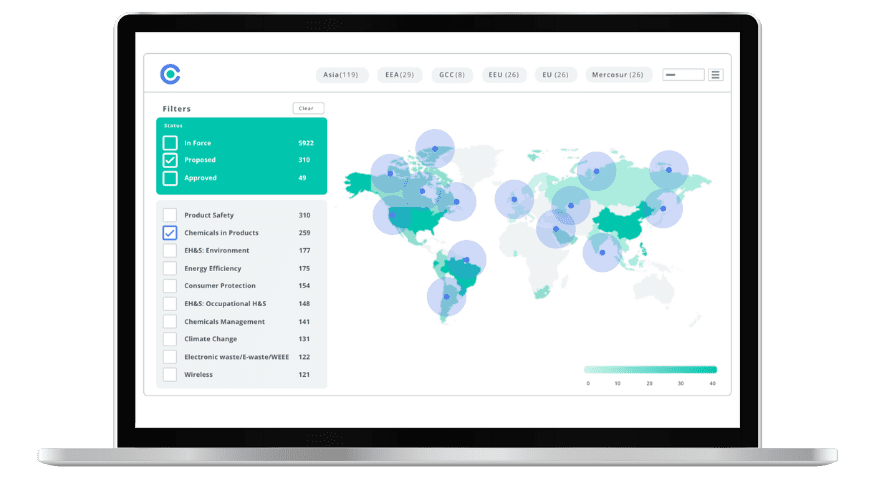
The platform provides access to over 110,000 regulatory source documents across 195 countries, including ESG-related regulations covering chemical restrictions, environmental product requirements, sustainability reporting mandates, and sector-specific sustainability rules across consumer electronics, medical devices, automotive, industrial machinery, chemicals, and other product categories.
Rather than treating ESG compliance as a separate reporting module, C2P integrates it into the same obligation management, evidence management, and regulatory monitoring infrastructure that product compliance teams use for safety and certification requirements. That integration reflects the operational reality: for a compliance team at a global manufacturer, ESG obligations and product safety obligations are managed by the same people using the same workflows.
Access to 40+ in-house subject matter experts through the Ask Our Experts feature means teams can get authoritative interpretation of specific ESG regulatory requirements without maintaining that expertise in-house for every jurisdiction.
The Compliance & Risks blog covers ESG regulatory developments and implementation considerations for product and enterprise teams. Subscribing to The Pulse Newsletter provides a curated regulatory intelligence feed for teams tracking ESG compliance developments across global markets.
How to Build a Business Case for ESG Compliance Investment
ESG compliance software investments are often competed against other technology priorities. A business case that resonates with finance and executive leadership tends to frame investment in terms of risk reduction and operational efficiency rather than regulatory obligation alone.
- Risk reduction framing: What is the potential cost of a compliance failure in your highest-risk markets? For companies subject to REACH substance violations, market withdrawal and recall costs can reach into the tens of millions. For CSRD-reporting companies, material misstatements in the sustainability report carry audit qualification risk and potential legal exposure. The cost of the software should be compared to the expected value of reducing that tail risk.
- Operational efficiency framing: How much time do your compliance and legal teams currently spend on manual regulatory monitoring, spreadsheet maintenance, and document preparation? That labor cost, multiplied by the headcount involved and the hourly rate, provides a denominator against which software efficiency gains can be compared.
- Market access framing: For companies entering new regulated markets, ESG compliance capability is increasingly a prerequisite. The revenue opportunity in regulated markets that your organization cannot currently enter efficiently because of compliance capability gaps is a legitimate input to the investment case.
A phased investment approach, starting with the regulatory scope that creates the most immediate compliance risk and expanding as the platform proves value, is often more effective at securing initial budget approval than a comprehensive deployment proposal.
FAQ
- What is ESG compliance software?
ESG compliance software is a technology platform that helps organizations manage their regulatory ESG obligations. It tracks applicable requirements across markets and product categories, manages evidence documentation that demonstrates compliance, monitors for regulatory changes, and supports audit-ready reporting. It is distinct from general ESG reporting software, which is primarily designed for voluntary sustainability disclosure rather than mandatory regulatory compliance management. - How is ESG compliance software different from GRC software?
Governance, Risk, and Compliance (GRC) software covers a broad range of enterprise risk and compliance use cases, often including financial, operational, and IT risks alongside regulatory compliance. ESG compliance software is typically more specialized, with deeper regulatory library coverage for sustainability-related requirements and purpose-built workflows for environmental, social, and governance compliance use cases. For organizations primarily managing ESG regulatory obligations, a specialized tool often provides better depth than a general GRC platform. - What regulations does ESG compliance software cover?
Coverage varies significantly by vendor. Comprehensive platforms cover ESG-related regulations across multiple jurisdictions, including EU CSRD, REACH, RoHS, CBAM, EUDR, national environmental and chemical regulations, and sector-specific sustainability requirements. Coverage breadth and update frequency should be assessed carefully during vendor evaluation, as this is a significant differentiator. - How does ESG compliance software handle regulatory changes?
Leading platforms monitor regulatory sources continuously and alert compliance teams when changes affect regulations relevant to their obligations. The most capable systems connect a regulatory change to the specific obligations, products, and markets it affects, enabling targeted impact assessment rather than generic notifications that require manual follow-up. - What should a compliance team expect from ESG compliance software implementation?
Implementation complexity varies by platform and organizational context. Expect initial effort to configure the regulatory scope relevant to your organization, map obligations to products and markets, and integrate with existing data systems. Implementation timelines range from weeks for targeted deployments to several months for enterprise-scale configurations. Organizations with near-term compliance deadlines should prioritize vendors with faster time-to-value and should be skeptical of platforms requiring extensive custom development.
Simplify Corporate Sustainability Compliance
Six months of research, done in 60 seconds. Cut through ESG chaos and act with clarity. Try C&R Sustainability Free.