Compliance Monitoring: The Complete Guide for Product & Regulatory Teams
THIS BLOG WAS WRITTEN BY THE COMPLIANCE & RISKS MARKETING TEAM TO INFORM AND ENGAGE. HOWEVER, COMPLEX REGULATORY QUESTIONS REQUIRE SPECIALIST KNOWLEDGE. TO GET ACCURATE, EXPERT ANSWERS, PLEASE CLICK “ASK AN EXPERT.”
Compliance monitoring is the ongoing process of tracking regulatory requirements, detecting changes to applicable laws and standards, and ensuring your products and operations remain within legal boundaries across every market you serve. Done well, it gives product and regulatory teams early warning before a regulatory shift becomes a costly disruption. Done poorly, it means your first notice of a material change arrives in the form of a failed audit, a shipment hold, or a market access block.
Quick Answer
Compliance monitoring means continuously tracking regulations, standards, and legal requirements relevant to your products and operations, then alerting the right people when something changes. The core components are: a defined regulatory universe, real-time change detection, assigned ownership for each obligation, and a process for translating regulatory updates into product or operational action. For global manufacturers and enterprise product teams, effective compliance monitoring is the difference between proactive risk management and reactive crisis response.
Table of Contents
- What Is Compliance Monitoring?
- Why Does Compliance Monitoring Fail?
- What Should a Compliance Monitoring Program Cover?
- How Do You Build a Compliance Monitoring System That Works?
- What Tools Support Compliance Monitoring?
- How Does AI Change Compliance Monitoring?
- FAQ
What Is Compliance Monitoring?
Compliance monitoring is the systematic tracking of regulatory requirements that apply to your products, supply chain, and business operations. It covers enacted laws, proposed regulations in the pipeline, industry standards updates, and enforcement trends. The goal is to know about a regulatory change before it takes effect, not after it creates a problem.
For product and regulatory teams, monitoring typically spans multiple jurisdictions, multiple regulatory bodies, and multiple product lines at once. A global electronics manufacturer, for example, may track RoHS and REACH in the EU, California Proposition 65 in the US, China RoHS requirements, and GHS chemical classification rules across a dozen markets simultaneously. That same company may also track emerging regulations: PFAS restrictions that have not yet been enacted but are advancing through regulatory pipelines in both the EU and several US states.
The scope of compliance monitoring has expanded significantly over the past decade. Beyond product regulations, compliance teams now monitor ESG obligations like the Corporate Sustainability Reporting Directive (CSRD) and the Corporate Sustainability Due Diligence Directive (CSDDD), supply chain transparency requirements like conflict minerals rules, and sector-specific standards from bodies like ISO, IEC, and ASTM.
Compliance monitoring is not the same as a compliance audit. An audit is a point-in-time assessment of your current compliance status. Monitoring is continuous. Audits tell you where you stand today. Monitoring tells you where the requirements are heading.
Why Does Compliance Monitoring Fail?
Most compliance monitoring programs fail for the same reason: they are built for yesterday’s requirements, not tomorrow’s.
The reactive model goes like this. A regulatory body issues a new rule or amends an existing one. At some point, a compliance team member reads about it, either in a trade publication, an alert from a third-party service, or a notification from a supplier. The team scrambles to assess the impact, determine the timeline, and figure out which products are affected. If they are lucky, they catch it with six months of runway. Often, they do not.
This approach has three structural problems.
First, regulatory signals appear long before a law takes effect. Proposed regulations go through public comment periods, committee reviews, and sometimes years of revision before enactment. A team watching only for enacted regulations is ignoring the most actionable window for preparation.
Second, the volume of regulatory activity has grown beyond what manual monitoring can handle. Our C2P database contains more than 115,000 regulations and standards globally across 195 countries. The EU alone issued thousands of regulatory acts in 2025. No team can read everything, so teams end up watching only a fraction of what is relevant to them.
Third, compliance monitoring is often siloed. The regulatory affairs team tracks regulations. Product engineering tracks standards updates. ESG teams track sustainability obligations. Supply chain teams track conflict minerals rules. None of these groups has a unified view, which means changes in one area do not automatically surface to the teams who need to act on them.
The result is predictable. A manufacturer misses a change to REACH restriction entries. A product ships to the EU with a newly restricted substance at a level that is no longer permitted. The cost of that miss, including potential market access loss, product reformulation, and supply chain disruption, can run into the millions. The cost of non-compliance goes well beyond the fine itself, as explored in depth in The Real Cost of Non-Compliance.
What Should a Compliance Monitoring Program Cover?
A mature compliance monitoring program covers four categories of regulatory activity.
- Enacted regulations and their amendments. This is the baseline: the laws that are already in force. RoHS Directive restrictions. REACH substance authorizations and restrictions. WEEE producer obligations. California Proposition 65 chemical listings. FDA device labeling requirements. These need to be tracked not just at initial enactment but through every subsequent amendment, because many high-impact changes come as updates to existing rules rather than new legislation.
- Proposed and pending regulations. This is where the proactive advantage lives. PFAS restrictions in the EU are advancing. Extended producer responsibility (EPR) frameworks are being enacted in markets where they did not previously exist. ESG disclosure mandates are tightening. Tracking proposed regulations gives product teams 12 to 36 months of runway to respond, instead of 90 days.
- Industry standards. Regulations often reference standards by name: IEC safety standards for electrical equipment, ISO quality management standards, ASTM test method standards. When those underlying standards are revised, product compliance requirements change even if the regulation itself has not been amended. Standards from bodies like IEC, ISO, ETSI, and UL need to be tracked alongside the regulations that incorporate them.
- Enforcement and interpretation. Regulations do not exist in a vacuum. How a regulatory body interprets and enforces a rule matters as much as the text of the rule itself. Enforcement actions in one jurisdiction can signal how similar rules will be applied elsewhere. Market surveillance reports and regulator guidance documents are compliance signals that formal monitoring programs often overlook.
How Do You Build a Compliance Monitoring System That Works?
Step 1: Define Your Regulatory Universe
The first step is knowing what you need to monitor. This sounds obvious. In practice, it is where most programs break down, because regulatory teams often underestimate the scope of applicable requirements.
Your regulatory universe is defined by four variables: the markets where you sell, the products you make, the industries you operate in, and the supply chain inputs that go into your products. Each combination generates a specific set of applicable requirements.
A medical device sold in the EU may require monitoring of the Medical Device Regulation (MDR), applicable IEC standards, REACH substance restrictions, and EU CSRD obligations if your company is large enough to fall within scope. That same device sold in the US adds FDA 510(k) clearance requirements and applicable FDA guidance documents. Sold in China, add NMPA registration requirements.
Step 2: Assign Ownership and Accountability
Every regulation in your universe should have an owner. Not a team, a person. Someone who is responsible for tracking changes to that requirement, assessing their impact, and escalating when action is needed.
Ownership does not mean the person does all the work themselves. It means they are accountable for ensuring the work gets done. When a REACH restriction list is updated and a substance your product contains appears on the new list, there should be no question about who picks up the phone.
A global compliance governance framework provides the structure for this. Creating a Global Compliance Governance Framework covers how to structure oversight, assign regional versus global responsibility, and build escalation pathways that work across business units.
Step 3: Set Your Monitoring Cadence
Different regulatory bodies update requirements on different schedules. The EU REACH restriction list can be updated multiple times per year. ISO standards are reviewed on five-year cycles. Proposed regulations may be in public comment for 60 days. Each type of regulatory activity demands a different monitoring cadence.
Real-time monitoring is appropriate for enacted regulations and enforcement actions. Daily or weekly review is appropriate for proposed regulations advancing through legislative processes. Quarterly review is appropriate for standards revision cycles.
The practical answer for most teams is automation. Manual review of regulatory sources is not scalable. An effective compliance monitoring system delivers alerts to the right people when something relevant changes, rather than requiring team members to periodically comb through regulatory feeds.
Step 4: Build an Alert and Escalation Workflow
A compliance alert is only useful if it reaches the right person and triggers the right action. In practice, alert fatigue is a real problem: teams that receive too many notifications begin to ignore them, which defeats the purpose.
Effective alert design involves filtering. A change to EU REACH SVHC (Substances of Very High Concern) designations matters to your chemistry team and your procurement team. It probably does not require immediate escalation to the Chief Compliance Officer unless a substance in your product appears on the new list.
Design your alert workflow with tiers. Tier one is a notification: something has changed, and here is what it is. Tier two is an assessment request: based on this change, please assess impact within 30 days. Tier three is an escalation: this change affects a current product and requires leadership review within 72 hours.
Every alert should include the regulatory source, the effective date of any change, the scope of products or markets affected, and a clear next-action requirement.
Step 5: Connect Monitoring to Product and Operations
This is the step that most compliance programs miss. Regulatory changes are only actionable when they connect to the people who can act on them. A regulatory update that stays inside the compliance team is not compliance monitoring. It is compliance reading.
When a new restricted substance appears under RoHS or REACH, product engineering needs to know which components contain that substance. Procurement needs to know which suppliers provide those components. R&D needs to know whether a substitute exists and what the reformulation timeline looks like. The compliance monitoring system needs to connect to bill-of-materials data, supplier records, and product development workflows.
Product managers play a critical role here. The Product Manager’s Guide to Predictive Regulatory Forecasting explains how regulatory monitoring integrates with product lifecycle management and the ROI that justifies the infrastructure investment.
What Tools Support Compliance Monitoring?
The market for compliance monitoring tools ranges from general regulatory intelligence platforms to purpose-built product compliance management systems.
- Regulatory intelligence platforms aggregate regulatory publications from government sources across multiple jurisdictions. They provide search, filtering, and alerting functionality. The challenge is signal-to-noise: without strong filtering and subject-matter context, these platforms generate high alert volumes that require significant analyst time to process.
- Product compliance management platforms are purpose-built for manufacturers tracking product-specific regulatory requirements. They connect regulatory data to product records, enabling teams to assess the impact of a regulatory change against their actual product portfolio rather than in the abstract. They also support evidence management: the documentation that proves compliance is in place when an auditor asks.
- Standards management tools track standards from bodies like IEC, ISO, ASTM, and ETSI, including revision histories and cross-references to the regulations that incorporate those standards.
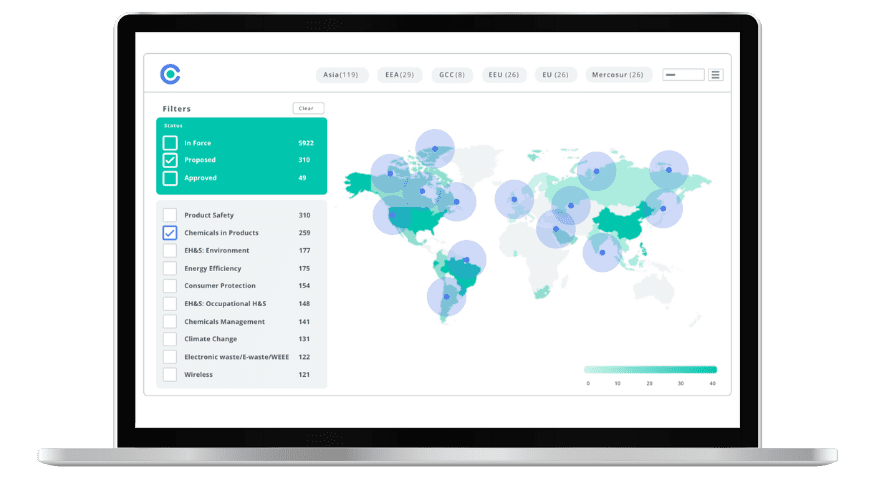
For enterprise teams managing compliance across multiple products, markets, and business units, the question is not whether to use technology but which technology creates the most complete picture. The C2P Platform covers 110,000+ regulations and standards across 195 countries, with daily regulatory alerts, AI-powered impact assessment, and built-in evidence management, making it one of the most comprehensive purpose-built options for global manufacturers.
How Does AI Change Compliance Monitoring?
AI is changing compliance monitoring in three ways that matter to product and regulatory teams.
- Regulatory change detection at scale. AI can monitor regulatory sources across dozens of jurisdictions and languages simultaneously, flagging changes that match a defined regulatory profile. What previously required a team of analysts combing through government publications can now happen in near real-time, with relevant changes surfaced automatically.
- Impact assessment acceleration. When a regulation changes, the first question is always: does this affect us? Answering that question manually requires cross-referencing the regulatory change against your product portfolio, supply chain inputs, and market presence. AI tools can automate this cross-referencing, producing an initial impact assessment in minutes rather than days.
- Regulatory forecasting. This is the most significant shift. AI can analyze proposed regulations in active legislative processes, evaluate historical enactment rates for similar proposals, and generate a probability estimate for whether a given regulation will be enacted. That turns compliance monitoring from a reactive discipline into a forward-looking intelligence function. Teams can prioritize preparation based on the likelihood that a given regulatory proposal will become law, rather than waiting for certainty before acting.
While AI significantly accelerates regulatory monitoring and impact assessment, it is not a standalone solution. Regulatory compliance requires context, interpretation, and validation that only human expertise can provide. At Compliance & Risks, AI-driven regulatory intelligence is combined with a global team of subject matter experts who continuously validate, enrich, and contextualize regulatory data. This human-in-the-loop approach ensures that regulatory updates are not only detected quickly, but also accurately interpreted and translated into actionable insights for product and compliance teams.
AI can identify patterns, flag changes, and map potential impact at scale. Our experts ensure those outputs reflect real-world regulatory intent, enforcement nuance, and market-specific requirements – reducing false positives, eliminating ambiguity, and providing confidence in decision-making.
The result is a compliance monitoring system that is both scalable and reliable: automated where speed is critical, and expert-led where accuracy and interpretation matter most.
FAQ
- What is the difference between compliance monitoring and a compliance audit?
Compliance monitoring is continuous. It tracks regulatory requirements and changes on an ongoing basis, with the goal of maintaining compliance before issues arise. A compliance audit is periodic and backward-looking. An audit assesses your current compliance status against applicable requirements at a point in time. Both are necessary, but monitoring is what prevents the negative findings an audit would otherwise uncover. - How often should a compliance monitoring program be reviewed and updated?
The regulatory universe changes constantly, so your monitoring coverage should be reviewed at least quarterly. Any time your company enters a new market, launches a new product, or acquires a business with different compliance obligations, the regulatory universe map should be updated immediately. The monitoring cadence for individual regulations should match the update frequency of those regulations, which varies significantly by regulatory body. - What regulations should product compliance teams prioritize monitoring?
Priority depends on your product categories and target markets. For global manufacturers, the highest-priority regulations typically include EU REACH, EU RoHS, WEEE, California Proposition 65, and applicable product safety directives for your category. ESG obligations under CSRD and CSDDD are relevant for larger companies, despite recent threshold and scope amendments in the EU. Any regulation with a hard compliance deadline and the potential for market access impact should be treated as high priority. - How does compliance monitoring integrate with product development?
Regulatory monitoring should connect to the product development process at the design stage, not after a product is ready to launch. When product engineers are selecting materials and components, the compliance team should be able to flag substances or configurations that are restricted in target markets or that are at risk of future restriction based on regulatory proposals currently in progress. Most teams use compliance requirements management tools that link regulatory data directly to bill-of-materials records for this purpose. - What is the most common failure in compliance monitoring programs?
The most common failure is treating compliance monitoring as a reactive information-gathering exercise rather than an intelligence function. Teams that monitor only enacted regulations, watch only the jurisdictions where they already sell, and route alerts only to the compliance team miss most of the value that monitoring can deliver. Effective compliance monitoring anticipates change, covers proposed regulations, and connects regulatory intelligence directly to the people who make product and procurement decisions.
Simplify Corporate Sustainability Compliance
Six months of research, done in 60 seconds. Cut through ESG chaos and act with clarity. Try C&R Sustainability Free.