Product Compliance Monitoring: What It Is and Why Your Team Needs It
THIS BLOG WAS WRITTEN BY THE COMPLIANCE & RISKS MARKETING TEAM TO INFORM AND ENGAGE. HOWEVER, COMPLEX REGULATORY QUESTIONS REQUIRE SPECIALIST KNOWLEDGE. TO GET ACCURATE, EXPERT ANSWERS, PLEASE CLICK “ASK AN EXPERT.”
Product compliance monitoring is the continuous process of tracking regulatory requirements that apply to specific products, across the markets where those products are sold, from design through post-market surveillance. Global manufacturers tracking compliance across 10 or more markets face hundreds of regulatory frameworks, each updating on its own schedule, across 195 countries and thousands of regulatory bodies. Product compliance monitoring is what keeps that picture current at the product level, mapping requirements to SKUs, materials, and categories, not just to the organization as a whole.
Quick Answer
Product compliance monitoring tracks the regulatory obligations that apply to your products in every market where they are sold or manufactured. It covers applicable standards and directives, changes to those requirements over time, and internal evidence that each product meets them. Teams that do this well catch regulatory changes before they affect a product’s market access. Teams that do not find out at the point of failure.
Table of Contents
- What Is Product Compliance Monitoring?
- How Product Compliance Monitoring Differs from General Compliance Programs
- What Does Product Compliance Monitoring Cover?
- Where Product Compliance Programs Break Down
- The Cost of Getting It Wrong
- What an Effective Product Compliance Monitoring Program Looks Like
- FAQ
What Is Product Compliance Monitoring?
Product compliance monitoring is the function responsible for knowing, at any given moment, whether a specific product is compliant with the requirements of every market it is sold in, and flagging when that status changes.
For a manufacturer selling electronics in the European Union, the United States, and Japan, that means tracking EU directives like RoHS and WEEE, FCC authorization requirements, and the Japanese VCCI and PSE schemes, across every relevant product category. Each of those frameworks updates on its own schedule. Each carries different documentation requirements. Each has enforcement consequences that range from market access restrictions to product recalls.
The monitoring function is what keeps that picture current. It watches for amendments, new standards, enforcement guidance, and proposed regulations before they become binding. It maps those changes to the affected product portfolio. And it surfaces the information in time for design, engineering, and supply chain teams to act.
Without that function operating continuously, the picture goes stale. A product that was compliant at launch may face a revised requirement 18 months later. If no one is watching, the gap between the old standard and the new one is invisible until it is not.
How Product Compliance Monitoring Differs from General Compliance Programs
General compliance monitoring watches an organization’s controls, processes, and obligations at a program level. Product compliance monitoring goes a level deeper: it works at the SKU and category level, tracing specific regulatory requirements back to specific products, materials, and markets.
The difference matters in practice. A general compliance program might confirm that a manufacturer has a process for managing RoHS documentation. Product compliance monitoring confirms that Product X, in its current bill of materials, meets RoHS 3 in the EU and the equivalent substance restrictions in China and the UK, and that those requirements have not changed since the last documentation review.
That granularity is what makes product compliance actionable. Regulations do not apply to organizations in the abstract. They apply to products in specific markets. A monitoring program that cannot trace requirements to the product portfolio cannot answer the question that actually matters: is this product still compliant, in this market, today?
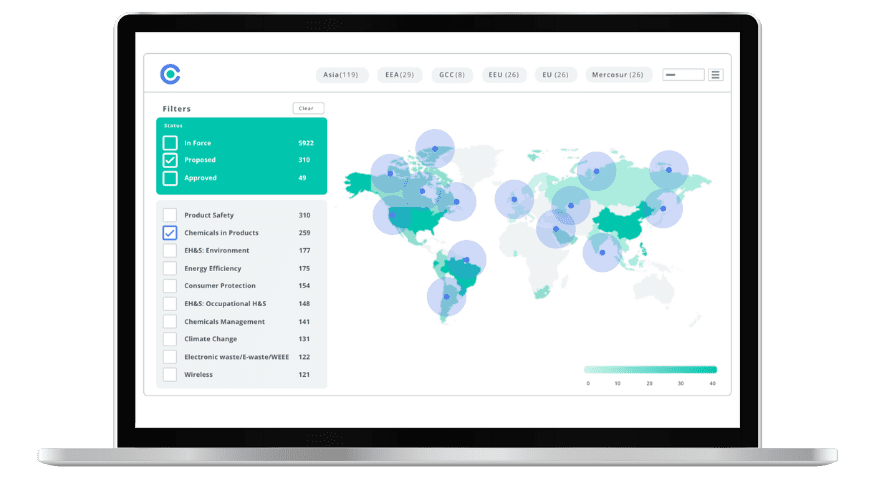
The C2P platform is built around this product-level structure, mapping regulatory content to product categories and flagging relevant changes as they occur across 195 countries and 115,000+ regulatory source documents.
What Does Product Compliance Monitoring Cover?
The scope of product compliance monitoring depends on the product type, industry, and markets involved. In general, it covers four areas.
Applicable Regulations and Standards
Every product category carries a set of applicable frameworks, directives, standards, and certifications. Electronics face RoHS, WEEE, CE, FCC, and similar requirements. Automotive components face ECE regulations, FMVSS, and country-specific homologation requirements. Chemical-adjacent products face REACH, CLP, and GHS frameworks. Monitoring starts with knowing which frameworks apply to which products, and keeping that mapping current as both the product portfolio and the regulatory environment evolve.
Regulatory Change Tracking
Regulations are not static. Standards get revised. Substance restriction lists expand. New categories of products get brought into scope of existing frameworks. Enforcement interpretations shift. Product compliance monitoring watches for all of these changes and routes them to the teams responsible for the affected products.
The regulations management function is central to this: it is the mechanism that translates regulatory activity into specific, actionable obligations for specific product lines.
Documentation and Evidence
Compliance is not a status. It is a documented record. Product compliance monitoring includes managing the certificates, declarations of conformity, test reports, material disclosures, and supplier documentation that demonstrate a product’s compliance at any point in time. That record needs to be current, organized, and retrievable, whether for an internal audit, a customer inquiry, or a regulatory inspection.
Post-Market Surveillance
In regulated industries, compliance does not end at market entry. Post-market surveillance tracks whether products continue to meet requirements after they have been sold: monitoring for field reports, safety issues, and regulatory updates that might affect products already in market. For medical devices in the EU, post-market surveillance is a formal regulatory requirement under MDR. For other product categories, it is simply good practice.
Where Product Compliance Programs Break Down
Most product compliance programs fail at one of three points.
Coverage gaps. Teams track the regulations they know about. When a product enters a new market, or when a familiar regulation gets amended, coverage gaps form. The EU generates regulatory changes continuously across its legislative bodies, standardization organizations, and member-state transpositions. A team that monitors EU requirements well may miss an equivalent restriction in a Southeast Asian market. A team that tracks one substance restriction list may not know a parallel list has been updated. Coverage gaps are invisible by definition: you do not know what you are not watching.
Reactive timing. Compliance teams that depend on notifications from trade associations, consultants, or colleagues learn about regulatory changes after they have been published, often 3 to 6 months after the original proposal. By the time a team starts assessing the impact on their product portfolio, the implementation timeline may already be compressed. Regulations with 18-month transition periods effectively become 12-month problems for teams that find out late. Proactive monitoring, tracking proposed regulations before they are enacted, is the only way to build adequate lead time.
Disconnected systems. When regulatory intelligence lives in one system, product data lives in another, and documentation lives in a third, connecting a regulatory change to the products it affects requires manual effort at every step. That manual effort is slow, inconsistent, and difficult to audit. The product compliance solution that connects these functions is what separates a program that works at scale from one that works only under ideal conditions.
The Cost of Getting It Wrong
The business case for product compliance monitoring is not primarily about avoiding fines. The real cost of compliance failures is operational.
A product recall costs multiples of what any monitoring program would have cost. Product recalls in the electronics sector routinely carry direct costs that reach into the tens of millions of dollars before accounting for brand damage or lost market share. Market access restrictions in a key jurisdiction can remove revenue without warning. A customs hold on a shipment because documentation does not meet the destination country’s current requirements has immediate cash flow consequences. A failed audit with a major customer can end the relationship.
The less visible cost is opportunity. Organizations with strong product compliance monitoring can enter new markets faster because they already have a process for assessing what applies and what documentation is required. For companies in electronics, automotive, or industrial manufacturing, the ability to assess regulatory readiness quickly is a competitive factor, not just a cost center.
AI-assisted regulatory monitoring has accelerated this further, compressing the time between a regulatory change and a usable impact assessment from days to hours.
What an Effective Product Compliance Monitoring Program Looks Like
A program that works at scale has five characteristics.
Product-to-regulation mapping. Every product in the portfolio is mapped to the regulatory frameworks that apply to it, by market. When a regulation changes, the system identifies which products are affected without manual triage.
Proactive regulatory horizon scanning. The program watches proposed regulations, not just enacted ones. Teams get 12 to 18 months of lead time on changes that would otherwise arrive as surprises.
Centralized documentation. Certificates, declarations, test reports, and supplier documentation are stored in a single place, versioned, and accessible to the people who need them.
Clear ownership. Each product category has a named owner who receives regulatory change alerts and is responsible for assessing impact. Without clear ownership, alerts get missed.
Audit-ready evidence. Documentation is organized to answer the questions an auditor will actually ask: What are the requirements? When did you know about them? What did you do in response? What evidence do you have that the product meets them?
Explore how C2P structures these functions or book a demo to see it applied to your product portfolio.
FAQ
- What is the difference between product compliance monitoring and product compliance management?
Monitoring is the ongoing surveillance function: watching for regulatory changes, tracking whether products meet current requirements, and flagging gaps. Management is the broader set of activities that follows: assessing impact, updating documentation, engaging suppliers, and remediating gaps. Monitoring is what tells you there is a problem. Management is how you fix it. - Which product categories face the most complex compliance monitoring requirements?
Electronics, automotive components, and chemical-adjacent products carry some of the highest regulatory complexity, because they face overlapping frameworks across multiple jurisdictions with different update cycles. Electronics sold globally face RoHS, WEEE, REACH, country-specific EMC requirements, and safety certifications that vary by market. Automotive components face homologation requirements, substance restrictions, and functional safety standards across North America, Europe, and Asia. - How often should product compliance monitoring be reviewed?
Continuous monitoring is not a quarterly or annual function. The regulatory environment changes throughout the year across every major market. Reviewing a monitoring program periodically is different from running it continuously. The program itself should generate real-time or near-real-time alerts. The program’s structure, coverage, and effectiveness should be reviewed at least annually. - What documentation should a product compliance monitoring program produce?
At minimum: a current map of applicable regulations by product category and market, a log of regulatory changes and how they were assessed, declarations of conformity and supporting test evidence, supplier certifications for restricted substances, and an audit trail showing when documentation was reviewed and updated. - Can product compliance monitoring be handled manually for a global portfolio?
Not reliably. Manual processes can work for small portfolios in a small number of markets. At scale, the volume of regulatory activity across 195 countries is too high, the rate of change too fast, and the cost of a missed requirement too significant for manual tracking to be a viable primary approach. Automated regulatory monitoring, with human review for impact assessment, is the standard for organizations managing global product portfolios.
Simplify Corporate Sustainability Compliance
Six months of research, done in 60 seconds. Cut through ESG chaos and act with clarity. Try C&R Sustainability Free.