What’s Trending in Compliance? May 2026

This blog was originally posted on 25th May, 2026. Further regulatory developments may have occurred after publication. To keep up-to-date with the latest compliance news, sign up to our newsletter.
At Compliance & Risks we empower global enterprises to unlock market access and confidently navigate regulatory complexity. With a 20-year legacy in regulatory intelligence, we help beloved global brands manage product and corporate sustainability obligations via C2P, transforming compliance into a force multiplier for enterprise growth.
Below we break down some of the top compliance trends in May 2026 that are generating the most interest globally this month.
1. EU: Guidance Document on Regulation (EU) 2023/1115 on Deforestation-Free Products, Commission Notice, May 2026
On 4 May 2026, the European Commission published the third edition of the guidance document on the application of the EU Deforestation Regulation (EU) 2023/1115 (EUDR).
This updated version improves clarity on application timelines, increases precision for operator and trader provisions, and facilitates more efficient due diligence and traceability.
The guidelines clarify the interpretation of definitions and facilitate implementation for both third-country partners and operators exporting to the Union. They support operators and traders, particularly SMEs, in achieving compliance while improving communication between Member State competent authorities.
The latest edition (2026 updates) incorporates significant updates to timelines and administrative requirements:
- Most obligations now apply as of 30 December 2026 to large and medium enterprises. For micro or small undertakings (established by 31 December 2024), the application date is deferred to 30 June 2027.
- The guidance further clarifies that the ‘micro or small primary operator’ category applies to those sourcing entirely from low-risk countries. These operators are only required to submit a one-time simplified declaration in the IT system rather than repetitive due diligence statements.
- The conversion of forest land for renewable energy deployment (e.g., wind farms or photovoltaics) may not be considered deforestation where the land use is not agricultural, subject to case-by-case assessment.
- This guidance clarifies that the EUDR acts as specific law and takes precedence over the Corporate Sustainability Due Diligence Directive (CSDDD) where their obligations overlap. It also notes that due diligence for the EUDR can help identify risks related to the Forced Labor Regulation.
- The Commission has indicated its intention to establish, by December 2026, repositories of relevant legislation for countries of production and certification schemes, with the aim of supporting operators in their risk assessments
These updates, inter alia, are expected to streamline compliance, including by reducing the number of due diligence statements required.
2. China: Industrial Product Green Design Guidelines, Notice No. 15, 2026
Published in April 2026, this guide on Industrial Product Green Design identifies 11 key directions: long life, non-toxicity, lightweighting, energy saving, water saving, material saving, noise reduction, space saving, easy recycling, reuse, and zero-carbon design. Each direction is linked to a design strategy such as material substitution, structural optimization, modularity, cleaner processes, and circular use of materials.
The guide calls for developing practical green design solutions in major industries, including automotive, machinery, machine tools, bearings, wind power, hydrogen equipment, photovoltaics, batteries, home appliances, packaging, detergents, textiles, biomanufacturing, methanol, and tires. It also promotes AI-enabled green design tools, lifecycle databases, industry smart agents, and a “1+N” green design standard system.
The guide encourages creating model green-design products, training specialist talent, and strengthening international cooperation. Government departments, industry groups, universities, research institutes, and enterprises are all assigned roles in standards, training, service capacity, and practical adoption.
The guide shows examples that include low-toxicity and lightweight design in cars, durability and noise reduction in construction machinery, long-life design for bearings and wind turbines, recyclable and modular battery packs, safer and more energy-efficient home appliances, reusable packaging, water-saving textile processes, low-carbon biomanufacturing and methanol, and quieter tire design. These examples are meant to be copyable and scalable across industries.
3. UK: Product Safety and Noncompliance Notifications for UK Market Surveillance and Enforcement Authorities, Guidance Document, May 2026
The UK Office for Product Safety and Standards (OPSS) published an updated guidance for market surveillance and enforcement authorities on 13 May 2026. This guidance is for market surveillance and enforcement authorities in the UK including the OPSS and outlines the requirement to notify the Secretary of State if products pose a risk to the health and safety of consumers or if products are found to be noncompliant with the relevant legislation.
The guidance outlines the notification requirements placed on authorities through their respective legal obligations in:
- Great Britain: the General Product Safety Regulations 2005 as applicable in GB and the Regulation on Accreditation and Market Surveillance as applicable in GB (‘GB RAMS’) (assimilated and amended in GB) and sector-specific product safety legislation; and
- Northern Ireland: the EU General Product Safety Regulation 2023/988 (EU GPSR) and the Regulation on Market Surveillance and Compliance of Products 2019/1020 as directly applicable in NI (‘MSC’) and sector-specific product safety legislation.
The General Product Safety Regulations 2005 (‘GPSR’), GB RAMS, EU GPSR and MSC establish the notification requirements for products found to pose a risk to the health and safety of consumers or end users and/or products that have been found to be noncompliant with the relevant legislation.
Compared with the previous Version 10, Version 11 (published 13 May 2026) supplements Section 2.11 of the guidance to clarify that it is OPSS policy that both product recalls and modification programmes are notified and published. Modification programmes include corrective action programmes which modify the product, without necessarily requiring the return of the product to the manufacturer for replacement.
Version 11 includes reference to the newly-issued additional guidance provided by OPSS to assist market surveillance authorities in Northern Ireland.
OPSS is now expressly offering support with the business notification process and procedure via the UK Product Safety Contact Point.
4. EU: A Simpler, Clearer and Better Enforced EU Rulebook, Communication, April 2026
On 28 April 2026, the EU Commission issued a Communication entitled A Simpler, Clearer and Better Enforced EU Rulebook. The Communication aims to modernise how EU laws are designed, implemented and enforced. It is also to be ensured that they are clear, agile and fit for purpose. Considering these goals, the Communication is introducing measures for better implementation and faster enforcement of EU legislation across all policy areas. A particular focus is placed on enforcing the single market rulebook.
The principles and measures mentioned in the Communication will be reflected in the better regulation guidelines and toolbox and be implemented gradually. Existing legislation will also be re-examined as necessary, in order to ensure that it is relevant and coherent across related pieces of legislation. To this end, the Commission Communication is accompanied by an Action Plan for Regulatory Deep Cleaning, aimed to address 12 priority areas.
As mentioned in the Communication, the 12 priority areas – free movement of goods and services, financial services, customs, taxation, health and food safety, agriculture, transport, energy, climate, environment, digital, housing and permitting – were selected based on internal analysis of implementation challenges and on stakeholder input, including in implementation dialogues and reality checks.
5. EU: Reporting Requirements Set by the REACH Restriction of Synthetic Polymer Microparticles, Guidance Document, April 2026
In April 2026, the European Chemicals Agency (ECHA) published Guidelines for the reporting requirements set by the REACH restriction of synthetic polymer microparticles (microplastics). It aims to assist users in complying with their obligations under the REACH Regulation.
The microplastics restriction (Entry 78 of Annex XVII of the REACH Regulation) sets out reporting requirements for certain uses of synthetic polymer microparticles (SPMs) subject to a derogation. The purpose of the Guidelines is to help manufacturers, industrial downstream users and suppliers of SPM comply with the annual reporting requirements to ECHA. The reporting is done in a IUCLID format, and the dossier is submitted to ECHA via REACH-IT.
As defined in the microplastics restriction, the reporting requirements set out an obligation to report estimated SPM releases to the environment from certain uses derogated from the prohibition of placing on the market. The information shall be submitted by (or on behalf of) each legal entity that is subject to the reporting requirements. The estimated emissions shall be reported per use and indicating the applicable derogation(s). The specific information to be reported depends on which derogation applies to the use in question.
Unlock Market Access
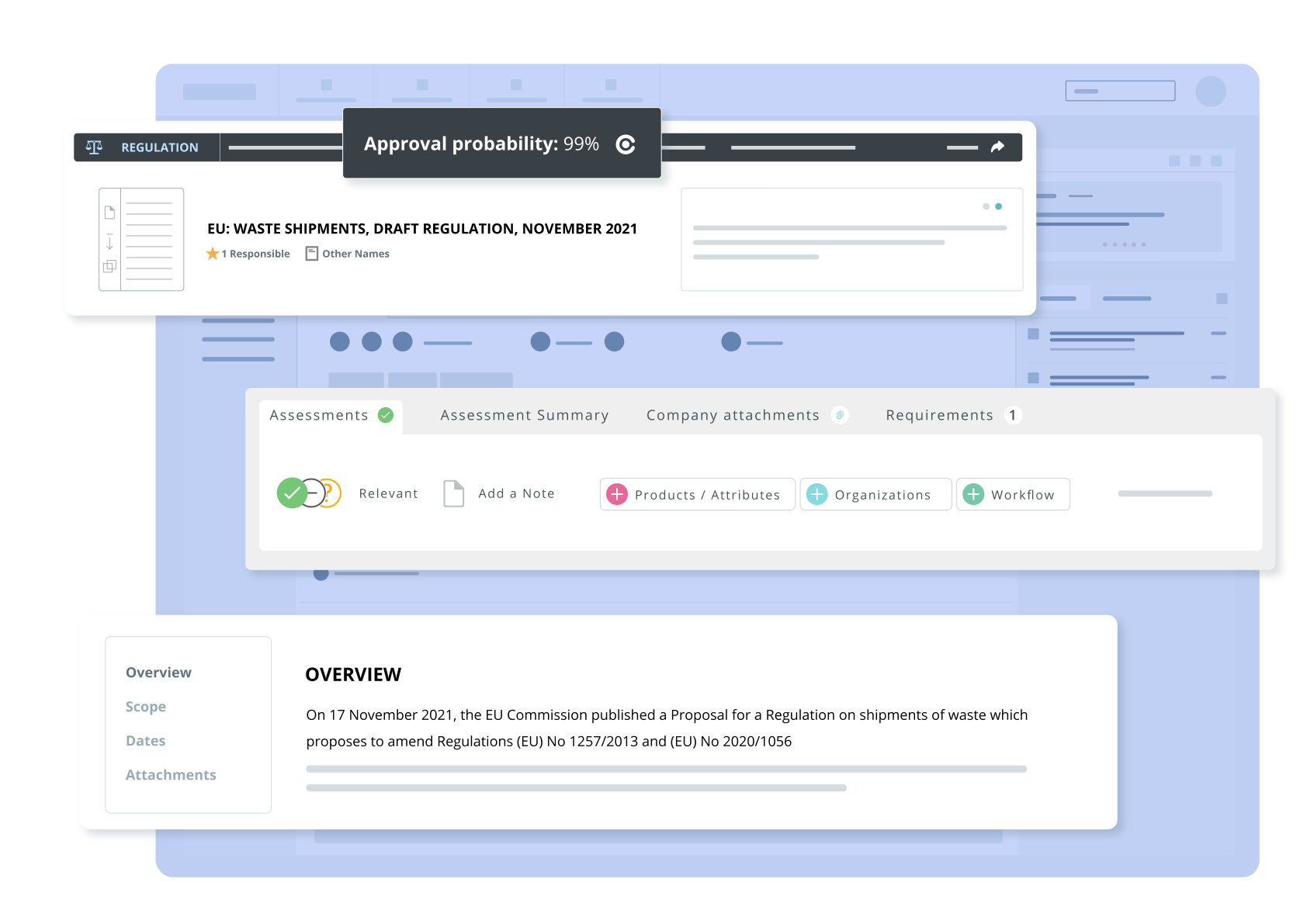
The top compliance trends in May 2026 is based on the most viewed regulations on C2P this month. If you would like to see C2P in action, book time with our team to witness the true power behind C2P.
Simplify Corporate Sustainability Compliance
Six months of research, done in 60 seconds. Cut through ESG chaos and act with clarity. Try C&R Sustainability Free.