What’s Trending in Compliance? January 2026

This blog was originally posted on 26th January, 2026. Further regulatory developments may have occurred after publication. To keep up-to-date with the latest compliance news, sign up to our newsletter.
At Compliance & Risks we empower global enterprises to unlock market access and confidently navigate regulatory complexity. With a 20-year legacy in regulatory intelligence, we help beloved global brands manage product and corporate sustainability obligations via C2P, transforming compliance into a force multiplier for enterprise growth.
Below we break down some of the top compliance trends in January 2026 that are generating the most interest globally this month.
1. USA: Toxic Substances Control Act (TSCA), Risk Evaluation Reports for BBP, DIBP, DBP, DCHP, DEHP and 1,3-Butadiene, December 2025
In December 2025, the U.S. Environmental Protection Agency (EPA) released the final risk evaluation and associated technical support documents for various chemical substances as set out below:
- Risk Evaluation for Butyl Benzyl Phthalate (BBP) – EPA Document # EPA-740-R-25-023
- Risk Evaluation for Diisobutyl Phthalate (DIBP) – EPA Document # EPA-740-R-25-027
- Risk Evaluation for Dibutyl Phthalate (DBP) – EPA Document # EPA-740-R-25-031
- Risk Evaluation for Dicyclohexyl Phthalate (DCHP) – EPA Document # EPA-740-R-25-038
- Risk Evaluation for 1,3-Butadiene – EPA Document # EPA-740-R-25-054
- Risk Evaluation forDiethylhexyl Phthalate (DEHP) – EPA Document # EPA-740-R-25-062
As the next step, the EPA will give companies clear rules to follow in relation to those substances that cause unreasonable risk (depending on specific conditions of use, if any).
2. EU: Call for Evidence for an Initiative on Better Regulation, Consultation Document, January 2026
On 7 January 2026, the European Commission published a Call for Evidence for an initiative titled “Communication on Better Regulation”.
This initiative aims to make the EU “Better Regulation” more efficient and proportionate, in order to shape better, simpler and more targeted EU laws that deliver for people and businesses.
The Commission currently uses a “Better Regulation” framework that has become complex, owing to factors including:
- The slow speed of the current system of evaluations and impact assessments;
- Stakeholder fatigue – people and businesses are being asked for feedback repeatedly through different channels;
- Regulatory burden – many EU laws have become so detailed and complex that they are difficult for countries to put into practice.
The initiative envisages measures to:
- Strengthen the proportionate application of better regulation, with a focus on achieving results;
- Make the consultation system smarter; and
- Ensure that EU laws are clearer, more straightforward, easier to implement and transpose, more enforceable and less burdensome.
Because this initiative would update the general framework for how the Commission legislates, it could eventually affect all areas of EU law.
The outcomes of this Call for Evidence will inform the preparation of the Communication, planned for adoption in Q2 2026.
Interested parties are invited to submit feedback before 4 February 2026.
3. USA: Uniform Packaging and Labeling Regulation, NIST Handbook 130, 2026
This Handbook, as last revised on 29 December 2025 by the U.S. National Institute of Standards and Technology (NIST), is a compilation of model laws and regulations, along with related interpretations and guidelines, designed to encourage uniformity in the adoption and implementation of weights and measures laws and regulations. It includes the Uniform Packaging and Labeling Regulation (UPLR), which provides model standards for the labeling of consumer and non-consumer commodities.
The Uniform Packaging and Labeling Regulation was first adopted by the National Conference on Weights and Measures (NCWM) in 1952. It has been continually revised to meet the complexities of an expansion in the packaging industry.
4. UK: Broadly Equivalent Standards for Packaging and Equivalent Standards for WEEE and Batteries, Guidance Document, December 2025
In December 2025, the UK Environment Agency published a guidance document on Broadly Equivalent Standards for Packaging and Equivalent Standards for WEEE and Batteries.
As per the Guidance, all evidence that companies submit to demonstrate equivalent environmental standards for packaging, batteries and waste electrical and electronic equipment (WEEE) shall:
- Relate to the overseas reprocessing site in the application;
- Have a valid date at the time of the application;
- Refer to the processing activity and the conditions and standards it needs to operate;
- Include copy of the original document, and an English translation if necessary;
- Have the competent authority’s official stamp on the original document if it is an environmental licence.
For waste that is subject to notification controls, companies should submit proof that they have applied for notification approval; and companies shall ensure that the shipped waste is classified correctly and all applicable controls are complied with. Furthermore, compliance with the Waste Import and Export Guidance is necessary.
The Guidance also provides a list of countries and guidance on regulation, however, companies are required to check if an export is allowed under the Waste Shipment Regulations. This can be done using the waste export controls tool.
5. India: Spectrum Roadmap for 6G Services, December 2025
On 31 December 2025, the Indian Department of Telecommunications published the Spectrum Roadmap for 6G Services.
The Department of Telecommunications (DoT) is laying the groundwork for India’s emergence as a leader in sixth-generation (6G) services.
The objectives of the Roadmap are to:
- Provide strategic long-term spectrum planning;
- Provide clear visibility of availability of spectrum over the next 10 years;
- Align national actions with with ITU-R and WRC Cycles;
- Vacate, re-farm or share radio frequency bands through modern coexistence techniques;
- Carry out collaborative research programmes to open 6G testbeds for start-ups and MSMEs, etc.
In addition to the existing frequency bands, the DoT has also identified additional spectrum to support the expansion of 5G and the future rollout of 6G services. Several new bands are being considered and made available through a structured, consultative process, involving key stakeholders. Timelines for the availability of spectrum is as follows:
- Short Term Planning (2025-2026);
- Mid Term Planning (2027-2030);
- Long Term Planning (2031-2035).
Unlock Market Access
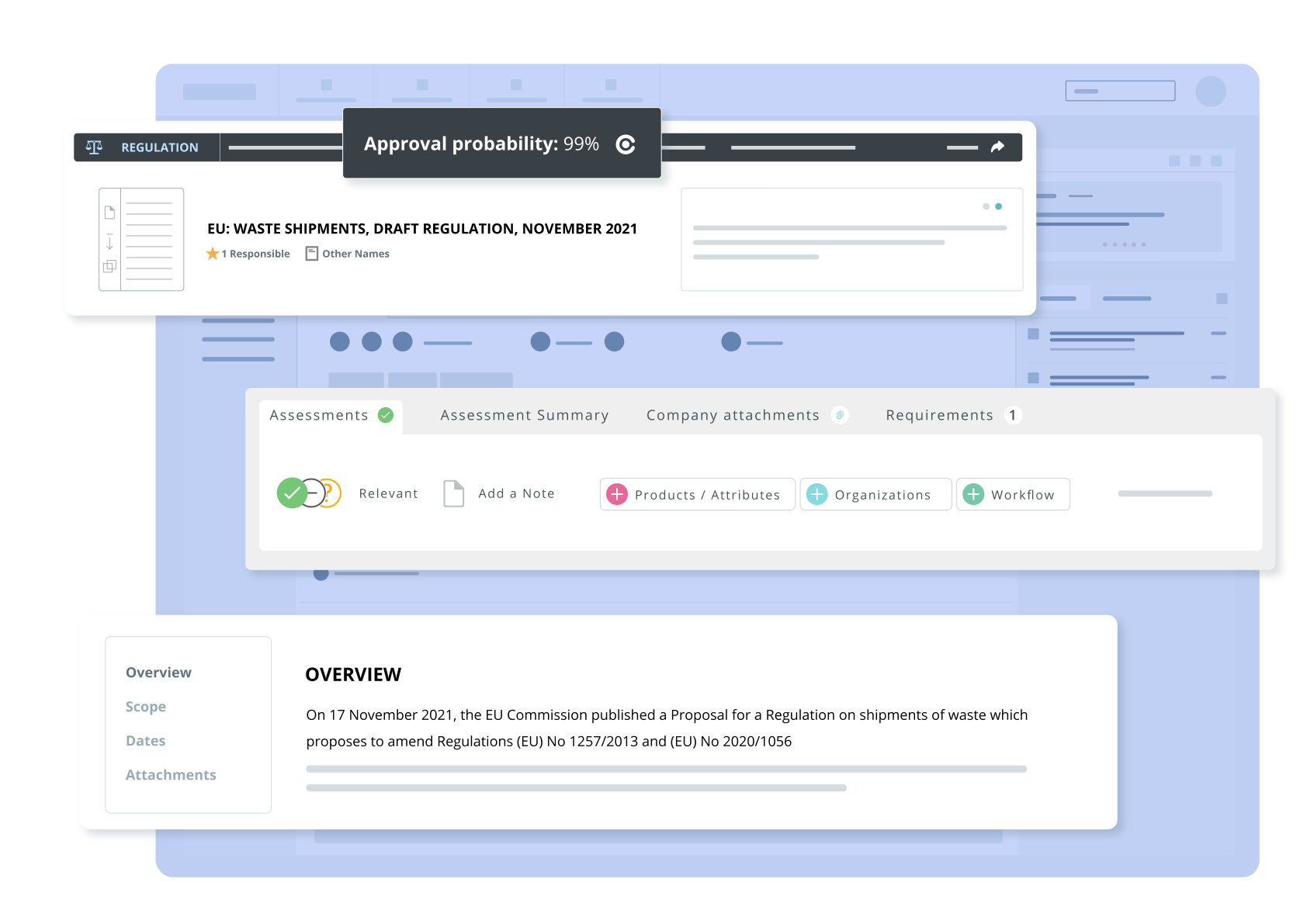
The top compliance trends in January 2026 is based on the most viewed regulations on C2P this month. If you would like to see C2P in action, book time with our team to witness the true power behind C2P.
Simplify Corporate Sustainability Compliance
Six months of research, done in 60 seconds. Cut through ESG chaos and act with clarity. Try C&R Sustainability Free.