Building a Compliance Program Risk Assessment Model That Actually Works
THIS BLOG WAS WRITTEN BY THE COMPLIANCE & RISKS MARKETING TEAM TO INFORM AND ENGAGE. HOWEVER, COMPLEX REGULATORY QUESTIONS REQUIRE SPECIALIST KNOWLEDGE. TO GET ACCURATE, EXPERT ANSWERS, PLEASE CLICK “ASK AN EXPERT.”
If we’re all being honest, the annual compliance risk assessment can feel like a chore. A massive, spreadsheet-fueled, box-ticking exercise that consumes weeks of your team’s time, only to produce a static document that’s outdated the moment you save it. You know the drill.
But what if we looked at it differently? What if that assessment wasn’t just a defensive measure, but the single most valuable ROI-generating activity in your entire program?
The stakes have never been higher. The average cost of non-compliance is now a staggering $14.82 million per year – nearly three times the cost of actually maintaining compliance. And with U.S. regulators handing out $4.3 billion in penalties in 2024 alone, the cost of getting it wrong is more than just a line item; it’s an existential threat.
This isn’t about fear-mongering. It’s about a fundamental shift in perspective. A robust, dynamic compliance program risk assessment model isn’t just about avoiding fines. It’s about building a resilient, intelligent organization that can see around corners.
This guide is designed for you – the compliance leader who knows there’s a better way. We’re going to walk through how to move beyond the limitations of manual processes and build a risk assessment model that gives you clarity, defensibility, and a true competitive edge.
Table of Contents
- The Real Cost of Getting Compliance Wrong
- The Crossroads: Is Your Manual Risk Matrix Holding You Back?
- A 6-Step Quantitative Risk Assessment Methodology You Can Actually Use
- The New Frontier: Assessing Risks Your Competitors Are Ignoring
- The Hidden Bottleneck: Why Data Integration Is the Hardest Part
- Choosing Your Path: A Practical Comparison of Risk Assessment Solutions
- Key Takeaways: Your Blueprint for a Modern Risk Assessment
- Frequently Asked Questions (FAQ)
- From Checkbox to Competitive Advantage: What’s Next?
The Real Cost of Getting Compliance Wrong
The numbers are in, and they paint a stark picture. Companies that invest in robust compliance programs spend, on average, $5.47 million annually. Those that don’t? They face an average cost of $14.82 million from fines, penalties, business disruption, and reputational damage.
It’s a simple calculation with profound implications. Every dollar you invest in proactive compliance delivers nearly a 3x return in avoided losses. This is why 95% of firms increased their compliance spending in 2023. They’re not just throwing money at a problem; they’re making a strategic investment in resilience and predictability.
Your risk assessment is the foundation of that investment. It’s the diagnostic tool that tells you where to allocate resources, where your biggest vulnerabilities lie, and where you have opportunities to strengthen your operations. A weak assessment leads to misallocated budget, blind spots, and, ultimately, a reactive, firefighting culture. A strong one provides the intelligence to act before an issue becomes a crisis.
The Crossroads: Is Your Manual Risk Matrix Holding You Back?
Every organization reaches a decision point. The way you’ve always done things – the trusted Excel spreadsheet with its color-coded cells and pivot tables – starts to show its cracks.
The Familiar Pain of Excel-Based Assessments
You know the moment. You’re trying to consolidate feedback from three different departments, the version control is a mess, and you have a sinking feeling that the underlying data from Q2 is already stale.
Manual assessments are plagued by chronic challenges:
- Data Silos: Your risk data lives everywhere – in HR systems, IT logs, audit reports, and third-party vendor files. Manually stitching this together is a nightmare of inconsistency and human error.
- Static Snapshots: An Excel-based assessment is a picture of a single moment in time. But risk is dynamic. New regulations emerge, controls degrade, and business processes change. Your annual snapshot is obsolete almost immediately.
- Subjectivity and Inconsistency: The “Low,” “Medium,” and “High” ratings are often based on gut feel. What one department head considers a high-impact risk, another might dismiss. This lack of a quantitative backbone makes prioritization and justification nearly impossible.
The Shift to Dynamic, Continuous Models
The alternative isn’t just a better spreadsheet. It’s a fundamentally different approach: a dynamic risk model powered by technology. Think of it as moving from a paper map to a live GPS.
Instead of a once-a-year event, risk assessment becomes a continuous, automated process. This is the core promise of GRC (Governance, Risk, and Compliance) platforms. Organizations that adopt this technology see immediate, tangible benefits: 64% report better visibility into their risk landscape, and 53% can identify and respond to issues faster.
A dynamic model connects directly to your business systems, ingesting real-time data to update risk scores and alert you to emerging threats. It transforms compliance from a reactive, historical review into a proactive, forward-looking function.
A 6-Step Quantitative Risk Assessment Methodology You Can Actually Use
So, how do you build this? Whether you’re refining your manual process or preparing to adopt a GRC platform, the methodology is the same. Here’s a structured approach that moves beyond subjective scales and builds a defensible, data-driven model.
Step 1: Define Your Regulatory Universe
Before you can assess risk, you have to know what rules you’re playing by. This goes beyond just listing regulations like RoHS or REACH. Your “regulatory universe” includes:
- External Regulations: Federal, state, and international laws.
- Industry Standards: Frameworks like ISO 27001 or specific industry codes of conduct.
- Contractual Obligations: Commitments made to customers and partners.
- Internal Policies: Your own code of conduct and ethical guidelines.
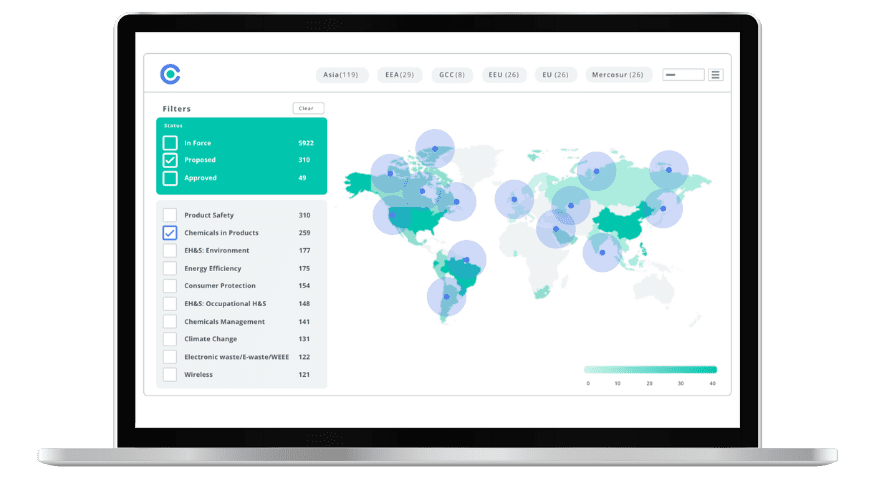
The goal is to create a comprehensive, centralized library of all your obligations. A tool like the C2P Platform can be invaluable here, providing a live, curated feed of global regulations relevant to your products and markets.
Step 2: Map Risk to Your Actual Processes
A regulation doesn’t exist in a vacuum. It impacts a specific business process, product line, or operational unit. The next step is to identify these “risk contact points.”
For example, a data privacy regulation like GDPR doesn’t just impact your legal team. It impacts:
- Marketing: How they collect and use customer data.
- Product Development: Building “privacy by design” into new features.
- HR: Handling employee data.
- IT: Securing the infrastructure where data is stored.
By mapping obligations to the specific processes they touch, you move from abstract rules to concrete operational risks.
Step 3: Score Inherent Risk (with Velocity)
This is where we leave the “Low/Medium/High” world behind. Inherent risk is the level of risk that exists before you apply any controls. A truly quantitative model needs more than two axes.
A more robust formula looks like this:
Inherent Risk Score = (Likelihood x Impact x Vulnerability)
- Likelihood (1-5): How probable is a compliance failure?
- Impact (1-5): What is the financial, reputational, and operational fallout?
- Vulnerability (1-5): How susceptible is this specific process to this type of failure?
But here’s the factor most models miss: Velocity.
Risk Velocity is the speed at which a risk can materialize and impact the organization. A slow-burning supply chain issue is dangerous, but a sudden data breach can be catastrophic in hours.
Think about adding a velocity score (1-5, where 5 is fastest) as a multiplier or a critical weighting factor. This helps you distinguish between risks that are equally severe but demand vastly different response times.
Step 4: Measure Control Effectiveness to Find Residual Risk
No process is without its safeguards. Now, you identify and assess the effectiveness of the controls you have in place to mitigate each identified risk. Controls can be preventative (e.g., automated system checks) or detective (e.g., monthly audits).
Rate each control’s effectiveness (e.g., 1 for weak, 5 for highly effective). Residual Risk is what’s left over.
Residual Risk = Inherent Risk Score – Control Effectiveness Score
This simple calculation gives you a clear, quantitative measure of your current risk exposure. It’s the number that tells you where your defenses are strong and, more importantly, where they are weak.
Step 5: Prioritize and Justify Remediation
With a list of quantified residual risks, prioritization becomes an objective exercise, not a political debate. You can create a heat map that clearly shows which risks pose the greatest threat to the organization.
This data is your business case. Instead of saying, “I think we need to invest in supply chain monitoring,” you can say, “We have a residual risk score of 22 in our supply chain, driven by high vulnerability and velocity. An investment of $X in a new monitoring system will improve our control effectiveness by 3 points, reducing our exposure by 40% and mitigating a potential multi-million dollar disruption.”
Step 6: Create a Continuous Feedback Loop
Finally, this entire process must be a living system, not a static report.
- Continuous Monitoring: Use technology to monitor control effectiveness and changes in the regulatory landscape in real time.
- Trigger Events: Define triggers (e.g., a new regulation, a failed audit, a new market entry) that automatically initiate a risk reassessment for the affected area.
- Regular Reporting: Generate dynamic dashboards for leadership that show risk trends over time, not just a snapshot.
The New Frontier: Assessing Risks Your Competitors Are Ignoring
A world-class compliance program doesn’t just manage today’s risks; it anticipates tomorrow’s. Two areas are rapidly emerging as major compliance battlegrounds, and most traditional risk assessment models are completely unprepared to handle them.
The Compliance Risk of AI Itself
Companies are racing to deploy AI, but few are assessing the unique compliance risks it creates. We’re not just talking about data privacy. You need a framework to assess:
- Model Governance Risk: Is there a clear process for approving, deploying, and monitoring AI models? Who is accountable if a model makes a biased or harmful decision?
- Bias and Fairness Risk: Is the model trained on data that reflects historical biases? How are you testing for and mitigating discriminatory outcomes?
- Explainability Risk: If a regulator or customer challenges a decision made by your AI, can you explain how it arrived at that conclusion? A “black box” is no longer a defensible position.
Integrated ESG Compliance
Environmental, Social, and Governance (ESG) is evolving from a corporate responsibility initiative into a hard-and-fast compliance domain with complex, interconnected risks. A modern risk assessment must be able to:
- Track Global Divergence: ESG regulations are fragmented and constantly changing across jurisdictions. You need to assess the risk of non-compliance with dozens of different standards.
- Map Supply Chain Dependencies: Your ESG risk doesn’t end at your own factory doors. You need visibility into the labor practices, carbon footprint, and ethical sourcing of your entire supply chain.
- Validate Data Integrity: How do you prove your ESG claims? Your assessment must include the risk of “greenwashing” and the controls needed to ensure your reporting is accurate and auditable.
The Hidden Bottleneck: Why Data Integration Is the Hardest Part
Here’s the uncomfortable truth about moving to a dynamic risk model: the biggest hurdle isn’t the methodology; it’s your data. The reason most companies are stuck in Excel is because their critical risk information is fragmented across dozens of legacy systems that don’t talk to each other.
This is the challenge of data integration. To build a truly continuous model, you need a system that can:
- Connect to Anything: Use robust APIs to pull data from HR, ERP, IT, and third-party systems.
- Normalize and Cleanse Data: Take data in different formats and translate it into a single, consistent structure for analysis.
- Sync in Real Time: Ensure that the data feeding your risk model reflects what’s happening in the business right now, not last quarter.
Without solving the data integration problem, “continuous monitoring” is just a buzzword. A modern GRC platform’s most important feature isn’t the dashboard; it’s the powerful integration engine running underneath. For more on this, explore our resources on achieving end-to-end product compliance.
Choosing Your Path: A Practical Comparison of Risk Assessment Solutions
You have options, and the right choice depends on your organization’s maturity, complexity, and scale.
| Criteria | Manual (Excel) | Consulting-Led | GRC Platform |
|---|---|---|---|
| Cost | Low initial cost, high hidden labor cost. | High upfront and ongoing fees. | Subscription-based, scales with usage. |
| Speed | Extremely slow and labor-intensive. | Faster initial setup, but still relies on periodic manual reviews. | Real-time. Continuous updates and immediate insights. |
| Precision | Low. Highly subjective and prone to human error. | Medium to High. Depends on consultant quality, but still a static snapshot. | High. Quantitative, data-driven, and consistent. |
| Scalability | Very poor. Breaks down with increased complexity or global scope. | Moderate. Can scale by adding more consultants, but at a high cost. | Excellent. Built to handle global regulations and complex organizations. |
| Audit Readiness | Low. Difficult to prove methodology and produce evidence. | High. Produces a defensible, well-documented report for a specific point in time. | Very High. Provides a complete, time-stamped audit trail of all risk activities. |
Key Takeaways: Your Blueprint for a Modern Risk Assessment
- What is the core purpose of a compliance risk assessment? It is to identify, analyze, and evaluate potential compliance failures so you can prioritize resources to mitigate them. Its modern purpose is to move beyond avoiding fines and become a source of strategic business intelligence.
- How do you create a risk assessment model? Follow a 6-step process: (1) Define your regulatory universe, (2) Map risks to business processes, (3) Quantitatively score inherent risk (including velocity), (4) Assess controls to find residual risk, (5) Prioritize remediation, and (6) Implement continuous monitoring.
- Why are manual, Excel-based models insufficient? They are static, siloed, subjective, and unable to keep pace with dynamic business environments and emerging risks like AI and ESG, making them a poor defense against the average $14.82 million cost of non-compliance.
Frequently Asked Questions (FAQ)
- Q: We’re not ready for a full GRC platform. Can we start with a hybrid model?
The best first step is to adopt the quantitative methodology outlined above within your current process. By moving from “Low/Medium/High” to a numerical scoring system, you’ll immediately improve the quality and defensibility of your assessment. This builds the foundation and the business case for future technology adoption. - Q: How do I justify the cost of GRC software to my CFO?
Frame it as an ROI decision, not a cost. Focus on three key areas: (1) Risk Reduction: Compare the platform’s cost to the multi-million dollar average cost of a compliance failure; (2) Efficiency Gains: Calculate the hundreds of hours your team spends on manual data collection, consolidation, and reporting. Automating this frees them up for higher-value strategic work; (3) Business Enablement: A dynamic risk model allows the company to move faster – entering new markets or launching new products with a clear understanding of the compliance landscape. - Q: Our data is a mess. Do we need to fix it all before using a GRC tool?
GRC platform is one of the best tools for tackling data quality issues. By attempting to integrate your systems, you quickly shine a light on where the inconsistencies and gaps are. The platform becomes your central hub for identifying, managing, and resolving data quality problems over time. - Q: What’s the difference between enterprise risk management (ERM) and a compliance risk assessment?
ERM takes a broader, top-down view of all risks to the organization (strategic, financial, operational, etc.). A compliance risk assessment is a bottom-up process focused specifically on the risk of failing to meet regulatory, legal, and internal policy obligations. The two are deeply connected, and the output of your compliance risk assessment should be a critical input into the overall ERM framework.
From Checkbox to Competitive Advantage: What’s Next?
The days of viewing compliance as a cost center are over. A well-executed, technology-enabled risk assessment program is a powerful engine for strategic growth. It provides the board with assurance, empowers business leaders to make smarter decisions, and builds a culture of resilience that can withstand the complexity of the modern regulatory world.
Moving from a static spreadsheet to a dynamic, intelligent system is a journey. The first step is recognizing the limitations of your current approach and understanding the immense value that a modern model can deliver.
If you’re ready to transform your compliance risk assessment from an annual chore into a strategic asset, let’s talk. Explore how C2P’s integrated platform provides the real-time regulatory intelligence and risk management tools you need to build a truly world-class compliance program.
Experience the Future of ESG Compliance
The Compliance & Risks Sustainability Platform is available now with a 30-day free trial. Experience firsthand how AI-driven, human-verified intelligence transforms regulatory complexity into strategic clarity.
👉 Start your free trial today and see how your team can lead the future of ESG compliance.
The future of compliance is predictive, verifiable, and strategic. The only question is: Will you be leading it, or catching up to it?
Simplify Corporate Sustainability Compliance
Six months of research, done in 60 seconds. Cut through ESG chaos and act with clarity. Try C&R Sustainability Free.