The Predictive Design for Compliance Methodology: A Framework for Agile Innovation
THIS BLOG WAS WRITTEN BY THE COMPLIANCE & RISKS MARKETING TEAM TO INFORM AND ENGAGE. HOWEVER, COMPLEX REGULATORY QUESTIONS REQUIRE SPECIALIST KNOWLEDGE. TO GET ACCURATE, EXPERT ANSWERS, PLEASE CLICK “ASK AN EXPERT.”
The nightmare scenario repeats itself across industries. Your team has poured months, maybe years, into a product. It’s elegant, it’s innovative, it’s ready. And then, at the eleventh hour, a single email from the regulatory team brings everything to a screeching halt. A substance in a minor component is now restricted in a key market. The documentation isn’t audit-ready. The launch date, once a fixed point on the horizon, is now a question mark.
This isn’t a failure of engineering or design. It’s a failure of process. It’s the painful, expensive result of treating compliance as a final checkbox instead of a core design principle.
For too long, we’ve accepted this reactive, gate-based approach to compliance. But what if we could flip the script? What if, instead of asking “Is this design compliant?” at the end, we started by asking “How can we design for compliance from the very first sketch?”
This is more than a semantic shift. It’s a strategic imperative. And it requires a new model – one built for the speed of modern, agile development. We call it the Predictive Design for Compliance (P-DfC) Methodology. It’s a framework for embedding regulatory intelligence into every stage of your product lifecycle, turning compliance from a bottleneck into a competitive advantage.
Table of Contents
- The Hidden Cost of Compliance Failure: Why DfC is a $67M Strategic Imperative
- The P-DfC Framework: A Phased Approach
- Choosing Your DfC Stack: Specialized Software vs. Traditional PLM
- Technical Deep Dive: Auditable Design in a World of Constant Iteration
- Key Takeaways: Your Path to Predictive Compliance
- Frequently Asked Questions
- Building a Culture of Compliance-Driven Innovation
The Hidden Cost of Compliance Failure: Why DfC is a $67M Strategic Imperative
Let’s talk numbers, because the cost of getting compliance wrong is staggering. It’s not just about potential fines, though the average cost of non-compliance for an organization hovers around a painful $15 million. The real damage is far greater.
The data is clear: the cost of non-compliance is, on average, 2.7 times higher than the cost of maintaining compliance. It’s the difference between a planned investment and an emergency bailout.
But even that figure doesn’t capture the biggest threat: loss of market access. Think about it. A single compliance deficiency can trigger a market access delay. And what does that actually cost? According to our own research, a 16-month delay can result in $67 million in lost revenue. That’s not a fine; that’s a catastrophic opportunity cost. It’s the revenue you never get back, the market share seized by a competitor who got there first, and the damage to investor confidence.
This is why Design for Compliance isn’t a line item for the legal department. It’s a C-suite level strategic imperative. It’s about revenue protection, risk mitigation, and speed to market. It’s about ensuring your innovation actually reaches your customers.
The P-DfC Framework: A Phased Approach
The Predictive Design for Compliance (P-DfC) methodology is designed to move your organization from a state of reactive panic to proactive control. It’s built on two core phases that integrate seamlessly into modern workflows.
Phase 1: Regulatory Forecasting (The “Predictive” Layer)
The most effective way to solve a compliance problem is to avoid it in the first place. Reactive compliance waits for a regulation to be published. Predictive compliance gets ahead of it.
This means your team needs to be tracking not just current laws, but proposed legislation, amendments, and regulatory trends. Are key markets discussing new restrictions on PFAS chemicals? Is the EU AI Act going to impact your product’s software? Knowing the answers to these questions during the concept phase is a superpower.
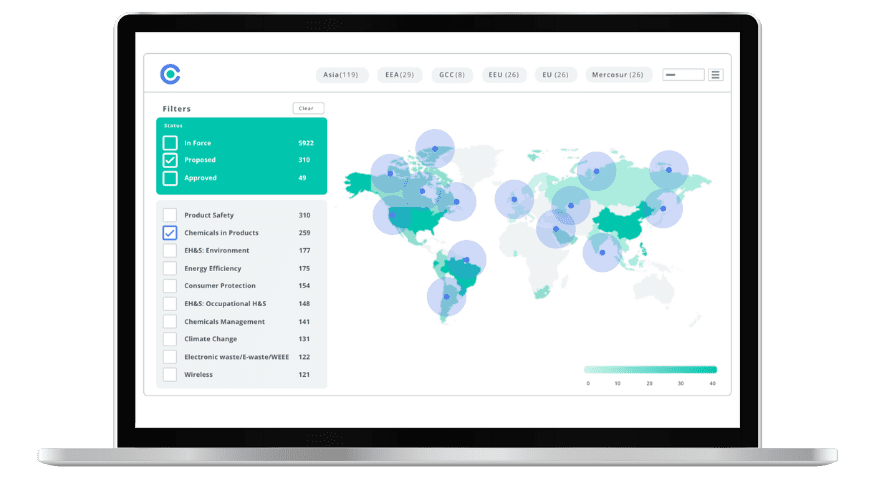
This is where technology becomes essential. Manually tracking regulatory updates across 195 countries is impossible. A modern approach leverages AI to monitor global regulatory bodies, providing your teams with early warnings and impact assessments.
But here’s the crucial part: for your engineers and designers to trust this AI, it needs to be transparent. This is the role of Explainable AI (XAI). XAI doesn’t just give you a recommendation; it shows its work. It provides the “why” behind its conclusions – citing the specific regulatory text or proposed amendment – which is critical for building confidence and creating an auditable trail for your design decisions. You’re no longer guessing; you’re making data-driven choices about the future.
Phase 2: Agile Integration & Cross-Functional Alignment
Having predictive intelligence is only half the battle. You need to embed that intelligence into the day-to-day chaos of your product development cycle. For agile teams, this can feel like a clash of cultures: agile’s speed versus regulatory’s rigidity.
The solution is not to slow down agile, but to make compliance agile. Here’s how:
1. Integrate Compliance into the “Definition of Done”
This is the single most powerful tactical change you can make. Research shows that teams integrating regulatory requirements directly into their sprints see 40% fewer compliance-related delays.
What does this look like in practice?
- A user story for a new hardware component isn’t “done” until its material composition has been checked against a real-time database of global regulations.
- A software feature isn’t “done” until its data handling protocols are documented to meet GDPR or CCPA standards.
- A JIRA ticket might have a sub-task: “Confirm all sub-components are REACH and RoHS compliant for the EU market.”
This approach transforms compliance from a final, monolithic gate into a series of small, manageable checks that happen continuously.
2. Establish a Clear Collaboration Model
Vague calls for “better collaboration” are useless. You need a system. Think of it as “Compliance as Code,” where rules and roles are clearly defined.
- Regulatory Team as Architects: Your compliance experts don’t act as gatekeepers. They act as architects, curating a “golden library” of pre-vetted materials, suppliers, and software components within a central platform.
- Engineering Team as Builders: Your engineers are empowered to pull from this library, confident that what they’re using is already compliant. This drastically reduces friction and decision fatigue.
- The Automated Triage: What happens when an engineer needs a new, unvetted component? The system automatically flags it. It doesn’t say “no.” It says “this needs review” and routes it to the right expert, with all the necessary data attached. The process is clear, auditable, and fast.
This model aligns everyone around a shared, accessible source of truth, eliminating the endless email chains and spreadsheet chaos that plague traditional compliance workflows.
Choosing Your DfC Stack: Specialized Software vs. Traditional PLM
You can’t run a modern DfC methodology on spreadsheets and email. You need a technology stack that supports this proactive, integrated approach. For many, the debate comes down to using their existing Product Lifecycle Management (PLM) system versus investing in a specialized product compliance platform.
While many PLMs claim to handle compliance, they often treat it as a generic attribute field. They are fundamentally designed for product data management, not deep regulatory intelligence. Think of it this way: a PLM knows what is in your product; a specialized compliance platform knows what that means for every market you sell in.
Here’s a breakdown of how they compare on the factors that actually matter for DfC:
| Feature | Traditional PLM System | Specialized Compliance Platform |
|---|---|---|
| Regulatory Intelligence | Static, often relies on manual data entry or third-party plugins. | Dynamic, with real-time updates from a global team of legal experts and AI monitoring. |
| Depth of Coverage | Surface-level. May track a few major regulations like RoHS. | Deep and granular, covering thousands of regulations across product safety, ESG, materials, and more. |
| Supply Chain Visibility | Limited. Tracks direct suppliers but often lacks visibility into sub-tier compliance. | Robust. Designed to cascade requirements and collect evidence deep into the supply chain. |
| Predictive Analytics | Non-existent. It’s a historical record of the product, not a forward-looking tool. | Core functionality. Identifies and analyzes emerging regulations and their potential business impact. |
| Audit & Reporting | Can be cumbersome. Often requires custom reports and manual data compilation. | Audit-ready by design. Generates comprehensive compliance reports and evidence dossiers with one click. |
The reality is, in regulated industries, relying on a generic PLM for compliance is like asking your CAD software to do your financial accounting. It’s the wrong tool for the job. A dedicated platform provides the depth, agility, and foresight needed to execute a true P-DfC strategy.
Technical Deep Dive: Auditable Design in a World of Constant Iteration
One of the biggest anxieties for engineering leaders is documentation. How do you maintain a perfect, regulator-ready audit trail when your design is changing every single day?
The traditional approach of creating massive design history files at the end of a project is a non-starter in an agile world. The key is automated, contemporaneous evidence collection.
Your DfC platform should act as a central repository that automatically links design decisions to compliance evidence.
- When an engineer selects a component, the system logs the timestamp and the specific version of the compliance rule it was checked against.
- When a supplier uploads a Full Material Declaration (FMD), it’s automatically attached to every product that uses that part.
- When a requirement changes due to a new regulation, the system automatically flags every affected product and creates a task to assess the impact.
This creates a living, breathing audit trail. It’s not something you have to painstakingly assemble months after the fact. It’s an organic output of your daily workflow. This is how high-stakes industries like medical devices manage FDA requirements (e.g., 21 CFR Part 820.30), and it’s a best practice that every hardware and software company can and should adopt. It’s about making your process inherently auditable, freeing your team to focus on innovation, not paperwork.
For a comprehensive approach to maintaining audit-ready documentation, explore our guide on compliance documentation lifecycle management.
Key Takeaways: Your Path to Predictive Compliance
- What is Design for Compliance (DfC)? DfC is the practice of integrating regulatory requirements into the earliest stages of the product design and development lifecycle, rather than treating compliance as a final check before launch.
- Why is DfC a Strategic Priority? Because non-compliance costs 2.7x more than compliance and market access delays can cost upwards of $67 million in lost revenue. Proactive DfC is a powerful risk mitigation and revenue protection strategy.
- How do you implement DfC in an Agile environment? By adopting the Predictive Design for Compliance (P-DfC) methodology. This involves two key phases: (1) using AI and expert analysis for regulatory forecasting and (2) integrating compliance checks directly into the Agile “Definition of Done” for continuous validation. This can reduce compliance-related delays by up to 40%.
- What tools do you need? While traditional PLM systems manage product data, a specialized regulatory tracking platform is essential for providing the deep, real-time, and predictive intelligence required for a successful DfC strategy.
Frequently Asked Questions
- Q: Our team is small. Doesn’t a system like this create too much overhead?
It’s actually the opposite. For small teams, the cost of a reactive compliance failure is even more acute. A proper DfC process, supported by the right platform, automates the most time-consuming work – researching regulations, chasing suppliers for data, and compiling reports. It frees up your limited engineering resources to focus on their core job: building great products. - Q: My PLM provider says they have a “compliance module.” Isn’t that enough?
You have to ask: is that module providing proactive, predictive intelligence, or is it just a glorified data field you have to update manually? Does it give you deep analysis of thousands of global regulations in real-time? For most PLMs, the answer is no. They provide a place to store compliance data, not a system to generate compliance intelligence. - Q: This sounds expensive. How do we justify the investment?
Frame it in terms of cost avoidance and ROI. Compare the subscription cost of a compliance platform to the $15 million average cost of non-compliance or the $67 million risk of a major market delay. The business case is incredibly clear. This isn’t a cost center; it’s an insurance policy that pays dividends in speed, market access, and brand reputation.
Building a Culture of Compliance-Driven Innovation
Moving to a Predictive Design for Compliance model is more than a process change; it’s a cultural shift. It’s about reframing compliance not as a department of “no,” but as a source of strategic insight that enables smarter, faster, and safer innovation.
When your engineers have regulatory requirements at their fingertips from day one, they can innovate with confidence. When your leadership team can see and mitigate risk months or years in advance, they can make bolder strategic bets.
The old way – designing in a vacuum and hoping for the best at the end – is a gamble your business can no longer afford to take. The future belongs to teams that build compliance in, not bolt it on.
Ready to de-risk your next product launch? Learn how the C2P platform by Compliance & Risks provides the predictive intelligence and integrated workflow you need to build a world-class Design for Compliance program.
Experience the Future of ESG Compliance
The Compliance & Risks Sustainability Platform is available now with a 30-day free trial. Experience firsthand how AI-driven, human-verified intelligence transforms regulatory complexity into strategic clarity.
👉 Start your free trial today and see how your team can lead the future of ESG compliance.
The future of compliance is predictive, verifiable, and strategic. The only question is: Will you be leading it, or catching up to it?
Six Months of Research, Done in 60 Seconds
Cut through ESG chaos and act with clarity. Try C&R Sustainability Free.