What’s Trending in Compliance? March 2026

This blog was originally posted on 23rd March, 2026. Further regulatory developments may have occurred after publication. To keep up-to-date with the latest compliance news, sign up to our newsletter.
At Compliance & Risks we empower global enterprises to unlock market access and confidently navigate regulatory complexity. With a 20-year legacy in regulatory intelligence, we help beloved global brands manage product and corporate sustainability obligations via C2P, transforming compliance into a force multiplier for enterprise growth.
Below we break down some of the top compliance trends in March 2026 that are generating the most interest globally this month.
1. EU: REACH Restriction Proposal on Per- and Polyfluoroalkyl Substances (PFAS), Questions and Answers Document, March 2026
The European Chemicals Agency’s (ECHA) Risk Assessment Committee (RAC) has concluded its evaluation of the universal restriction proposal on all per- and polyfluoroalkyl substances (PFAS). Its opinion is the first part of ECHA’s two-committee scientific evaluation of the proposal.
RAC has adopted its opinion based on extensive and independent evaluation of PFAS hazards as well as its practicality (including enforceability). The evaluation is based on the proposal submitted in January 2023 by the Dutch, German, Danish, Norwegian and Swedish authorities. This proposal covered all PFAS and all uses.
Further to RAC’s final opinion (on 2 March 2026), on 11 March 2026, ECHA’s Socio-Economic Analysis Committee (SEAC) agreed its draft opinion which will be published imminently for a 60-day consultation. SEAC is expected to adopt its final opinion by the end of 2026. It will take into account new information received in the consultation where relevant. This adoption will conclude ECHA’s Committees’ scientific evaluation of the proposed restriction and the opinions will then be formally submitted to the EU Commission.
2. Canada: Proposed Revisions to the Radio Frequency Allocation Table, Consultation Document, March 2026
On 5 March 2026, Innovation, Science and Economic Development Canada (ISED) proposed amendments to the Canadian Table of Frequency Allocations (the Table) to reflect the outcomes of the 2023 World Radiocommunication Conference (WRC-23) and domestic requirements.
The Table was last modified in 2022 and now the ISED invites comments on the new proposals, as well as any input to ensure the completeness and accuracy of the Table.
The deadline for comments is 4 May 2026.
3. USA: Energy Conservation Program: Energy Conservation Standards for Small Electric Motors, Final Determination, 10 CFR Part 431, February 2026
In February 2026, the U.S. Department of Energy (DOE) published a Final Determination on Energy Conservation Program: Energy Conservation Standards for Small Electric Motors.
DOE concluded that more stringent standards for Small Electric Motors would not be economically justified or cost-effective. As a result, DOE decided not to amend the existing energy conservation standards for these motors.
4. EU: Guidance on the Application of Regulation (EU) 2024/2847 (Cyber Resilience Act), Draft Communication, March 2026
On 3 March 2026, the European Commission released the draft guidance on the practical application of the Cyber Resilience Act.
The draft provides clarity on high-stake questions concerning:
- Scope;
- Free and open-source software;
- Substantial modifications and spare parts;
- Support period;
- Important and critical products;
- Cybersecurity risk assessment and integration of products and components;
- Remote data processing;
- Reporting obligations;
- Vulnerability handling; and
- Interplay with other legislation.
Feedback on the draft may be submitted until 31 March 2026.
5. Singapore: Mandatory Compliance Requirements for Regulated Goods Under the Energy Conservation Act, Circular, February 2026
On 27 February 2026, the Singapore National Environment Agency (NEA) published a Circular reiterating the mandatory compliance requirements for certain regulated goods under the Energy Conservation Act. Concerned products include:
- Commercial storage refrigerators (CSRs);
- Water heaters;
- Televisions with resolution of 33,177,600 pixels (8K TV);
- Single-phase split type air-conditioners (including single-phase VRF); and
- Household refrigerators.
These goods imported or manufactured must meet the Minimum Energy Performance Standards (MEPS) and comply with the Mandatory Energy Labelling Scheme (MELS) from 1 April 2026 as the transition period of clearing existing non-compliant stock is expiring. Fines for non-compliance are set not exceeding $10,000.
Unlock Market Access
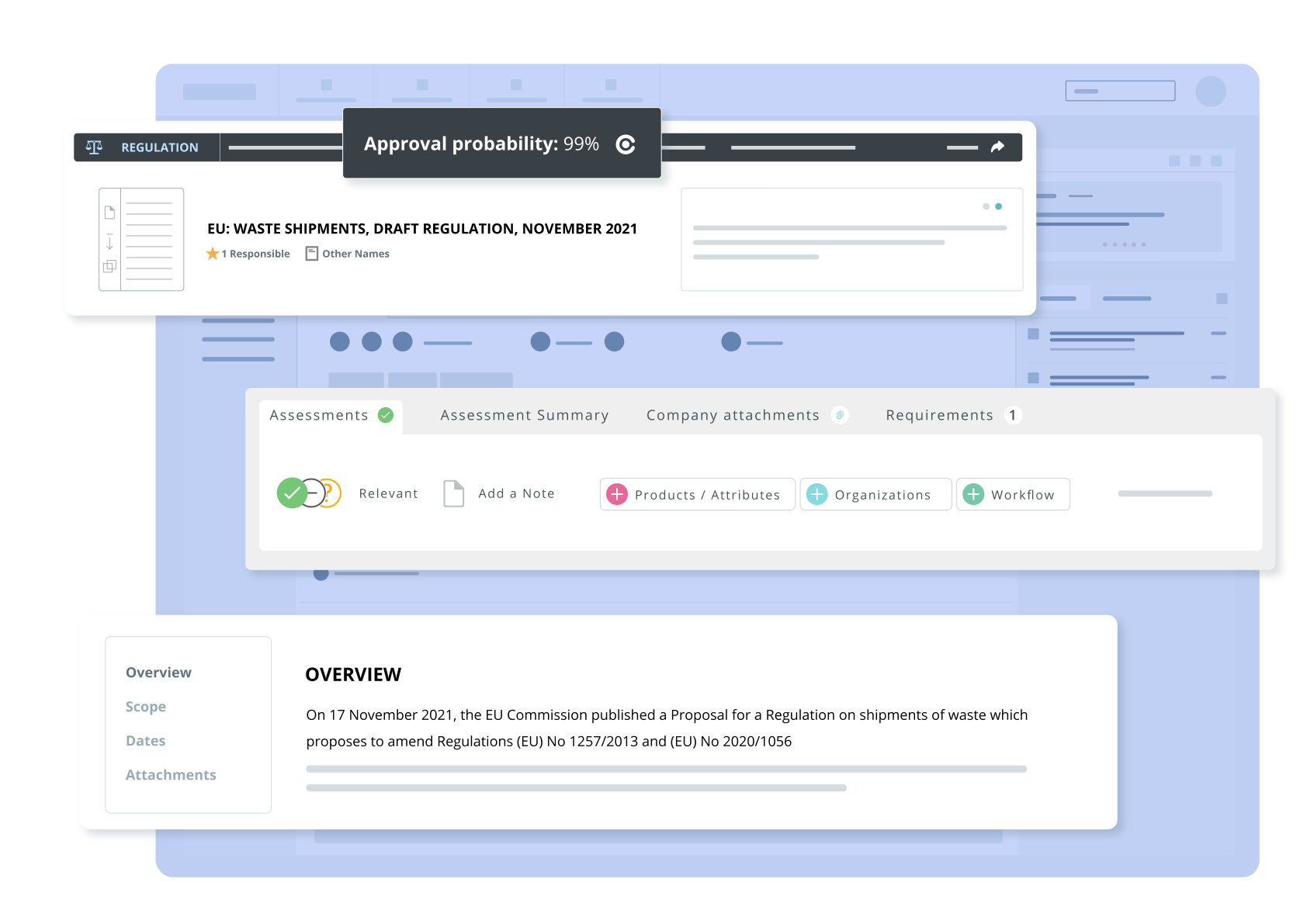
The top compliance trends in March 2026 is based on the most viewed regulations on C2P this month. If you would like to see C2P in action, book time with our team to witness the true power behind C2P.
Simplify Corporate Sustainability Compliance
Six months of research, done in 60 seconds. Cut through ESG chaos and act with clarity. Try C&R Sustainability Free.