The Biweekly Pulse: 27th March – EU PPWR, ECGT Directive, and EU REACH Updates

The Pulse was originally posted on 1st April, 2026. Further regulatory developments may have occurred after publication. To keep up-to-date with the latest compliance news, sign up to our newsletter.
Check out the latest 2026 Regulatory Compliance Updates with The Pulse, your biweekly source for global regulatory insights!
This Week’s Trending Sources in C2P
- PFAS Under Pressure: Key Trends and Challenges Worldwide, Whitepaper, March 2026
- RoHS in 2026: Essential Updates From the EU, Uzbekistan, Vietnam, and Brazil, Blog, March 2026
- Maryland (USA): Packaging and Paper Products – Producer Responsibility, Draft Compliance Guide, February 2026
What is Our Content Team Talking About?
EU Commission Publishes Draft Guidelines and FAQ Document on EU Packaging and Packaging Waste Regulation (PPWR)
by Conor O’Donoghue, Regulatory Compliance Specialist
Today, the EU Commission has published two important documents for economic operators working to ensure compliance with the PPWR:
- Draft guidelines on the implementation of the PPWR for economic operators and Member States.
- A FAQ document addressing practical issues raised by stakeholders.
The draft guidelines appear to deal with similar matters to the leaked version of this draft that was widely circulated in recent months. It includes clarification on certain definitions (such as the manufacturer and producer), exemptions from recycled content targets, packaging labelling, and re-use targets.
The FAQ document is particularly interesting as it deals with many questions that have been raised by stakeholders since the adoption of the Regulation. Here is a selection of some topical questions that have been answered in the document.
From Which Date Will Companies Have to Carry Out the Conformity Assessment Procedure Mandated by the PPWR?
In general, the Regulation applies from 12 August 2026 (Article 71). However, certain key provisions will apply only from the date specified therein. In several cases, the entry into force of the obligation is linked to the expiry of a certain time after the adoption of the necessary implementing or delegated acts. This will give stakeholders and Member States sufficient time to adapt. When a relevant provision does not specify a specific date for its entry into application, the general application date applies, and companies will thus have to carry out the conformity assessment procedure by 12 August 2026.
The Wording ‘Type, Batch or Serial Number or Other Element’ in Article 15(5) Suggests That Manufacturers Can Choose to Only Indicate One of These. Which One?
The wording should be understood as a type, batch or serial number or other element allowing the identification of the packaging in question. Manufacturers can choose freely among these.
If Packaging is Made From the Same Materials, But Has Different Sizes, Should a Declaration of Conformity be Drawn Up for All Sizes Of or is Just One Declaration for All Sizes Enough?
According to Annex VII, the manufacturer must draw up a written declaration of conformity for each packaging type… The declaration of conformity should be drafted at the level where packaging has the same characteristics in view of the applicable requirements and the packaged products. Therefore, if the products differ, a manufacturer should not draft a single declaration of conformity for all packaging placed on the market.
Which is the First Calendar Year That Producers Must Report to the Register of Producers?
All Member States shall establish a register of producers that producers must register in and report to. By February 2026, the Commission shall adopt an implementing act laying down the format for EPR registering in and reporting to the EPR register (Article 44(14) PPWR). Member States will have 18 months to establish the register after the adoption of the act (Article 44(1) PPWR).
Producers shall report by June for each full preceding calendar year, and producers will therefore have to report to the national EPR registers according to the new harmonised rules for the first time by 1 June 2029.
The guidelines and FAQ document may be found via the links below and will be made available in C2P shortly:
What Are Our Knowledge Partners Talking About?
Empowering Consumers for the Green Transition Directive – Check Your Sustainability Claims and Warranty Information for Compliance With New EU Regime
by Cooley
The new European Union (EU) Directive 2024/825 on ‘Empowering Consumers for the Green Transition’ (ECGT Directive) will start to apply from 27 September 2026. It amends existing EU consumer laws and imposes new consumer information requirements that will require website changes for traders selling to EU customers. It also introduces stricter rules on claims that will impact the way traders can talk about their sustainability credentials. For future environmental claims and sustainability labels, third-party verification will be necessary.
1. New Pre-Contractual Information Requirements
The ECGT Directive will require traders to provide consumers with additional, new information before a consumer enters into the contract. These new information requirements will apply for both bricks-and-mortar and online sales. There are also new requirements for both physical goods and digital content.
Physical Goods
For physical goods (including those with digital elements), the following new information must be provided:
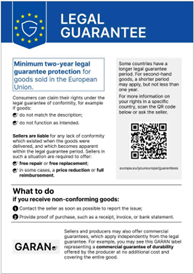
- A notice with a reminder about the legal guarantee of conformity and its main elements, including the minimum duration of two years. This notice must follow the template in Commission Implementing Regulation 2025/1960. There are different formats available for online and bricks-and-mortar sales. For example, for online sales, the notice must look like the one pictured below. For in-store sales, the notice can be in black and white, but must be at least A4 in size:
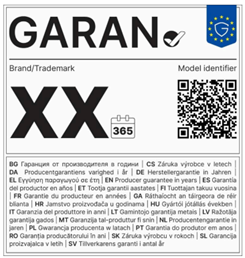
- If a free commercial warranty is offered lasting more than two years, then a label with information on the commercial warranty must also be provided. This label must also follow the template set by the EU. Again, there are different formats available for online and bricks-and-mortar sales. For example, for online sales, the notice will typically look like the one pictured below, though there is also a version that can be used as a nested display. For in-store sales, the notice can be in black and white. Where it is printed on packaging, it must meet specified dimensions and minimum font sizes.
- The repairability score, where applicable (e.g., this may be imposed by EU ecodesign rules, currently the only product group subject to this requirement being smartphones and tablets).
- Information about the availability and estimated cost of, and how to order, spare parts that are necessary to keep the goods in conformity; the availability of repair and maintenance instructions; and about repair restrictions. This does not create an obligation to offer repairs, spare parts or repair or maintenance instructions. However, if they are offered, and producers make this information available to traders, then it must be provided to consumers. The European Commission Q&A clarifies that this does ‘not mean that the producer-trader is obliged to inform the consumer proactively if a product cannot be repaired’.
- For goods with digital elements, information on the period of time during which software updates will be provided, where that information is available to traders.
- For online sales, information on environmentally friendly delivery options, where these are available.
Digital Goods
For digital goods (including digital content and services, such as apps) the following new information must be provided:
- A reminder of the existence of the legal guarantee of conformity for digital content and digital services. This is the legal guarantee established under the regime in Directive 2019/770. Unlike the requirement for physical goods, there is no harmonized template notice for this “reminder”.
- The minimum period of time during which software updates will be offered.
2. New Prohibitions on Certain Types of Claims
The ECGT Directive will ban certain types of claims, including:
- Generic environmental claims like ‘sustainable’, ‘green’ and ‘energy efficient’, unless traders can demonstrate ‘excellent environmental performance’ (e.g., EU Ecolabel, national schemes such as Germany’s Blue Angel, or top energy efficiency Class A under the EU Energy Labelling Regulation) relevant to the claim.
- Environmental claims about an entire product or a trader’s entire business when it only concerns a certain aspect of a product or a specific part of a trader’s business.
- Claiming that a product has a neutral, reduced or positive impact on the environment based on the offsetting of greenhouse gas emissions, such as saying a product is ‘carbon neutral’ or ‘net zero’.
- Presenting minimum legal requirements as a distinctive feature of a trader’s offer. This means that if a trader is required to achieve a certain environmental target by law, e.g., minimum recycled content in plastic packaging, this cannot be presented as if it is a feature of a trader’s offer.
- Misleading claims about the longevity of a product. This includes presenting a software update as necessary when it only enhances functionality; falsely claiming that under normal conditions of use a good has a certain durability in terms of usage time or intensity; presenting a good as allowing repair when it does not; inducing consumers to replace or replenish consumables of a good earlier than necessary; and withholding information concerning functional impairment when consumables, spare parts or accessories from a third party are used, or falsely claiming that such impairment will happen.
3. New Rules on Sustainability Labels – Including Third-Party Verification
The ECGT Directive introduces new requirements that impact traders using sustainability labels. Sustainability label is defined to include any trust mark, quality mark or equivalent distinguishing a product or business by virtue of its environmental or social characteristics, e.g., B Corp, Global Organic Textile Standard (GOTS), Fairtrade and the Forest Stewardship Council (FSC).
From 27 September 2026 onwards, all sustainability labels used in the EU must either be established by a public authority or based on a certification scheme that complies with the ECGT Directive’s requirements. If this is not the case, the sustainability labels can no longer be used by traders in the EU.
Certification schemes underpinning sustainability labels need to meet requirements on transparency, openness and credibility and the trader’s compliance with the certification scheme’s standards must be verified by a third party that is independent from both the scheme owner and the trader.
While in practice compliance requires sustainability certification providers to take action, traders who display the sustainability label or certification remain legally responsible for only displaying sustainability labels based on a compliant certification scheme.
4. New Requirements for Claims Relating to Future Environmental Performance – Also Including Third-Party Verification
The ECGT Directive bans claims related to future environmental performance, such as claims that a business ‘will become carbon neutral’ or that a product ‘will be made of fully recycled materials in the future’, unless these claims comply with the following:
- The claims are based on clear, objective, publicly available and verifiable commitments;
- The commitments are set out in a detailed and realistic implementation plan that includes measurable and time-bound targets and other relevant elements necessary to support its implementation, such as resource allocation;
- The implementation plan is regularly verified by an independent third-party expert; and
- The findings of the independent third-party expert are made available to consumers.
5. Enforcement and Implementation
EU Member States are required to adopt national legislation to implement the new rules. There may be differences between different EU Member States in how they implement the ECGT Directive. Germany, for example, applies certain rules on misleading commercial practices to certain B2B transactions. However, the legislative amendment adopted to implement the ECGT Directive into German law expressly limits the requirements for claims about future environmental performance, for example, to B2C contexts.
The ECGT Directive will be enforced by the regulatory authorities of each EU Member State.
Fines for noncompliance can be up to 4% of a trader’s annual turnover in the relevant EU Member State (or more if the relevant EU Member State sets a higher maximum under national law). The relevant consumer laws are also in scope of the EU’s Representative Actions Directive, which allows claimants to bring class-action-style claims in the EU based on non-compliance with these obligations.
With just over six months until the new requirements start to apply, traders operating in the EU are advised to review their websites, product packaging and any other marketing claims for compliance. They should also check their websites and sales flows to make sure that they are compliant with the new consumer information requirements, in particular that they are showing customers the EU harmonised notice and label where required.
Key Takeaways
- Effective 27 September 2026, the EU’s Empowering Consumers for the Green Transition Directive introduces new requirements for traders offering goods and services to consumers in the EU.
- New pre-contractual information requirements will be introduced impacting every retailer in the EU, including an obligation to show customers a harmonised notice as a reminder of the minimum two-year guarantee.
- Certain types of claims will be banned in the EU, including generic claims like ‘sustainable’ and ‘carbon neutral’ claims based on offsets.
- Sustainability labels can only be used if compliance is monitored by an independent third party.
- Claims about future environmental performance trigger obligations to have an underlying implementation plan and commitments that are verified by an independent third party.
What Are Our Clients Asking About?
Could You Clarify the Definition of “Placing on the Market” as Defined in Article 3(12) of the REACH Regulation, Also in the Context of Annex XVII, Entry 77?
Answered by Dieudonné Ymedji, Senior Regulatory Compliance Specialist
Generally, the restrictions outlined in Annex XVII prohibit or limit the manufacture, sale, and use of certain hazardous substances, mixtures, and articles.
The term “placing on the market” indicates that these restrictions apply when a substance, mixture, or article is first supplied or made available to a third party after the restriction date takes effect.
Regarding Annex XVII, entry 77, any stock that was legally manufactured or imported before the restriction date (6 August 2026) will be subject to the new restrictions if it is first supplied to a third party on or after that date.
Consequently, stock produced before this date that does not comply with the new limits cannot be legally supplied after the restriction date.
Regarding supply to customers with pre-signed agreements before the restriction date (6 August 2026), the regulation does not provide an exemption for pre-existing contracts or agreements. The restriction applies to the act of placing on the market, not to the date of contract signing. Thus, even if agreements were made prior to 6 August 2026, supplying non-compliant articles after this date is likely prohibited.
In summary, all articles placed on the market after this date must meet the new formaldehyde emission limits, regardless of production date or prior agreements. Non-compliant stock unsold by 6 August 2026 must be either upgraded to meet limits, diverted for any exempt use, or kept out of the EU market.
Stay Ahead Of 2026 Regulatory Compliance Updates with The Pulse
Want to stay on top of 2026 Regulatory Compliance Updates?
All insights in The Pulse come directly from C2P – the trusted compliance platform used by over 300 of the world’s leading brands. With coverage across 195+ countries, C2P empowers you to achieve, maintain, and expand market access faster and with confidence.
C2P is an enterprise SaaS platform designed to meet your unique compliance needs. It brings together everything in one place – regulations, standards, requirements, and evidence – so you can manage compliance across the enterprise with ease.
Need more? Our tailored add-on packages unlock use-case-specific solutions, enriched global regulatory content, and direct access to a global team of subject matter experts and professional services.
C2P is your key to unlocking global market access.
- Accelerate time-to-market for products
- Reduce non-compliance risks that impact your ability to meet business goals and cause reputational damage
- Enable business continuity by digitizing your compliance process and building corporate memory
- Improve efficiency and enable your team to focus on business critical initiatives rather than manual tasks
- Save time with access to Compliance & Risks’ extensive Knowledge Partner network

Keep Your Finger on the Pulse of Regulatory News!
Join 30,000+ compliance professionals for 2026 regulatory compliance updates on hot compliance issues, market insights on the latest trends, and free regulatory webinars and whitepapers