Regulatory Compliance Tools: What the Best Teams Actually Use
THIS BLOG WAS WRITTEN BY THE COMPLIANCE & RISKS MARKETING TEAM TO INFORM AND ENGAGE. HOWEVER, COMPLEX REGULATORY QUESTIONS REQUIRE SPECIALIST KNOWLEDGE. TO GET ACCURATE, EXPERT ANSWERS, PLEASE CLICK “ASK AN EXPERT.”
The best compliance teams use regulatory compliance tools to monitor regulatory change, map obligations to products and processes, manage evidence, and maintain audit-ready documentation across jurisdictions. They do not rely on a single platform. They build a deliberate stack, with purpose-built tools for intelligence, obligation tracking, and workflow, integrated around a central system of record.
This guide breaks down the tool categories high-performing compliance teams rely on, what capabilities actually matter, and how to think about building a compliance technology program that holds up under regulatory scrutiny.
Quick Answer
Regulatory compliance tools fall into four primary categories: regulatory intelligence and change management platforms, obligation and requirement mapping systems, evidence and document management tools, and workflow and audit trail software. The best compliance teams use a combination of these, anchored by a platform that provides centralized regulatory content, impact assessment workflows, and structured audit documentation. Generic GRC platforms and spreadsheet-based tracking consistently fail at the regulatory intelligence and obligation traceability layers.
Table of Contents
- What Are Regulatory Compliance Tools?
- Why the Tool Category Matters More Now Than It Did Five Years Ago
- The Four Types of Tools High-Performing Teams Use
- Regulatory Intelligence and Change Management Platforms
- Obligation and Requirement Mapping Tools
- Evidence and Document Management
- Workflow, Task Management, and Audit Trails
- How to Evaluate Regulatory Compliance Tools for Your Program
- FAQ
What Are Regulatory Compliance Tools?
Regulatory compliance tools are software platforms and systems designed to help organizations track regulatory obligations, assess their impact on products or operations, manage compliance evidence, and demonstrate regulatory adherence to auditors, customers, and regulators.
The category is broad because compliance itself is broad. A financial services firm managing obligations under Dodd-Frank, MiFID II, and Basel III has different tool needs than a global manufacturer tracking RoHS, REACH, and PFAS restrictions across 30 markets. Both need regulatory compliance tools, but the regulatory content layer, the obligation mapping logic, and the audit documentation requirements differ significantly.
What unifies the category is purpose: these tools exist to turn an unmanageable volume of regulatory change into a structured, auditable workflow that a compliance team can actually execute.
Understanding what regulatory compliance requires at the operational level is the prerequisite for selecting tools that fit the work.
Why the Tool Category Matters More Now Than It Did Five Years Ago
The volume and complexity of regulatory change has accelerated. Teams that were managing a relatively stable set of obligations in 2019 are now tracking:
The EU Corporate Sustainability Reporting Directive (CSRD), which requires large companies operating in the EU to disclose detailed sustainability data aligned with European Sustainability Reporting Standards. Phased implementation began in 2024.
The EU AI Act, which entered into force in August 2024 and introduces tiered obligations based on AI system risk classification. Prohibited AI practices became enforceable in February 2025. High-risk AI system obligations apply from August 2026.
The SEC’s cybersecurity disclosure rules, which require public companies to disclose material cybersecurity incidents within four business days and report annually on their cybersecurity risk management programs.
Expanding PFAS restrictions at the US federal and state levels, mirrored by EU regulatory action under REACH and cascading into product standard revisions across multiple industries.
No compliance team can track this volume of change manually and respond at the speed regulators expect. Regulatory compliance tools close that gap.
The Four Types of Tools High-Performing Teams Use
The strongest compliance programs are not built on a single platform. They are built around four tool types that address distinct parts of the compliance workflow.
Regulatory Intelligence and Change Management Platforms
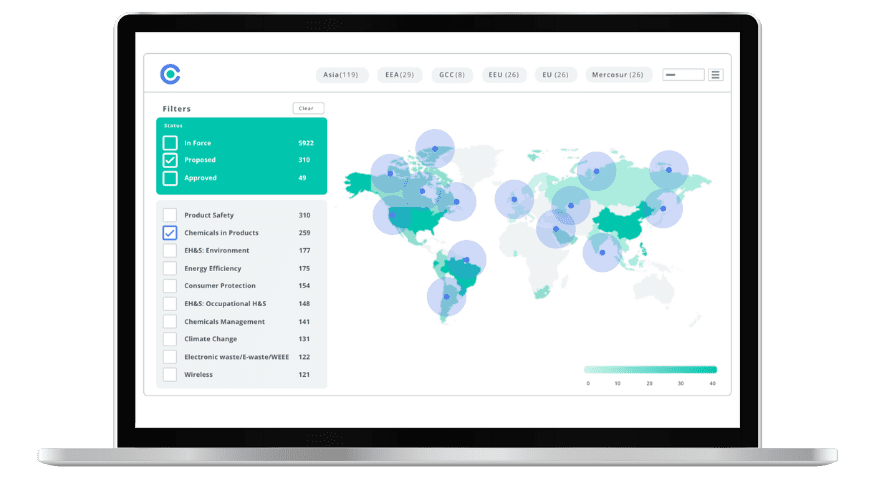
Regulatory intelligence platforms monitor regulatory sources globally, classify changes by jurisdiction and topic, and surface updates that apply to a specific organization’s footprint. Change management functionality turns those updates into structured workflows with impact assessments, assigned owners, and documented resolution.
This is the hardest layer to get right, and the one where most teams underinvest. The failure mode is relying on email alerts or public regulatory feeds without a structured workflow attached. The alert arrives. Someone reads it. Nothing gets formally assessed, assigned, or tracked. Six months later, a compliance gap surfaces that should have been caught.
The platforms that perform best in this category maintain curated databases of primary regulatory source documents, updated by compliance professionals rather than automated scrapers. The difference in content quality, and therefore in the accuracy of impact assessments, is significant.
For organizations managing product compliance specifically, the depth of coverage across chemical regulations, product safety standards, and market access requirements is the key differentiator. A platform with strong EU coverage but limited visibility into China’s GB standards or Brazil’s INMETRO requirements is not adequate for a globally distributed product portfolio.
Obligation and Requirement Mapping Tools
Knowing a regulation exists is not enough. The operational question is: which specific requirements under this regulation apply to which of our products, processes, or business units, and how do we demonstrate compliance with each one?
Obligation mapping tools create a structured link between a regulatory requirement and the internal control, product specification, process, or evidence that satisfies it. This traceability layer is what makes compliance auditable at scale. Without it, compliance becomes a recurring, manual scavenger hunt every time an auditor or regulator asks for proof.
High-performing compliance teams use obligation mapping to:
Maintain a living inventory of regulatory requirements by product line, market, and business unit.
Flag which requirements are satisfied, which are in progress, and which are overdue for review.
Connect requirements to specific evidence documents, with expiry dates and renewal workflows attached.
Provide cross-functional visibility so procurement, engineering, legal, and quality can each see the requirements relevant to their work.
For organizations navigating the expanding set of product and market obligations, this is also the layer that supports the internal conversation about managing regulatory compliance across products and markets as regulatory scope expands
Evidence and Document Management
Compliance evidence is not static. Test reports expire. Certifications lapse. Supplier declarations of conformity reference standards that get revised. A document that satisfied a regulatory requirement two years ago may not satisfy it today.
Evidence management tools in the regulatory compliance space handle the document lifecycle: attaching evidence to specific requirements, tracking expiry dates, triggering renewal workflows before lapse occurs, and maintaining version history so the compliance record is accurate and defensible.
This matters most during audits and regulatory examinations. When an auditor asks for proof of compliance with ISO 27001 controls, FDA 21 CFR Part 820 requirements, or EU Medical Device Regulation (MDR) technical documentation, the ability to produce current, version-controlled evidence on short notice is the difference between a clean audit and a costly remediation.
The best platforms in this category integrate evidence management directly into the obligation mapping layer, so documents are always tied to the specific requirements they satisfy rather than stored in disconnected folders.
Workflow, Task Management, and Audit Trails
Compliance is a team sport. Regulatory affairs works with procurement, engineering, legal, product management, and quality. A regulatory change that affects chemical content in a product requires action from sourcing, design, and compliance simultaneously. A tool that cannot support multi-user workflows and cross-functional task assignment is not adequate for enterprise compliance programs.
Workflow tools in the compliance space provide:
Configurable task templates for recurring compliance activities like annual certifications, periodic regulatory reviews, and supplier attestation cycles.
Escalation rules that flag overdue tasks to senior compliance leadership before they create exposure.
Structured audit trails that capture who did what, when, with what evidence, and under whose authorization.
Role-based access controls that give different teams visibility into the compliance records relevant to their function without exposing sensitive data outside its appropriate scope.
The audit trail function is particularly important in regulated industries. In a FDA inspection, SEC examination, or FCA supervisory review, regulators want to see not just that the right outcome was achieved, but that the right process was followed, documented, and overseen appropriately.
How to Evaluate Regulatory Compliance Tools for Your Program
Selecting regulatory compliance tools requires honest answers to a few foundational questions before evaluating vendor capabilities.
What is your regulatory footprint? The jurisdictions and regulatory frameworks you operate under determine what content depth and coverage you need from an intelligence platform. A US-only financial services firm and a global consumer electronics manufacturer have almost nothing in common in their tool requirements, even if they share the same job title.
What is your compliance team’s operational maturity? A team that is still managing obligations in spreadsheets needs different onboarding support and workflow configuration than a team that has operated a structured compliance program for years and is looking for a more capable platform.
Where are your current failure points? Most compliance teams that evaluate new tools are solving a specific problem: alerts that do not reach the right people, evidence gaps that surface during audits, regulatory changes that get missed in markets outside the primary geography. Knowing your specific failure modes helps you evaluate tools against real operational needs rather than marketing claims.
What integration requirements do you have? Regulatory compliance tools rarely operate in isolation. They need to connect to ERP systems, procurement platforms, quality management systems, and sometimes customer-facing compliance portals. Evaluate integration capabilities before committing to any platform.
For a structured look at how compliance programs approach these questions, including how to build the internal business case for compliance technology investment, the compliance management software buyer’s guide at Compliance & Risks covers the evaluation framework in depth.
FAQ
- What is the difference between GRC software and regulatory compliance tools?
GRC (Governance, Risk, and Compliance) software is a broad category that covers internal policy management, risk assessment, and compliance workflows. Regulatory compliance tools, particularly in the product and market access space, focus specifically on tracking external regulatory obligations and managing the evidence that satisfies them. GRC platforms often lack the regulatory content depth needed for product compliance work, where the database of applicable regulations is the core functional asset. - How do compliance teams monitor regulatory changes across multiple jurisdictions?
High-performing teams use regulatory intelligence platforms that maintain curated databases of primary regulatory source documents and surface changes filtered by jurisdiction, product category, and topic. The most capable platforms include AI-assisted analysis that helps teams prioritize changes by likely impact and implementation urgency, reducing the manual triage burden significantly. - What should a regulatory compliance tool include to support audit readiness?
Audit-ready compliance tools need obligation traceability (linking requirements to evidence), evidence expiry tracking, structured audit trails capturing workflow history, and the ability to produce compliance records on demand. The key is having a documented chain of custody from the regulatory requirement through the assigned response, the completed action, and the attached evidence. - How long does it take to implement a regulatory compliance platform?
Implementation timelines vary significantly based on the complexity of the regulatory footprint, the state of existing compliance data, and the level of configuration required. Most enterprise implementations run 60 to 180 days. Teams that invest time upfront in mapping their obligation library before implementation see faster time-to-value and fewer gaps in the configured system. - Can regulatory compliance tools replace compliance staff?
No. Regulatory compliance tools extend the capacity of compliance staff by automating monitoring, routing, and documentation tasks that would otherwise consume significant manual effort. The work of interpreting regulatory requirements, assessing operational impact, and making judgment calls about risk tolerance requires experienced compliance professionals. Tools make that expertise more productive, not redundant.
Simplify Corporate Sustainability Compliance
Six months of research, done in 60 seconds. Cut through ESG chaos and act with clarity. Try C&R Sustainability Free.