End-of-Life Compliance Strategies for Sustainable Decommissioning: Your Roadmap to Responsible Business
THIS BLOG WAS WRITTEN BY THE COMPLIANCE & RISKS MARKETING TEAM TO INFORM AND ENGAGE. HOWEVER, COMPLEX REGULATORY QUESTIONS REQUIRE SPECIALIST KNOWLEDGE. TO GET ACCURATE, EXPERT ANSWERS, PLEASE CLICK “ASK AN EXPERT.”
You’re running a business, making things, selling things, innovating. And honestly, it’s a lot. You’re navigating supply chains, market demands, and, increasingly, a complex web of regulations that govern what happens after your product has served its purpose. We’re talking about End-of-Life (EOL) compliance—the often-overlooked but absolutely critical aspect of product lifecycle management.
Think about it: the sheer volume of products ending their lives is staggering. The global tonnage of e-waste is projected to rise to 82 million tons by 2030, with less than 22% properly recycled. That’s not just an environmental issue; it’s a massive regulatory and risk management challenge for businesses like yours.
This isn’t just about ticking boxes; it’s about safeguarding your brand, protecting sensitive data, minimizing financial penalties, and, crucially, building a truly sustainable operation. For businesses operating globally, this challenge is magnified exponentially, weaving together data security imperatives with environmental responsibility within frameworks like the WEEE Directive and a growing number of local Extended Producer Responsibility (EPR) legislation.
Ready to gain control? Let’s dive in.
Table of Contents
- The Unseen Challenge: What is End-of-Life Compliance?
- Why It Matters: Risks vs. Rewards
- Navigating Global Regulatory Frameworks
- The Core Pillars of Sustainable Decommissioning
- Crafting Your EOL Compliance Strategy
- Future-Proofing Your EOL Strategy
- Key Takeaways for Proactive Compliance
- Frequently Asked Questions
- Conclusion: From Obligation to Opportunity
- Sources
The Unseen Challenge: What is EPR and End-of-Life Compliance?
Extended Producer Responsibility (EPR) is a policy framework that makes producers accountable for their products throughout the entire lifecycle, including after consumer use. It shifts physical and/or financial responsibility to producers and incentivises environmentally conscious product design, aligning business operations with sustainability and regulatory compliance goals.
The scope has generally encompassed product takeback and proper treatment, achievement of recycling targets, labelling and reporting requirements, as well as financial responsibility and promotion of ecodesign measures. It extends to several product sectors such as electronics, batteries, packaging and textiles.
On the other hand, EOL compliance, as part of EPR obligations, refers to the legal and ethical obligations businesses have to properly collect, recover, and treat their products after they are no longer functional or desired.Think about the complexity here. It’s not just about what you do, but how you prove you did it, and how you ensure every step is secure and sustainable.
Why It Matters: Risks vs. Rewards
Ignoring EOL compliance isn’t just risky; it’s honestly just bad business. The consequences can be severe:
Data Breaches & Security Risks: Improper disposal of IT assets containing sensitive customer data can lead to catastrophic breaches. The costs, including legal fees and reputational damage, can be devastating. Think about the General Data Protection Regulation (GDPR), HIPAA, and NIST 800-88 as a legal and operational requirement to mitigate data destruction risks.
Hefty Fines & Penalties: Regulatory bodies globally are cracking down. Non-compliance with EPR, or local environmental laws can result in significant financial penalties, often running into the hundreds of thousands or even millions.
Reputational Damage: In today’s hyper-connected world, consumers, investors, and partners are increasingly scrutinizing a company’s environmental and social responsibility. Poor EOL practices can quickly erode public trust and brand value.
But let’s flip the script. Proactive EOL compliance offers significant rewards:
Cost Savings & Value Recovery: Proper ITAD and EOL management can uncover opportunities for asset remarketing, reuse, and the recovery of valuable raw materials from e-waste. This isn’t just disposal; it’s potential revenue.
Enhanced ESG & Brand Reputation: Demonstrating a commitment to sustainable decommissioning significantly boosts your Environmental, Social, and Governance (ESG) profile. This resonates with conscious consumers and attracts ethical investors.
Operational Efficiency: Streamlined EOL processes, especially with global regulatory tracking platforms, bring order to what can be a chaotic undertaking, reducing administrative burden and freeing up internal resources.
Navigating Global Regulatory Frameworks
The global regulatory landscape for EOL products is incredibly fragmented and constantly evolving. Understanding the core frameworks is your first step to mastering it.
WEEE Directive: A Deep Dive
The Directive on Waste Electrical and Electronic Equipment (WEEE Directive) is probably one of the most well-known and impactful EOL regulations, particularly for businesses operating in the European Union. Enacted in 2002 and revised in 2012, it aims to prevent the generation of e-waste and promote the reuse, recycling, and recovery of electrical and electronic equipment.
Under the WEEE Directive, “producers” have clear responsibilities including registration with national WEEE registers in each EU Member State, providing regular data on quantities of EEE placed on the market, establishing take-back systems for consumers, bearing the costs associated with collection and treatment, and providing information to users.
The WEEE Directive covers virtually all EEE, categorized into six broad categories: temperature exchange equipment, screens and monitors, lamps, large equipment, small equipment, and small IT and telecommunication equipment – with very few exceptions such as military and space equipment, infectious medical devices, etc. If your product has a plug or runs on batteries, it’s almost certainly within the WEEE Directive scope.
Here’s where it gets complicated. While the WEEE Directive is an EU-wide framework, its implementation varies significantly across the 27 Member States. Each country has different registration processes, reporting frequencies and formats, financing mechanisms, collection infrastructure, and producer definitions. This means a company selling EEE in five different EU countries might have to manage five slightly different WEEE compliance schemes. This is exactly why a comprehensive platform like C2P becomes invaluable.
Compliance Beyond WEEE
EOL compliance beyond WEEE is increasingly common worldwide, covering packaging (like Germany’s VerpackG), batteries (following the new EU Batteries Regulation), textiles addressing the fast-fashion waste crisis, and tires, oils, and vehicles.
The variations are profound: product scope, financial obligations (flat fees, per-unit fees, weight-based fees), reporting requirements, collection methods, and labeling requirements all differ by jurisdiction.
The Core Pillars of Sustainable Decommissioning
A robust EOL compliance strategy stands firm on three interconnected foundations: secure data destruction, efficient reverse logistics, and meticulous documentation.
Data Security & Destruction: Non-Negotiable
For any product that stores data, secure data destruction is not just a best practice; it’s a legal and ethical imperative. Improperly erased data is a gaping vulnerability, inviting breaches, fines, and reputational ruin.
A simple “delete” or reformat isn’t enough. Residual data can often be recovered using forensic tools. Secure erasure ensures data is irretrievable, protecting your company and your customers.
Logical Destruction involves software-based methods to overwrite data multiple times, rendering it unrecoverable. It allows for potential reuse of hardware and is environmentally friendly, but requires functional hardware and adherence to standards like NIST SP 800-88 Revision 2 and IEEE 2883-2022.
Physical Destruction involves rendering the storage media physically unusable through shredding, pulverizing, degaussing, or incineration. It provides absolute certainty of data destruction but destroys the hardware completely.
The key is selecting the method appropriate for the sensitivity of the data and the asset type. You need a verified, auditable process.
The Certificate of Data Destruction is your proof, your safeguard, your audit trail. It’s a formal certification from a qualified ITAD vendor confirming that data on specified assets has been destroyed according to recognized standards. It should include vendor details and certifications, client details, asset information with serial numbers, destruction method and standard used, date and location, verification confirmation, and authorized signature. Without it, you have no verifiable proof that sensitive data was properly handled.
Reverse Logistics & Take-Back Programs
Once a product reaches its EOL, it needs to get from the user back to a processing facility. This is where reverse logistics and take-back programs come into play.
Models include retailer take-back, producer-owned collection points, third-party networks partnering with established recyclers, and mail-back programs for smaller items. Challenges include consumer participation, cost, infrastructure, and cross-border logistics.
Best practices involve making it incredibly easy for consumers to return products, clear communication about why and how to return products, incentives for returns, and integrated systems using technology to track returns and coordinate with recycling partners.
Product Labeling & EOL Documentation
Many EPR schemes, including WEEE, mandate specific labeling on products including the WEEE symbol (crossed-out wheeled bin), battery symbols for hazardous content, and material identification codes for recycling.
Your internal records are your first line of defense in an audit. Maintain detailed asset inventory, disposal requests, vendor contracts, and proof of payment. Your audit trail should include certificates of data destruction, weight and material reports from recycling partners, shipping manifests, and compliance reports submitted to regulatory bodies.
A centralized platform that integrates these documents and tracks EOL processes across your organization simplifies audits and provides an undeniable record of your commitment to compliance.
Crafting Your EOL Compliance Strategy
Building an EOL compliance strategy starts internally, then extends to strategic partnerships.
Internal Process Development
Implement systems that track product lifecycles from cradle to grave and flag products nearing their EOL. Create clear, documented policies for all EOL processes including asset identification criteria, data classification, approval workflows, vendor selection criteria, documentation requirements, training programs, and internal audit schedules.
Clearly assign ownership. Establishing a cross-functional team covering IT, legal, procurement, and sustainability ensures all angles are covered.
Partnering for Success
For most businesses, partnering with specialized providers is the most effective and least risky approach. Look for key certifications including R2 (Responsible Recycling), e-Stewards, NAID AAA Certification, and ISO certifications demonstrating a systemic approach to management.
Don’t just accept a sales pitch. Ask potential vendors about their full service scope, data security standards, certificate of data destruction details, environmental practices, reporting capabilities, multi-country compliance handling, insurance coverage, and relevant references.
For most global enterprises, outsourcing to a reputable provider leveraging platforms like C2P is the smarter, more secure, and more sustainable path. It’s about leveraging specialized expertise to navigate complexity.
Future-Proofing Your EOL Strategy
The world of EOL compliance is dynamic. True leadership means looking ahead.
Emerging trends include AI and robotics being deployed in recycling facilities for more efficient sorting, blockchain for traceability offering immutable records, and material science innovation developing more easily recyclable materials.
Circular economy principles aren’t just about recycling; they’re about designing products to last longer, to be repaired, to be refurbished, and to have their components reused. This not only reduces waste but creates new value streams.
Don’t wait for regulations to hit. Engage with industry associations, regulatory bodies, and expert platforms. A robust regulatory intelligence platform provides continuous, real-time alerts on changes, ensuring you’re never caught off guard.
Key Takeaways for Proactive Compliance
EOL compliance is the legal and ethical responsibility for managing products at the end of their lifecycle. Build your strategy by understanding global regulatory frameworks, implementing strong internal processes, and partnering with certified providers. Documentation including certificates of data destruction and detailed audit trails is crucial for mitigating risk. Effective EOL compliance protects against data breaches and fines while enhancing ESG, driving cost savings, and fostering competitive advantage.
Frequently Asked Questions
Q: My company only operates in one country. Do I still need to worry about global EOL compliance?
A: If you only sell products within one country and don’t export, your primary concern will be the national and local EOL regulations specific to that country. However, many national regulations are derived from broader directives like WEEE. If you have any plans for international expansion, it’s wise to understand the global landscape now.
Q: Is it really worth investing in a compliance platform or expert services when I can just use a local recycler?
A: A local recycler might handle disposal, but they often lack the comprehensive global regulatory expertise, secure data destruction protocols, detailed reporting, and audit-readiness required for full compliance. The cost of non-compliance including fines and data breaches far outweighs the investment in a holistic solution.
Q: How do I know if my products fall under WEEE or other EPR regulations?
A: Generally, if your product has a plug, uses batteries, or is a type of packaging, it’s likely subject to some form of EOL regulation. A thorough product portfolio analysis against the specific definitions within each regulation is required. Expert solutions like C2P are designed to help you determine product scope across 195 countries.
Q: What’s the biggest risk for companies getting EOL compliance wrong?
A: Data breaches (eg., from insecure ITAD), financial penalties and reputational damage. The specifics will vary from jurisdiction and product sector.
Q: How can I convince my leadership team to prioritize EOL compliance?
A: Frame it in terms of risk mitigation (avoiding multi-million dollar fines and data breach costs), brand protection (meeting ESG expectations of investors and consumers), and potential cost savings through value recovery. Show them that proactive compliance is a strategic investment, not just an overhead.
Conclusion: From Obligation to Opportunity
End-of-Life compliance isn’t just another regulatory hurdle; it’s a fundamental aspect of responsible, sustainable business in the 21st century. The sheer complexity, especially across diverse global markets, means that a piecemeal approach simply won’t cut it. You need a strategy that integrates data security, reverse logistics, and meticulous documentation within robust compliance frameworks.
By moving beyond mere obligation and embracing a proactive, intelligent approach, you transform potential liabilities into genuine opportunities. Opportunities to safeguard your data, protect your brand reputation, achieve significant cost efficiencies, and, ultimately, contribute to a more sustainable world.
Ready to simplify your global EOL compliance and build a truly future-proof strategy? Explore how C2P’s regulatory compliance platform can help you stay ahead of changing regulations and prove compliance across 195 countries.
Sources
- United Nations Institute for Training and Research (UNITAR) and International Telecommunication Union (ITU). (2024). The Global E-waste Monitor 2024: Electronic Waste Rising Five Times Faster than Documented E-waste Recycling. Retrieved from https://ewastemonitor.info/the-global-e-waste-monitor-2024/
- Investment Recovery Association. Comprehensive Guide to End-of-Life IT Asset Disposition–Best Practices for Security, Compliance and Sustainability. Retrieved from https://www.invrecovery.org/end-of-life-it-asset-disposition/
- Okon Recycling. End of Life Equipment Management: Data Security, Recycling Strategies, and Compliance Practices. Retrieved from https://www.okonrecycling.com/end-of-life-equipment-management/
- Securis. What is a Certificate of Data Destruction? Retrieved from https://www.securis.com/certificate-of-data-destruction/
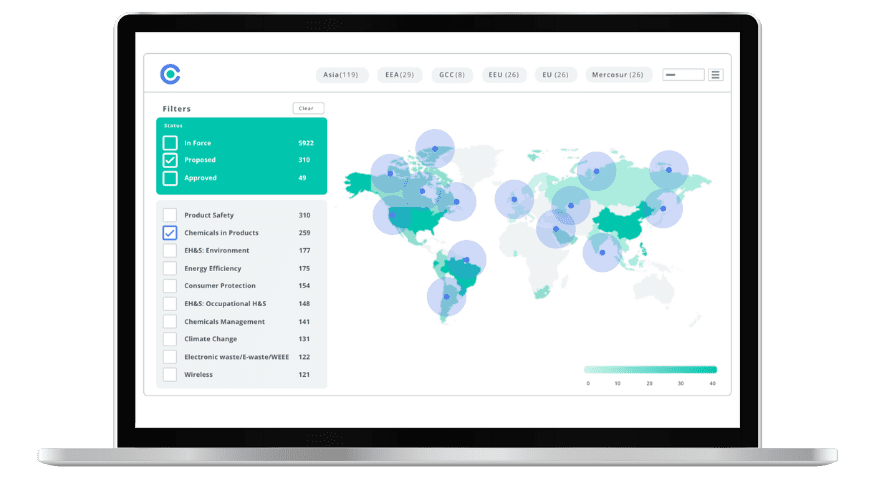
Simplify Corporate Sustainability Compliance
Six months of research, done in 60 seconds. Cut through ESG chaos and act with clarity. Try C&R Sustainability Free.