What Is a Compliance Management System? A Guide for Enterprise Teams
THIS BLOG WAS WRITTEN BY THE COMPLIANCE & RISKS MARKETING TEAM TO INFORM AND ENGAGE. HOWEVER, COMPLEX REGULATORY QUESTIONS REQUIRE SPECIALIST KNOWLEDGE. TO GET ACCURATE, EXPERT ANSWERS, PLEASE CLICK “ASK AN EXPERT.”
A compliance management system is a structured framework that enables organizations to identify, monitor, and address regulatory obligations before they become violations. For enterprise teams operating across multiple countries and product lines, it functions as the single source of regulatory truth: connecting obligations to evidence, ownership to accountability, and change signals to action.
Most organizations discover their compliance management gaps in the worst possible way: a shipment blocked at customs, a recall triggered by a regulation they missed, or an audit that reveals evidence stored in spreadsheets no one can find. The system was reactive by design. A properly built compliance management system makes it proactive.
Table of Contents
- Quick Answer: What Is a Compliance Management System?
- Why Enterprise Teams Need a Compliance Management System
- What Are the Core Components of a Compliance Management System?
- How Does a Compliance Management System Work in Practice?
- What Should Enterprise Teams Look for in a CMS?
- How Is a Compliance Management System Different from a Policy Management Tool?
- FAQ
Quick Answer: What Is a Compliance Management System?
A compliance management system (CMS) is a platform or structured framework that centralizes an organization’s regulatory obligations, maps them to internal controls and evidence, and provides ongoing monitoring for changes. It covers the full compliance lifecycle: identifying applicable regulations, assigning ownership, collecting and maintaining evidence, and tracking compliance status across jurisdictions and product lines.
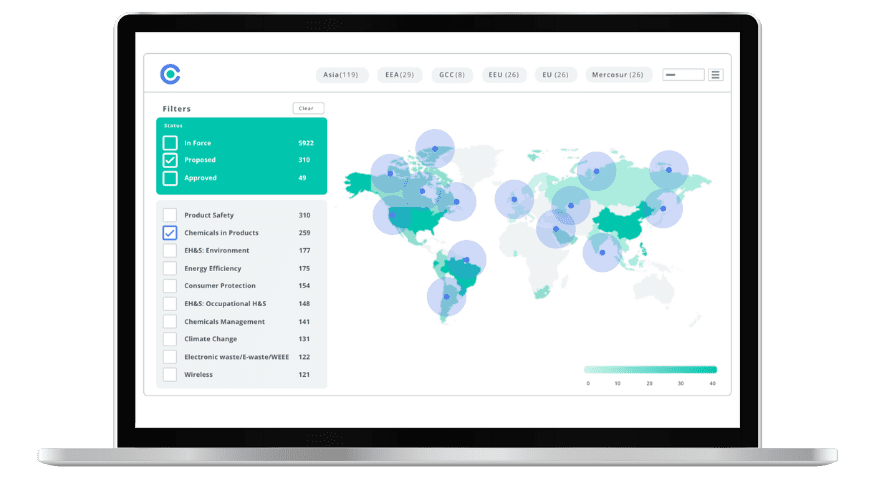
For enterprise teams, a CMS typically includes a regulatory database, requirements management, evidence management, workflow automation, audit trails, and alerts for regulatory changes. The goal is to move from reactive compliance firefighting to a position where regulatory changes are anticipated, assessed for impact, and addressed before they create market access problems or legal exposure.
Why Do Enterprise Teams Need a Compliance Management System?
The question most compliance leaders should be asking is not whether they need a system. It is whether their current approach will hold when the regulatory environment accelerates further.
Consider the scale. A global manufacturer selling consumer electronics into the EU, the US, China, and Southeast Asia is tracking obligations under RoHS, EU REACH, PFAS restrictions, Ecodesign/ESPR, California Proposition 65, China RoHS, and a growing list of country-specific chemical and safety regulations. Each regulation has its own scope, exemption logic, documentation requirements, and amendment cycle. Some update annually. Some trigger product redesigns with 18-month lead times.
Without a compliance management system, this tracking happens across spreadsheets, shared drives, email threads, and institutional memory. The information is siloed. When a team member leaves, knowledge leaves with them. When a regulation amends, the update may never reach the product team until it is too late.
The cost of that failure is well-documented. Market access delays due to non-compliance can stall revenue for 12 to 18 months. Recalls triggered by missed requirements carry direct financial consequences plus long-term reputational exposure. Regulatory fines in major jurisdictions have increased significantly as enforcement agencies invest in digital monitoring capabilities.
A compliance management system addresses this at the root. It replaces fragmented tracking with a centralized system of record, connects regulatory change alerts to the teams who need to act, and maintains the evidence trail that auditors require.
The Scale Problem Is Getting Worse
The volume of global regulatory change is not stable. Environmental regulations, supply chain due diligence requirements like CSDDD, ESG disclosure obligations under CSRD, and product safety updates are all expanding simultaneously. Teams that managed compliance manually five years ago are finding that the same approach no longer scales.
This is particularly acute for enterprises that have grown through acquisition, now managing compliance across product lines, manufacturing sites, and markets that were never designed to share data. A compliance management system creates the infrastructure for consistency even when the underlying business is operationally complex.
What Are the Core Components of a Compliance Management System?
Regulations Management
The foundation. A compliance management system needs a structured database of applicable regulations, indexed by jurisdiction, industry, product type, and substance or requirement category. This is not a static list. Regulations amend, new regulations are proposed, and exemptions expire. The system needs to track the full lifecycle of each regulatory document and surface changes with enough lead time for teams to respond.
For product compliance specifically, this includes chemical restrictions like REACH SVHC lists, RoHS substance limits, PFAS restrictions, and conflict minerals rules. For ESG compliance, it includes CSRD reporting obligations, CSDDD due diligence requirements, and sector-specific sustainability standards.
Requirements Management
Regulations contain requirements. Requirements need to map to specific products, components, manufacturing processes, or business functions. Effective requirements management breaks regulatory text into discrete, actionable obligations and assigns ownership to the right team or individual.
This mapping is what separates a compliance management system from a document library. A library tells you the rule exists. A requirements management module tells you which products are affected, who is responsible, what evidence is needed, and when the next review is due.
Evidence Management
Compliance without evidence is compliance in name only. Enterprise teams need to maintain documentation that demonstrates conformance: test reports, declarations of conformity, substance data from suppliers, technical files, and certifications. That documentation has to be organized by regulation, by product, by supplier, and by expiry date.
Evidence management in a compliance management system keeps documentation mapped to the requirements it satisfies. When an auditor asks for proof of RoHS compliance for a specific product line, the answer is not a two-week search through shared drives. It is a structured record with a clear chain from requirement to evidence to product.
Evidence expiry is particularly important. Certifications lapse. Test reports age out of validity windows. A compliance management system should alert teams before documentation gaps create compliance exposure.
Regulatory Change Monitoring
Static compliance is not compliance. A regulation you were compliant with last quarter may have an amendment in force next quarter. A proposed regulation that looked unlikely two years ago may now be within 18 months of adoption.
Change monitoring in a compliance management system delivers alerts calibrated to what an organization has flagged as relevant: specific jurisdictions, specific industries, specific substance groups. The alert is the starting point. The system then needs to support impact assessment: which products are affected, which requirements are changing, what the response timeline is.
Workflow and Accountability
Regulations create obligations. Obligations require action. A compliance management system needs to connect the two through defined workflows: task assignment, review cycles, escalation paths, and approval chains. This is what makes compliance a managed process rather than a periodic scramble.
Audit-ready organizations do not assemble compliance evidence when an auditor asks. They maintain it continuously through structured workflows that ensure the right people are reviewing, updating, and signing off on compliance records at the right intervals.
Reporting and Dashboards
Executive and board-level visibility into compliance status has become a governance expectation, not a nice-to-have. A compliance management system should support reporting at multiple levels: operational dashboards for compliance teams, summary views for functional leaders, and board-level risk summaries for CCOs and general counsel.
This visibility also serves the business. A product manager assessing whether to enter a new market needs to understand the compliance burden before the launch decision, not after the regulatory review comes back with a stop shipment recommendation.
How Does a Compliance Management System Work in Practice?
The operational sequence in a well-implemented compliance management system follows a consistent pattern, regardless of the specific regulatory domain.
A new regulation or amendment is published. The system surfaces an alert to the compliance team based on their configured filters: jurisdiction, industry, substance category, or regulatory body. The team reviews the alert and assesses applicability: which products are in scope, what the new requirement means for existing documentation, and what timeline the regulation provides for compliance.
If action is required, tasks are assigned through the workflow module to the relevant product team, supplier management function, or testing laboratory. Evidence is collected, reviewed, and mapped to the requirement. When the evidence satisfies the requirement, the obligation status is updated. If the regulation has a specific compliance declaration or registration requirement, the documentation trail supports that submission.
Throughout this cycle, the system maintains an audit trail: who did what, when, and what evidence was reviewed. This record is what protects the organization when an enforcement action or customer audit requires demonstration of a managed compliance process.
For global manufacturers operating across dozens of regulatory requirements simultaneously, this cycle runs in parallel across hundreds or thousands of requirement records. The system provides the infrastructure to manage that volume without relying on institutional memory or manual coordination.
The Role of AI in Modern Compliance Management Systems
AI has become a meaningful part of compliance management system capabilities, though implementation quality varies significantly between vendors.
The most practical current application is predictive regulatory intelligence: analyzing the trajectory of proposed regulations to estimate likelihood of adoption, jurisdiction, and timeline. For enterprise teams making capital investment decisions or product roadmap commitments, knowing whether a proposed restriction is likely to be enacted in the next 18 months versus quietly abandoned is a strategic input, not just a compliance detail.
AI also supports requirement extraction from regulatory text, flagging potential applicability across product catalogs, and summarizing amendment changes against prior versions. These capabilities reduce the manual workload of regulatory monitoring and help compliance teams focus analysis on obligations that require judgment rather than routine tracking.
What Should Enterprise Teams Look for in a Compliance Management System?
Not every compliance management system is built for enterprise scale. The evaluation criteria that matter most for large organizations with global regulatory obligations are distinct from what works for a small company managing a single jurisdiction.
Regulatory Database Depth
The value of a compliance management system is only as good as the regulatory content it contains. Enterprise teams need a database that covers their actual regulatory footprint: not just EU and US requirements but also China, Japan, South Korea, Brazil, India, and emerging markets where environmental and product safety regulation is expanding rapidly.
Breadth matters, but so does depth. A system that lists a regulation without tracking its amendments, exemption lists, and proposed changes forces teams to maintain parallel monitoring processes, defeating the purpose of centralization.
Subject Matter Expertise Access
Regulations are not always self-interpreting. Ambiguous scope definitions, technical exemptions, and novel substances create interpretation questions that require domain expertise, not just database access. The ability to escalate a compliance question to subject matter experts who specialize in specific regulatory domains is a significant differentiator for complex compliance programs.
Global Coverage Including Emerging Markets
Teams managing supply chains and market entry across more than a handful of countries need coverage that extends beyond the obvious jurisdictions. Regulatory activity in markets like India, Vietnam, and South Korea is expanding, and gap analysis for market entry increasingly requires understanding requirements in these regions.
Integration with Product Lifecycle Processes
Compliance decisions happen at the product design stage. A compliance management system that exists only in the legal or compliance function, disconnected from the PLM, ERP, or supplier management systems where product decisions are made, arrives too late in the cycle to prevent compliance-driven redesigns and delays.
Integration with product lifecycle management and regulatory forecasting processes reduces the gap between regulatory change and product response.
Evidence Management That Supports Audit Readiness
The evidence management capability is frequently underestimated during vendor evaluation, and frequently the source of problems during audits. Evaluate whether the system can map evidence to specific requirements, track expiry dates for certifications and test reports, and generate the documentation package an auditor would request for a specific product or market.
For organizations building toward a global compliance governance framework, evidence management is the operational backbone that makes the governance structure work at scale.
Alert Configurability
A system that sends every regulatory alert to every team member immediately becomes noise that teams learn to ignore. Alert configurability – by jurisdiction, by regulation type, by product category, by substance – ensures that the people who need to know about a change receive it, and those who do not are not distracted by irrelevant notifications.
How Is a Compliance Management System Different from a Policy Management Tool?
This distinction matters because enterprise organizations often have both, and confusing their functions leads to gaps.
A policy management tool manages internal policies: the organization’s own rules, procedures, and controls. It tracks policy versions, manages acknowledgment and training completion, and supports the internal governance process.
A compliance management system manages external obligations: the regulations, standards, and legal requirements imposed by governments, regulators, and standard-setting bodies. It tracks what the outside world requires of the organization, maps those requirements to internal evidence and ownership, and monitors for external changes.
Both have value. An organization needs to manage internal policies and external obligations. But using a policy management tool as a substitute for a compliance management system means the external regulatory landscape is being tracked manually, inconsistently, or not at all.
For product compliance, the distinction is even sharper. The C2P Platform is built specifically for external regulatory obligations: tracking the 110,000+ regulations and standards that govern product safety, chemical content, labeling, and market access across 195 countries. That is a fundamentally different scope from internal policy management.
For teams evaluating options, the ultimate guide to buying product compliance software provides a detailed framework for navigating vendor capabilities in this specific category.
Frequently Asked Questions (FAQ)
- What is the difference between a compliance management system and compliance software?
Compliance software is a broad category that includes any tool supporting compliance activities: policy management, training tracking, incident reporting, audit management, and regulatory tracking. A compliance management system is a more specific structure, usually referring to the full framework for managing external regulatory obligations, including the database of applicable regulations, requirements mapping, evidence management, and change monitoring. In practice, enterprise teams need compliance software that includes or integrates with a robust compliance management system capability. - How do enterprise teams implement a compliance management system without disrupting ongoing operations?
Implementation typically follows a phased approach. The first phase establishes the regulatory scope: which jurisdictions, industries, and regulatory categories the system will cover. The second phase populates requirements: mapping applicable regulations to products, processes, and ownership. The third phase migrates evidence: bringing existing documentation into the structured evidence management module. Parallel operation with legacy tracking methods is common during implementation. Most enterprise deployments prioritize the highest-risk regulatory domains first, often product chemical compliance or ESG disclosure, before expanding to additional regulatory areas. - Can a compliance management system handle ESG and product compliance in the same platform?
Some systems are purpose-built for one domain or the other. Purpose-built product compliance platforms cover chemical restrictions, substance lists, RoHS, REACH, and product safety requirements. ESG compliance platforms cover sustainability reporting, human rights due diligence, and disclosure requirements like CSRD and CSDDD. Some enterprise platforms attempt to cover both. The key evaluation question is depth: a system that covers both domains at shallow depth may not meet the specialized requirements of either. Teams with significant obligations in both areas should evaluate whether a single unified platform meets the depth requirements for each domain, or whether specialized systems with integration are the better architecture. - How does a compliance management system help with supplier management?
Supplier management is a critical compliance management function for product manufacturers. Compliance obligations for chemical content, conflict minerals, and supply chain due diligence require documentation from suppliers: declarations of conformity, substance declarations, audit certifications, and supplier assessments. A compliance management system should support supplier data collection workflows, track the status of outstanding supplier documentation, alert teams when supplier certifications are approaching expiry, and map supplier evidence to the specific products and requirements it satisfies. - What is the ROI of a compliance management system for enterprise teams?
The ROI case for a compliance management system typically rests on three categories of value. The first is risk avoidance: non-compliance fines, recall costs, and market access delays. The second is efficiency: reducing the manual labor of regulatory monitoring, evidence collection, and audit preparation. The third is speed: faster market entry and product launches when compliance status is known and documented in advance rather than assessed under deadline pressure. Organizations that have experienced a significant non-compliance event typically have the clearest ROI picture. For those that have not, the calculus requires estimating the probability and cost of the regulatory events a better system would prevent.
Simplify Corporate Sustainability Compliance
Six months of research, done in 60 seconds. Cut through ESG chaos and act with clarity. Try C&R Sustainability Free.