The Definitive Guide to AI-Powered Compliance Systems: From Architecture to Audit
THIS BLOG WAS WRITTEN BY THE COMPLIANCE & RISKS MARKETING TEAM TO INFORM AND ENGAGE. HOWEVER, COMPLEX REGULATORY QUESTIONS REQUIRE SPECIALIST KNOWLEDGE. TO GET ACCURATE, EXPERT ANSWERS, PLEASE CLICK “ASK AN EXPERT.”
You feel it, don’t you? That slight hum of anxiety in every meeting about AI. It’s the tension between the immense promise of efficiency and the terrifying, undefined risk. Your board wants to innovate, your engineering team is building, but you – the one responsible for compliance – are left wondering how you’ll ever prove to a regulator that your systems are fair, transparent, and under control.
You’re not alone. Over 50% of compliance officers are now actively using or testing AI, a massive jump from just 30% in 2023. The conversation has shifted, fast. It’s no longer if we use AI, but how we govern it. And with deadlines for high-risk systems under the EU AI Act looming in August 2026, inaction is no longer an option. The fines are real, and they are astronomical.
But here’s the problem with most of the advice out there: it’s either too high-level, explaining what AI is, or it’s a thinly veiled product pitch. It doesn’t get into the trenches with you. It doesn’t answer the questions your CTO is asking about architecture or the questions your legal counsel has about auditability.
This guide is different. We’re going to bridge that gap. We’ll move past the definitions and give you a practical, technical blueprint for building and evaluating AI-powered compliance systems that are not just effective, but auditable. We’ll cover the specific use cases that deliver immediate ROI, the non-negotiable architectural components for high-risk systems, and a maturity model to guide your implementation.
Let’s get started.
Table of Contents
- The New Compliance Imperative: Why Proactive AI Governance is Non-Negotiable
- Decoding the EU AI Act: A Practical Checklist for High-Risk Systems
- Beyond Monitoring: High-Impact Use Cases for AI-Powered Compliance
- The Blueprint for Trust: Designing a Compliance-First AI Architecture
- Your Roadmap to Resilience: An AI Compliance Implementation Maturity Model
- Frequently Asked Questions
The New Compliance Imperative: Why Proactive AI Governance is Non-Negotiable
For years, compliance has been a largely reactive discipline. A new regulation is published, and teams scramble to interpret it, update policies, and manually check for adherence. It’s slow, expensive, and prone to human error.
AI promises to flip that model on its head. But slapping an AI model onto a legacy process is like putting a jet engine on a horse-drawn cart. It’s fast, chaotic, and almost certainly ends in a crash.
The real opportunity lies in building proactive, resilient systems from the ground up. This isn’t just a nice-to-have; it’s where the entire market is heading. The AI Governance market is exploding, with a projected CAGR of up to 49.2% through 2034. This isn’t just hype – it’s a clear signal that enterprises are prioritizing structure, control, and auditability over simply deploying more AI.
Why the sudden urgency? Because regulations like the EU AI Act have teeth. They demand not just that your AI systems work, but that you can prove how they work, demonstrate that they are fair, and show that a human is ultimately in control. This requires a fundamental shift in thinking from MLOps to a truly compliance-first architecture.
Decoding the EU AI Act: A Practical Checklist for High-Risk Systems
The EU AI Act classifies AI systems into four risk tiers: unacceptable, high, limited, and minimal. While understanding all four is important, the “High-Risk” category is where the immediate, high-stakes compliance battle is being fought. These are systems where failure could have a significant impact on people’s safety, rights, or opportunities.
Think about it: AI used in hiring, credit scoring, medical diagnostics, or critical infrastructure. If your organization operates in these domains, you are squarely in the regulatory crosshairs.
Meeting the requirements for High-Risk systems means operationalizing Articles 9 through 15. Here’s a practical breakdown of what that actually means for your teams:
- Article 9: Risk Management System: This isn’t a one-time check. You need a continuous, living process to identify, evaluate, and mitigate risks throughout the AI’s entire lifecycle. It must be documented and updated constantly.
- Article 10: Data Governance: You must be able to prove your training, validation, and testing data sets are relevant, representative, and free of correctable errors and biases. Can you demonstrate the lineage of every piece of data your model was trained on?
- Article 11: Technical Documentation: Before your AI system ever goes live, you must have comprehensive documentation ready for regulators. This includes the system’s purpose, its core components, its limitations, and the logic it follows.
- Article 12: Record-Keeping & Logging: This is the big one, and where most organizations fall short. Your system must automatically generate logs of every event, decision, and input. These logs need to be tamper-proof and detailed enough to trace every single outcome back to its origin. Think of it as an indestructible black box for your AI.
- Article 13: Transparency and Provision of Information: Users must know they are interacting with an AI system. You must provide them with clear information about the system’s capabilities, its limitations, and their rights.
- Article 14: Human Oversight: You must design systems that can be effectively overseen by humans. This means building in “stop” buttons, circuit-breakers, and clear interfaces that allow a person to intervene, challenge, or override an AI-driven decision.
- Article 15: Accuracy, Robustness, and Cybersecurity: Your system has to perform as intended, be resilient against errors or inconsistencies, and be secure from cyber threats. You need to prove you’ve tested for all of these.
Looking at this list, it’s clear that a simple spreadsheet or a standard software development lifecycle just won’t cut it. You need systems built for this new reality.
Beyond Monitoring: High-Impact Use Cases for AI-Powered Compliance
So, what does this look like in practice? A robust, AI-powered compliance system isn’t just about avoiding fines; it’s about creating a massive competitive advantage. It transforms your compliance function from a cost center into a strategic asset.
Here are three use cases where organizations are seeing the biggest returns.
Use Case 1: Real-Time Regulatory Change Management
The old way: A new 1,000-page regulation drops. Legal teams spend weeks reading it. GRC teams spend months mapping its clauses to hundreds of internal controls and policies. By the time they’re done, the next amendment is already on the horizon.
The new way: An AI system using Natural Language Processing (NLP) and Large Language Models (LLMs) ingests the new regulation the moment it’s published.
- It parses and categorizes the entire text, identifying obligations, prohibitions, and deadlines.
- It maps these new rules directly to your existing internal policy library, highlighting conflicts, gaps, and areas needing updates.
- It automatically generates tasks and assigns them to the relevant stakeholders, complete with context and deadlines.
This isn’t science fiction. This is what modern platforms like our regulatory tracking solution can enable, turning a months-long manual process into a task that takes a matter of hours.
Use Case 2: Predictive Risk Scoring
Traditional compliance is about finding issues during an audit. Predictive compliance is about preventing them from ever happening.
Machine learning models can be trained on vast datasets of internal and external information – employee communications, transaction logs, expense reports, and public enforcement actions – to identify subtle patterns that signal potential non-compliance. For example, a model could flag a combination of unusual trading activity, after-hours building access, and specific communication patterns as a high-risk indicator for insider trading, long before a human analyst could connect the dots. This allows compliance teams to intervene proactively, providing targeted training or investigation before a minor issue becomes a major breach.
Use Case 3: Automated Due Diligence with Agentic AI
Due diligence for vendors, partners, or M&A targets is a notoriously manual and time-consuming process. Agentic AI is changing the game.
Think of an AI Agent as an autonomous worker. You give it a goal – for instance, “Perform a comprehensive ESG and sanctions screening on Company X” – and it gets to work.
- The agent scours public records, news archives, and sanctions lists.
- It analyzes corporate filings and financial statements for red flags.
- It even reviews social media and forum discussions for reputational risks.
- Finally, it synthesizes all this information into a concise, evidence-backed risk report.
This isn’t just about speed. It’s about continuous monitoring. The agent can be set to run this check daily, alerting you the moment a vendor’s risk profile changes. This moves due diligence from a one-time pre-contract check to a living, breathing part of your risk management framework.
The Blueprint for Trust: Designing a Compliance-First AI Architecture
Here’s where the rubber meets the road. To power these use cases and satisfy regulators, you need more than just a good algorithm. You need a rock-solid technical architecture designed from the ground up for compliance.
A traditional MLOps pipeline focuses on model performance. A Compliance-First Architecture focuses on trust, transparency, and auditability. It consists of four essential layers:
Layer 1: Data Ingestion & Integrity Layer
This is your foundation. It’s not enough to just pull in data; you must be able to prove its integrity.
- Data Lineage: You need to track the exact origin and every transformation of your data, from source to model. This is non-negotiable for satisfying the EU AI Act’s Article 10 on data governance.
- Bias Detection: Before data even reaches your model, automated tools should scan it for statistical biases related to protected characteristics (age, gender, ethnicity, etc.) and flag them for human review.
Layer 2: The Model Core with Explainability Wrappers
This is where your AI – whether it’s a predictive model or a generative LLM – lives. The key here is to avoid “black box” systems.
- LLMs with RAG: For generative AI, the best practice is using a Retrieval-Augmented Generation (RAG) architecture. Instead of relying solely on its internal training, the LLM retrieves information from a trusted, curated knowledge base (like your company’s compliance policies or a real-time regulatory feed) to formulate its answers. This ensures responses are grounded in verifiable facts, not creative hallucinations.
- Glass Box Wrappers: Every decision the model makes is passed through an explainability layer. Tools like SHAP or LIME generate human-readable explanations for each outcome (e.g., “This loan application was flagged as high-risk because of factors X, Y, and Z”). This transparency is crucial for both internal review and regulatory disclosure.
Layer 3: The Human Oversight & Circuit-Breaker Layer
This is your safety net, directly addressing Article 14.
- Intervention Interfaces: Compliance officers must have a dashboard where they can monitor AI decisions in real-time, flag questionable outputs for review, and easily override the system.
- Circuit-Breakers: This is a critical mechanism. If the system’s behavior drifts outside of predefined safety parameters (e.g., it starts denying loan applications at a rate that suggests bias), the circuit-breaker automatically halts the process and alerts a human operator. It’s the emergency stop button that regulators demand.
Layer 4: The Immutable Audit Layer
This is arguably the most critical component for proving compliance (Article 12). Every single action, decision, and piece of data that flows through the first three layers must be logged in a way that is permanent and tamper-proof.
- Technology: This often involves technologies like append-only logs (e.g., Apache Kafka) or even distributed ledgers (blockchain). The key is that once a record is written, it can never be altered or deleted.
- What it Captures: The log must capture everything: the input data, the version of the model used, the intermediate steps the AI took, the final output, the explainability report, and any human oversight actions that followed. If a regulator asks you six months from now why your AI made a specific decision, you can provide them with a complete, undeniable forensic record.
Your Roadmap to Resilience: An AI Compliance Implementation Maturity Model
Building this architecture doesn’t happen overnight. It’s a strategic journey that requires alignment between your Chief Compliance Officer, CTO, and Legal Counsel. Here’s a phased approach to maturity:
Phase 1: Foundational Readiness (The First 6 Months)
- Goal: Get your data house in order and establish governance.
- Key Actions:
- Data Audit: Identify all data sources used for existing and planned AI systems.
- Appoint a Governor: Establish a cross-functional AI governance committee with clear roles and responsibilities.
- Bias & Lineage Tooling: Implement tools to automatically scan for bias and track data lineage.
- Stakeholders: Led by the CTO, with strong input from Legal.
Phase 2: System Implementation & Proactive Monitoring (Months 6-18)
- Goal: Deploy your first compliance-first AI use cases and build the core architecture.
- Key Actions:
- Pilot Program: Select a high-value, medium-risk use case (like regulatory change management) to build out your 4-layer architecture.
- Implement Monitoring Dashboards: Build the human oversight interfaces and circuit-breaker alerts.
- Immutable Log Setup: Deploy the technology for your immutable audit trail.
- Stakeholders: A joint effort between Engineering and the Compliance team.
Phase 3: High-Risk Resilience & Audit-Readiness (Months 18+)
- Goal: Achieve a state of continuous compliance where you are always ready for an audit.
- Key Actions:
- Expand to High-Risk Systems: Confidently deploy AI in high-risk areas like HR and finance, knowing the guardrails are in place.
- Conduct Mock Audits: Run internal drills where a “red team” acts as a regulator, stress-testing your documentation, logs, and oversight procedures.
- Automate Reporting: Configure your system to automatically generate the compliance reports required by regulators.
- Stakeholders: Led by the Chief Compliance Officer, demonstrating proven control to the board.
The journey from reactive checklists to proactive, AI-powered resilience is a marathon, not a sprint. But by following a structured, architecturally sound approach, you can turn one of today’s biggest business risks into your most powerful strategic advantage.
Frequently Asked Questions
- Q: What’s the real difference between standard MLOps and a compliance-first AI architecture?
MLOps (Machine Learning Operations) is primarily focused on the efficiency and performance of deploying and maintaining models. It asks, “Is the model accurate? Is it running efficiently?” A compliance-first architecture asks different questions: “Is the model fair? Is its decision-making transparent? Can we prove every step to an auditor? Can a human effectively intervene?” It incorporates MLOps principles but adds critical layers of governance, explainability, and immutable logging that are non-negotiable for regulated industries. - Q: How much human oversight is “sufficient” under the EU AI Act?
There isn’t a magic number, as it depends on the risk level of the AI system. For a high-risk system like credit scoring, “sufficient” oversight means a human has the final say on any adverse decision and can meaningfully investigate and override the AI’s recommendation. The key is that the human is not just rubber-stamping the AI’s output. The system must provide them with enough context and explanation (from the explainability layer) to make an informed, independent judgment. - Q: Can we really trust an AI to make compliance decisions?
Trust isn’t the right word; verification is. You don’t blindly trust the AI. You build a system of guardrails around it – the 4-layer architecture – that ensures its behavior remains within acceptable, predefined boundaries. The trust is placed in the verifiable, auditable system as a whole, not in the algorithm alone. The AI automates the low-level analysis, but the system ensures a human is always in a position to validate, intervene, and control the final outcome. - Q: Our organization isn’t based in the EU. Does the AI Act still apply to us?
Yes, very likely. The EU AI Act has extraterritorial scope. This means if your AI system is used by or affects individuals within the European Union – regardless of where your company is headquartered – you are subject to the regulation. Given the global nature of business, most multinational companies will need to comply.
The landscape of compliance is changing permanently. The tools of the past – manual checks, spreadsheets, and reactive policies – are no match for the complexity and speed of the modern regulatory world. Building a robust, AI-powered compliance function is no longer an innovation project; it’s a core requirement for sustainable growth and risk management.
If you’re ready to move from theory to practice and build a compliance architecture that gives you confidence and control, learn more about C2P, our compliance intelligence platform.
Experience the Future of ESG Compliance
The Compliance & Risks Sustainability Platform is available now with a 30-day free trial. Experience firsthand how AI-driven, human-verified intelligence transforms regulatory complexity into strategic clarity.
👉 Start your free trial today and see how your team can lead the future of ESG compliance.
The future of compliance is predictive, verifiable, and strategic. The only question is: Will you be leading it, or catching up to it?
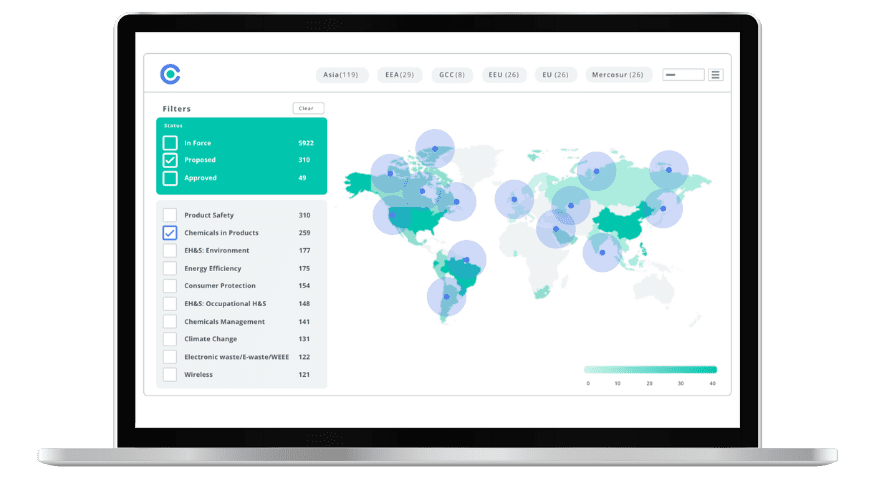
Simplify Corporate Sustainability Compliance
Six months of research, done in 60 seconds. Cut through ESG chaos and act with clarity. Try C&R Sustainability Free.