Cross-Functional Compliance Collaboration: How to Break Down Silos and Build Products That Ship on Time
THIS BLOG WAS WRITTEN BY THE COMPLIANCE & RISKS MARKETING TEAM TO INFORM AND ENGAGE. HOWEVER, COMPLEX REGULATORY QUESTIONS REQUIRE SPECIALIST KNOWLEDGE. TO GET ACCURATE, EXPERT ANSWERS, PLEASE CLICK “ASK AN EXPERT.”
Global regulatory fines hit $19.3 billion in 2024. Medical device recalls jumped 13.8% in Q1 of that year alone. And most of these failures trace back to the same root cause: compliance was treated as a checkpoint at the end, not a function woven into product development from day one.
Cross-functional compliance collaboration fixes this. It means R&D, product, legal, quality, and compliance teams working from the same regulatory intelligence – at the same time – instead of passing documents over the wall and hoping nothing falls through.
This isn’t theory. Organizations that embed compliance into cross-functional workflows reduce framework implementation time by up to 40%, according to recent industry data. They ship faster. They get fewer surprises at certification. And they spend far less time firefighting.
Here’s how to make it work at your organization – including the specific collaboration models, the frameworks that hold them together, and the technology that makes them scale.
Table of Contents
- Why Siloed Compliance Keeps Breaking Down
- Three Cross-Functional Compliance Collaboration Models That Work
- The Frameworks That Hold Cross-Functional Collaboration Together
- Technology That Makes Cross-Functional Compliance Scale
- What Cross-Functional Compliance Collaboration Actually Delivers
- Implementation Roadmap: From Siloed to Collaborative
- Moving Forward
- Frequently Asked Questions
- Sources
Why Siloed Compliance Keeps Breaking Down
Every compliance leader has a version of this story: a product is weeks from launch. Engineering has signed off. Marketing is ready. Then someone on the regulatory team flags a requirement that was missed in the design phase – maybe a new restriction in the EU, or a materials disclosure that wasn’t on anyone’s radar.
The product goes back to engineering. Timelines slip. Costs spike. Relationships between teams get strained.
This isn’t a people problem. It’s a structural one. When departments operate in isolation, the same pattern plays out:
- R&D optimizes for speed and technical performance. Regulatory requirements aren’t on their dashboard, so they don’t factor into early design decisions. The result: redesigns that could have been avoided with a 30-minute conversation in week one.
- Product management is balancing customer demands, competitive pressure, and launch timelines. Regulations across 195 countries? That’s someone else’s job – until it blocks the release.
- Legal gets pulled in late, usually to review something that’s already been built. Without early context, their feedback feels like a brake, not a guide. And they’re right to raise concerns – they’re just doing it with incomplete information.
- Compliance is monitoring a massive, constantly shifting regulatory environment. But without a structured way to get that intelligence into R&D and product workflows early, the information arrives too late to change anything without significant rework. (For a deeper look at this challenge, see assessing the impact of regulations on product development timelines.)
The cost isn’t just operational. In H1 2025, regulatory penalties for financial institutions alone totaled $1.23 billion – a 417% increase over the same period in 2024. For product companies, the math is even more punishing when you factor in recall costs, lost market access, and the reputational damage that follows.
Siloed compliance doesn’t just slow you down. It’s an expensive way to operate.
Three Cross-Functional Compliance Collaboration Models That Work
There’s no universal org chart for this. But three models consistently show up in organizations that get compliance collaboration right. The choice depends on your size, product complexity, and how many jurisdictions you operate in.
1. The Embedded Compliance Model
A compliance specialist sits directly within the R&D or product development team. They’re in the stand-ups. They’re reviewing design specs. They’re flagging regulatory implications before decisions get locked in.
This is compliance by design in its most literal form. The compliance function isn’t consulted – it’s participating.
Where it works best: Organizations with complex, rapidly evolving products where regulatory requirements change the design itself. Think medical devices, connected products with data privacy implications, or chemical formulations with substance restrictions across multiple markets.
The tradeoff: It requires dedicated compliance resources for each product team, which means it doesn’t scale easily unless you have the headcount.
2. The Centralized Model with Matrixed Responsibility
A core compliance team sits at the center of the organization but formally matrices into product, engineering, and legal teams. They establish standardized touchpoints at each stage of the product compliance lifecycle – design review, prototype, pre-launch, post-market – and run structured check-ins at each gate.
Where it works best: Mid-to-large enterprises that need consistency across product lines without embedding a specialist in every team. This is the most common model, and for good reason – it balances oversight with autonomy.
The tradeoff: Requires discipline to maintain the touchpoints. Without it, the matrixed relationships become informal and start to erode.
3. The Hub-and-Spoke Model
A central “hub” – your global compliance team – sets policies, standards, and strategic direction. Regional “spokes” – compliance officers or liaisons in each market – adapt those standards to local requirements and coordinate with local R&D, product, and legal teams.
Where it works best: Global companies operating across many jurisdictions. If you’re managing regulatory requirements across multiple industries in the EU, North America, APAC, and beyond, you need local expertise connected to a central strategy. This model does that.
The tradeoff: Coordination overhead. The hub needs to invest in clear communication and shared tools, or the spokes start drifting and you end up with inconsistent standards.
The Frameworks That Hold Cross-Functional Collaboration Together
Picking a model is step one. Making it work requires communication structures and accountability systems that keep every team aligned.
Compliance by Design Workshops
Run these at the front end of every product development cycle – before significant investment is made. Bring compliance, legal, R&D, and product management into the same room (or call) to map potential regulatory impacts and identify constraints early.
The goal: surface the questions that, if left unanswered until month six, would trigger a redesign. This shifts the relationship between compliance and product teams from reactive problem-solving to proactive prevention.
Two practical steps to make these workshops stick:
- Create clear channels for follow-up. The workshop generates questions. You need a system where non-compliance teams can get timely, plain-language answers without filing a formal request. Expert regulatory guidance can fill this gap when internal bandwidth runs thin.
- Document decisions, not just discussions. Every workshop should produce a brief regulatory impact summary that travels with the product through development.
RACI Matrices for Compliance Workflows
RACI – Responsible, Accountable, Consulted, Informed – eliminates the ambiguity that kills cross-functional work.
For each compliance touchpoint in the product lifecycle, map out:
- Who does the work (Responsible)
- Who owns the outcome (Accountable)
- Who needs to weigh in (Consulted)
- Who needs to know the result (Informed)
This sounds basic. It is basic. But the number of organizations where “everyone knows” who handles regulatory sign-off – and where three different teams think it’s someone else’s job – is staggering.
Build the RACI with stakeholders from every function in the room. Getting stakeholder agreement upfront is what separates RACI matrices that get followed from ones that get filed away.
Technology That Makes Cross-Functional Compliance Scale
Frameworks and models set the structure. Technology is what keeps it running when you’re managing compliance across 50 product lines and 30 countries.
Regulatory Intelligence Platforms
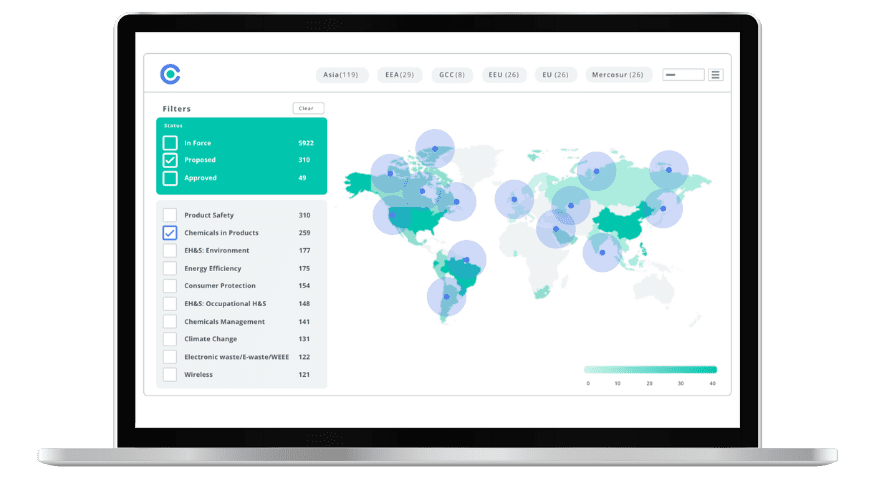
A GRC platform centralizes your regulatory data – requirements, internal policies, risk assessments, audit trails, evidence – into a single source of truth. When C2P tracks 110,000+ regulations across 195 countries, every team is working from the same information. No one is relying on a six-month-old spreadsheet that legal updated but forgot to share.
This is the foundation. Without a shared data layer, collaboration degrades into email chains and version control nightmares.
Workflow Automation
Automation handles the work that humans forget or deprioritize:
- Alerts when a regulatory change affects an active product line
- Guided approval workflows that route decisions to the right people at the right stage
- Automatic document routing for legal review at predefined gates
The value isn’t just speed. It’s consistency. Every product goes through the same compliance process, regardless of which team is building it.
AI-Powered Compliance Analysis
AI is changing what’s possible in compliance operations. The practical applications today:
- Regulatory monitoring at scale. AI scans new and proposed regulations across jurisdictions and flags the ones relevant to your product portfolio — before they take effect.
- Conflict detection. AI can analyze product specifications against regulatory texts to identify potential compliance gaps, giving teams time to adjust designs rather than scramble at certification.
- Predictive risk scoring. Pattern recognition across regulatory data helps prioritize which products or markets need attention first.
This isn’t a future-state vision. These capabilities exist now and are already reducing the manual burden on compliance teams.
Connecting the Systems
The real multiplier comes when your regulatory intelligence platform connects to your product lifecycle management (PLM) system, your document management tools, and your project management workflows.
When a regulatory change triggers an alert in C2P that automatically creates a task in the PLM system for the relevant product team – that’s compliance woven into operations, not bolted onto them.
What Cross-Functional Compliance Collaboration Actually Delivers
The business case is straightforward:
- Stronger reputation with regulators and customers. Consistent compliance isn’t just a risk mitigation play. It builds the kind of track record that makes market access easier, audit cycles smoother, and customer relationships more durable.
- Faster time-to-market. Catching regulatory issues in design review instead of at certification eliminates the redesign cycles that blow up timelines. One industry benchmark: organizations using integrated compliance workflows reduce framework implementation time by up to 40%.
- Lower penalty exposure. Proactive identification doesn’t just reduce fines – it avoids the operational disruption that comes with enforcement actions. With global fines at $19.3 billion in 2024 and enforcement accelerating into 2025, the exposure is real and growing. (See 25 critical stats every compliance officer needs to know for the full picture.)
- Fewer recalls and market withdrawals. Medical device recalls hit 3,232 across five key industries in 2024 – the second-highest annual total in six years. Early-stage compliance integration – especially around product safety – directly reduces late-stage failures.
- Operational efficiency. Shared information, clear responsibilities, and automated workflows eliminate the duplicated effort that comes from teams working in parallel on the same regulatory question without knowing it.
Implementation Roadmap: From Siloed to Collaborative
This isn’t a flip-the-switch change. It’s a phased transition.
Phase 1: Diagnose (Weeks 1-4) Map your current compliance touchpoints across the product lifecycle. Where are the handoffs? Where do things stall? Interview stakeholders in R&D, product, legal, and compliance to identify the specific friction points – not the theoretical ones. Use this phase to manage emerging business risks that might otherwise go unnoticed in the gap between teams.
Phase 2: Design (Weeks 5-8) Choose your collaboration model (embedded, centralized/matrixed, or hub-and-spoke) based on your organization’s size, product complexity, and geographic footprint. Build your RACI matrix. Define the compliance gates in your product development process.
Phase 3: Pilot (Weeks 9-16) Start with one product line or one business unit. Run the new model. Measure what changes – time to regulatory sign-off, number of late-stage issues, rework hours. Gather feedback from every function involved.
Phase 4: Scale (Months 5-12) Take what worked in the pilot and roll it out. Implement the technology infrastructure – regulatory intelligence, workflow automation, system integrations – that makes the model sustainable at scale. Invest in training so teams understand not just the process, but the reasoning behind it.
Phase 5: Optimize (Ongoing) Track KPIs quarterly. Refine the model based on real data, not assumptions. Access regulatory resources to stay current on shifting requirements.
Moving Forward
Siloed compliance was a reasonable approach when regulations were simpler and product development cycles were longer. Neither is true anymore.
The organizations gaining an edge are the ones treating compliance as a cross-functional capability – embedded in product development, powered by shared intelligence, and supported by technology that keeps everyone working from the same data.
That’s not a burden. That’s a competitive advantage.
If you’re ready to see how integrated regulatory intelligence can support cross-functional compliance at your organization, request a demo of the C2P platform.
Frequently Asked Questions
- Q: Won’t adding more collaboration steps slow down product development?
The opposite. Cross-functional compliance collaboration front-loads the regulatory work that would otherwise hit late in the cycle. When you catch a material restriction or a labeling requirement during design review, you adjust the spec. When you catch it during certification testing, you redesign the product. Proactive compliance processes consistently reduce total development time by eliminating the rework that siloed approaches create. - Q: How do we get buy-in from R&D and product teams who see compliance as a blocker?
Show them the cost of the current approach. Pull the data on how many times in the last year a product was delayed, redesigned, or blocked from a market due to a late-stage compliance issue. Then show them how the new model eliminates those disruptions. Most R&D and product leaders aren’t anti-compliance – they’re anti-rework. Frame it that way. - Q: We’re global. How do we keep compliance consistent across regions?
The hub-and-spoke model was built for this. A central compliance team sets global standards while regional liaisons adapt them to local requirements. The key enabler is a shared regulatory intelligence platform. When every region is pulling from the same database – like C2P’s coverage across 195 countries – you maintain consistency without sacrificing local accuracy. - Q: What if we’re a smaller company without a large compliance team?
Start with the centralized/matrixed model at a smaller scale. Even a single compliance lead who establishes formal touchpoints with R&D, product, and legal can transform how regulatory issues surface and get resolved. A RACI matrix and a shared regulatory intelligence tool give a small team the structure and data access that would otherwise require much larger headcount. - Q: How do we measure whether our collaboration model is working?
Track these KPIs: time from design freeze to regulatory clearance, number of late-stage compliance issues per product, rework hours attributed to regulatory gaps, and time spent on manual regulatory monitoring. Compare quarter over quarter. Also track leading indicators – like the percentage of products that complete a compliance by design workshop before entering development. For benchmarks, see how leading brands measure compliance outcomes.
Sources
- Gartner. “Improve Compliance Collaboration.” 2025. https://www.gartner.com/en/legal-compliance/trends/improve-compliance-collaboration
- TrustCloud. “The evolution of compliance: top 7 trends to watch in 2025.” October 24, 2025. https://community.trustcloud.ai/docs/grc-launchpad/grc-101/compliance/the-evolution-of-compliance-top-7-trends-to-watch-in-2025/
- TrustCloud. “Cross-functional collaboration in internal audits: A path to enhanced value.” January 3, 2025. https://community.trustcloud.ai/docs/grc-launchpad/grc-101/compliance/cross-functional-collaboration-in-internal-audits-a-path-to-enhanced-value/
- SpeakUp. “How to strengthen collaboration across compliance, HR, and legal teams.” September 23, 2025. https://www.speakup.com/blog/how-to-strengthen-collaboration-across-compliance-hr-legal
- MetricStream. “Why AI & Automation Are Critical for Compliance Success in 2025.” 2025. https://www.metricstream.com/blog/why-ai-automation-are-critical-for-compliance-success.html
- DSALTA. “AI Compliance Automation: What Works & Why It Matters.” December 8, 2025. https://www.dsalta.com/resources/articles/ai-powered-compliance-automation-what-really-works-in-2026
- Project-Management.com. “RACI Matrix: Responsibility Assignment Matrix Guide.” September 26, 2025. https://project-management.com/understanding-responsibility-assignment-matrix-raci-matrix/
- Fintech Global. “Global regulatory fines soar to record-breaking $19.3bn in 2024.” February 19, 2025. https://fintech.global/2025/02/19/global-regulatory-fines-soar-to-record-breaking-19-3bn-in-2024/
- Fenergo. “Regulatory penalties for global financial institutions skyrocket 417% in H1 2025.” August 28, 2025. https://resources.fenergo.com/newsroom/regulatory-penalties-for-global-financial-institutions-skyrocket-417-in-h1-2025
- Honeywell / Sparta Systems. “The Rising Cost of Product Recalls: Why Prevention Matters.” 2025. https://www.spartasystems.com/resources/the-rising-cost-of-product-recalls-why-prevention-matters/
Experience the Future of ESG Compliance
The Compliance & Risks Sustainability Platform is available now with a 30-day free trial. Experience firsthand how AI-driven, human-verified intelligence transforms regulatory complexity into strategic clarity.
👉 Start your free trial today and see how your team can lead the future of ESG compliance.
The future of compliance is predictive, verifiable, and strategic. The only question is: Will you be leading it, or catching up to it?
Simplify Corporate Sustainability Compliance
Six months of research, done in 60 seconds. Cut through ESG chaos and act with clarity. Try C&R Sustainability Free.